Continuing from the sixth chapter of John, the Gospel in today’s Mass has Jesus reminding us that it is not we who have just incidentally or accidentally found Jesus in our lives, but rather it is the Father Himself who first finds us and draws us to Jesus.
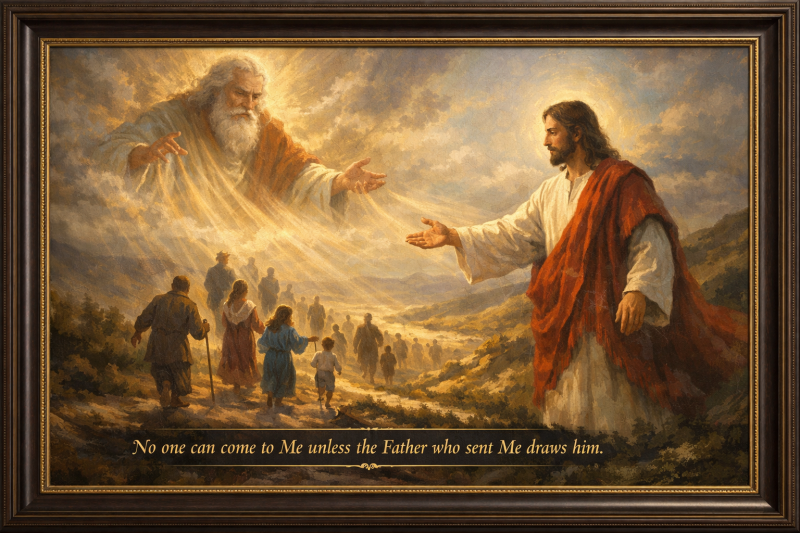
And then Jesus, in turn, reveals to us who the Father is and brings us into a loving relationship with Him.
And so Jesus—the first thing He says in today’s Gospel to the crowds is that, and I quote, “No one can come to me unless the Father who sent me draw him” (John 6:44).
Now, my brothers and sisters, for example, from my own life: I was born into a Catholic family. That is already the Father at work—the Heavenly Father, who is surrounding me with a loving family, with parents who bring me up in the faith. That is already the Father drawing me to Jesus.
And then as I got older, through a series of events—and yes, even accidents which should have left me for dead—I began to inquire more deeply into my relationship with the Lord. Again, this is the Father drawing me to Jesus.
And then when I finally and maturely began to get closer to Him, the Lord, of course, began to deepen my love for the Father. So the Father brought me to the Son; the Son deepens my love for the Father through the Holy Spirit that we receive at Baptism, and that is strengthened in the Sacrament of Confirmation. All these beautiful gifts come to us through the loving mercy, generosity, and grace of God.
And then Jesus promises: “Everyone who listens to my Father and learns from him comes to me” (John 6:45). “Not that anyone has seen the Father,” said Jesus, “except the one who is from God; he has seen the Father” (John 6:46). “Amen, amen, I say to you, whoever believes has eternal life” (John 6:47).
So, my brothers and sisters, we have to remember: He is telling His fellow countrymen, the Jewish people, that He has this privileged vision of God. And not only that, but He is calling Him His own Father. Nobody had ever heard, up until the time of Jesus, anyone speaking with such familiarity regarding the Father. This closeness was very unsettling to them.
“How are you making yourself equal to God? You are calling yourself the Son of the Father—the Son of God. Therefore, are you God?” God from God, Light from Light, true God from true God—yes.
And “whoever believes has eternal life” (John 6:47).
And then this is a beautiful introduction to what He says to them about the Eucharist—about Him being the Bread of Life.
We need sustenance, and that sustenance is God Himself—through His grace, through His blessings, certainly in a spiritual and profound sense, in all the ways He sustains us through life. But also in a very mystical, powerful, and beautiful way: in His humble connection to us through the Eucharist.
Our Lord, who created all things, veils Himself beneath a tiny piece of bread. Imagine that.
Who would do that?
Who would have the humility necessary in order to veil Himself so that we would not be terrified, so that we would not run away, so we would not hide our face in shame—but rather that we would have the courage to approach?
This is the loving arms of the Father in Jesus, through the power of the Holy Spirit, who invites us to go and receive Him at Holy Communion.
My brothers and sisters, in the first reading we hear about the Apostle Philip, who is told to head south on the road that goes down from Jerusalem to Gaza—the desert route. And in the desert he will find an Ethiopian eunuch who is returning home after having gone to Jerusalem to worship.

He is seated in his chariot, reading the prophet Isaiah.
And who indicates this to Philip? The Holy Spirit.
Listen to what we read in today’s first reading: “The Spirit said to Philip, ‘Go and join up with that chariot’” (Acts 8:29). And Philip ran up and heard him reading Isaiah the prophet, and said, “Do you understand what you are reading?” And the eunuch replied, “How can I, unless someone instructs me?” (Acts 8:30–31).
So he invited Philip to get in and sit with him.
Now this is already beautiful, right? Here is a man who is thirsting for God, who wants to know more, and who invites someone who can teach him. But it is the right person—it is the one truly sent by God.
It is not just any person with good intentions who would like to share the Gospel. Yes, we can all try to do that—but unless we are united to the Church…
Philip was one of the Twelve—the first bishops, the first appointed ministers—sent to proclaim the Good News and to break the Bread through which Jesus would become one with those early converts.
And so the Scripture passage that the eunuch was reading was this: “Like a sheep he was led to the slaughter, and as a lamb before its shearer is silent, so he opened not his mouth. In his humiliation justice was denied him. Who will tell of his posterity? For his life is taken from the earth” (Acts 8:32–33; cf. Isaiah 53:7–8).
Now do not forget: this is Philip, within a short time of the crucifixion of our Lord, who now has a crystal-clear understanding of what the prophet Isaiah is describing—through the Spirit of God who inspired the prophets.
And so he explains this passage to the eunuch—and not only this passage, but we can imagine much more.
In fact, he is brought to Baptism by Philip. “Then both Philip and the eunuch went down into the water, and he baptized him” (Acts 8:38). “When they came out of the water, the Spirit of the Lord snatched Philip away, and the eunuch saw him no more, but continued on his way rejoicing” (Acts 8:39).
You see, my brothers and sisters, Philip was not just any person trying to explain the Scriptures.
My brothers and sisters, we need to be careful as well whom we get our information from. We should always pray for protection. Because the Lord instituted authority in the Church for this precise reason—so that it is not merely someone’s opinion that we are hearing about this passage of Isaiah, but the authentic interpretation guided by the Holy Spirit.
And there will be people like this eunuch whom the Lord will place in our lives—people who need a word of encouragement, a strengthening of the soul.
But we should always allow the Holy Spirit to move us—so that He will indicate the right time to speak, the right words to say. He will place them in our mouths.
And the Spirit of the Lord will dwell within us and bring others to Jesus.
This is our goal.
For Jesus is the Bread of Life, who fills us with peace, joy, and strength.
May Almighty God bless you, the Father, and the Son, and the Holy Spirit. Amen.
Add comment
Comments