As we come to the seventh Sunday of Easter, we celebrate the Ascension of our Lord into heaven. Our Lord, who spent forty days after the Resurrection walking with and among particular and certain individuals who had seen Him, to whom He made Himself manifest after His Passion and death, proving that He was risen from the dead.
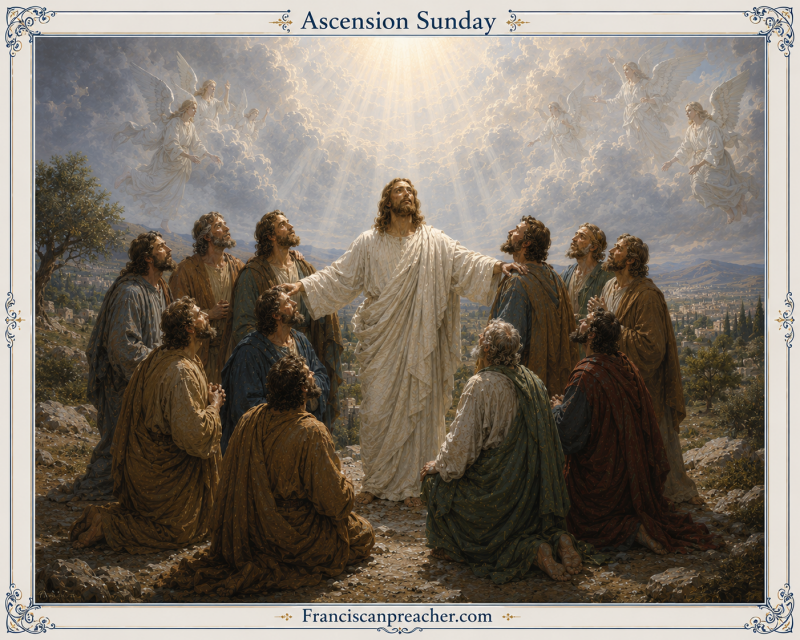
But now He arrives at the culmination of His victory, as He is about to ascend to the Father and take His rightful place at the right hand of the power of God — the place He had always enjoyed from all eternity, being the Second Person of the Trinity, God from God, Light from Light.
In today’s Gospel, we see a very beautiful commission that our Lord gives to the Apostles:
“Go therefore, and make disciples of all nations, baptizing them in the name of the Father and of the Son and of the Holy Spirit, teaching them to observe all that I have commanded you. And behold, I am with you always, until the end of the age.” (Matthew 28:19–20)
Now, my brothers and sisters, that final line that Jesus spoke to the Apostles is the key to understanding why Saint Matthew the Evangelist omits an explicit Ascension scene in his Gospel.
They are the very last words of Saint Matthew’s Gospel, placed on the lips of Jesus. And Matthew wants us to realize what he began his Gospel with: the great promise that the long-awaited Messiah had finally come.
But who was He exactly?
He was God with us — Emmanuel.
“They shall name him Emmanuel,” which means “God is with us.” (Matthew 1:23)
We see right at the very beginning of the Gospel the same reminder: He is with us. Do not be afraid.
And He sent the Apostles out with a mission, much like He sends each and every one of us out with a mission. And bishops throughout the ages have characterized this mission with three important Greek words: martyria, diakonia, and koinonia.
Martyria means witness.
Diakonia means service.
Koinonia means fraternal love.
Those same three characteristics which animated the preaching and the life of the early Church are the same three characteristics which animate us today.
And so we ask ourselves: what does martyria — to witness — mean?
We speak of the martyrs, the martyrs who shed their blood witnessing to the identity of Jesus and who He was.
And so, when we are called, for example, as witnesses in a pending litigation, and we go to a court and stand before the magistrate and the lawyers and the parties involved, we are asked questions regarding what we had witnessed.
The Apostles went out, and they described to the people in vivid detail — examples of which are the Gospels themselves — the written recollections of what happened. And they described Jesus and everything He did, everything He said, to the best of their ability.
Because, as Saint John the Evangelist says:
“If everything had to be written down, the entire world would not be big enough to contain all the books that would have to be written.” (cf. John 21:25)
Incredible days of grace. Moments of divine power.
And so, what do we witness to when we go out into the world?
How Jesus has transformed our lives.
Could it have been through an accident? Could it have been through the gradual working of the Holy Spirit within us? And that is also a very big part of it, because we will see that to witness, to serve, and to love are done in the Spirit of Christ only through the power of the Holy Spirit that is given to us.
It is given to us at Confirmation, and He comes to us throughout our lives because Jesus is with us.
And then diakonia — to serve.
“Greater love than this no man has: that he lays down his life for his friends.” (John 15:13)
In other words, not just to die for somebody, but every day, through the choices we make, dying to ourselves in order to help somebody else.
In this we see how the diaconate, the diakonia, is intimately linked with martyria, with witnessing, and with koinonia, which means fraternal love.
And Jesus Himself said:
“By this all men will know that you are my disciples, if you love one another as I have loved you.” (cf. John 13:35)
My brothers and sisters, on this Ascension Sunday, remember: Jesus is with you.
So go out there and witness to the faith. Go out there and spend yourselves out of love for Him — that love that I know is in your heart, ready to come out as a sign of your gratitude for everything He has done for you.
And go out there and love.
As Saint Augustine of Hippo once said: “Love, and do what you will.”
But he is obviously speaking about the love that Jesus spoke of — the love we ought to have for one another as He has for us.
In the name of the Father, and of the Son, and of the Holy Spirit. Amen.
Go in peace.
Add comment
Comments