In today’s beautiful readings, we are reminded once again that Jesus lives and that he walks with us every step of the way until we make it to the other side, to the ports of heaven, safely and securely, if we but trust in him.
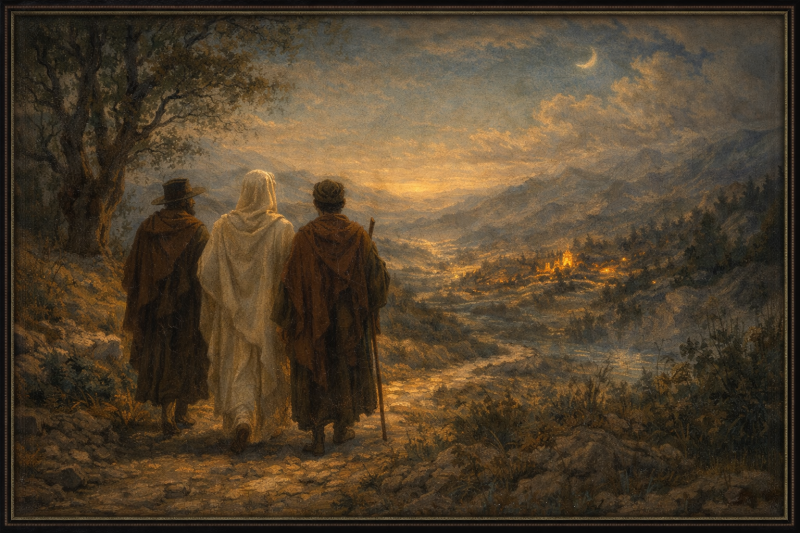
First of all, let’s go right to the gospel of the three readings, perhaps the most poignant, the most deep and rich in spiritual importance. Here we have two of the disciples on Easter Sunday morning, who, instead of remaining with the others locked up in the upper room out of fear, have decided to head over to Emmaus. Now, the question is, how is it that all the others were so afraid, and yet these guys decided to just walk freely through the countryside to Emmaus? We can speculate as to why this may have been. But nevertheless, we know through the reading itself that they were indeed like the others, disappointed. They thought that Jesus was the Messiah, but then what happened so scandalized them, and it turned their hopes and their dreams into a failed nightmare.
And so they’re walking along and they’re distressed. Actually, we’re told that they looked very downcast right when Jesus asked them, “What are you discussing as you walk along?” (Luke 24:17). They stopped, looking downcast. To them, this was the saddest thing ever—the Messiah whom they saw in action, speaking words of fire and truth, imparting the Holy Spirit through miracles, walking on water, raising the dead—but then so brutally massacred in his Passion in Jerusalem. How would you and I have reacted? Most likely the same. We too probably would have locked ourselves up somewhere and wept, or just said, “You know what? I’ve got to return to my old life.” And how many times does that happen? When hope is taken away from us, we return to our old ways of doing things, or to our old addictions that we had, for a while, transcended.
And so Jesus suddenly walks beside them, and their eyes are kept from recognizing him. Look at how God comes to us. He comes to us veiled. He comes to us under so many forms, and most of the time we don’t realize it—until we spend time in prayer, until we reflect. For it was only at the breaking of the bread, at the end of the story, that their eyes were opened and they realized it was Jesus (Luke 24:30–31). We are told about who these two disciples most likely were. One of them—we have his name, Cleopas; the other remains nameless. And the Fathers of the Church always said that this detail was not accidental, but rather the nameless disciple represents each and every one of us.
How we are always meant to walk with somebody else on this path of faith. Notice, in the sacraments, there’s never just one person on his own participating in a sacrament. It’s always two or more people. You go to confession—it’s you and the priest. You’re going to get married—it’s the husband and the wife. You’re going to get baptized—it’s you as an infant, most likely, and the rest of your family, the priest, the whole believing community. You go to receive the Eucharist—you’re with the community of believers. You’re on your deathbed—a priest is by your side for the anointing of the sick, et cetera, et cetera.
My brothers and sisters, we’re never on our own. We were never meant to make this journey on our own. And so, if you are closed in on yourself, if you are isolated, if you are having a hard time dealing with others, remember that God is insisting that we make this journey together—together.
Now, what happens when Jesus suddenly appears to them and spends time with them and explains to them the Scriptures and everything that was written about him in them? They are animated with zeal, with fire. In fact, they ask each other, “Were not our hearts burning within us while he spoke to us on the way and opened the Scriptures to us?” (Luke 24:32). And what he did with them, my brothers and sisters, he did with the Apostles, and he does with us if we but give him the time of day.
Spend time with the Word of God. Reflect on it. Digest it like food. He comes to us not only in the Eucharist, but even in his Word. Get the flavor of it. Get every ingredient down. Get every taste registered. For so rich and bountiful is the Word of God.

Look at what happens to the Apostles, namely Saint Peter, after Jesus spends time with them and appears to them and reassures them that everything he had told them was real. He stands up with the Eleven, raises his voice and proclaims: “You who are Jews, indeed all of you staying in Jerusalem, let this be known to you and listen to my words… You who are Israelites, hear these words: Jesus the Nazarene was a man commended to you by God with mighty deeds, wonders, and signs… this man, delivered up by the set plan and foreknowledge of God, you killed, using lawless men to crucify him” (Acts 2:14, 22–23).
Now why would Saint Peter say, “according to the set plan and foreknowledge of God”? Because precisely they had seen how Jesus fulfilled all the prophecies. And if they hadn’t seen it yet, just as Jesus explained it to the two disciples on the road to Emmaus, so he explained it to them. And now the Apostles are given the Spirit, the Holy Spirit, to be able to explain it to the world, beginning in Jerusalem.
My brothers and sisters, Jesus is the Lamb—the Lamb of God who takes away the sins of the world (John 1:29). The Lamb of God who atones for our transgressions. The Lamb of God whom, if we embrace, becomes the blood which the angel sees and passes over, sparing us, uniting us with God, so that one day we can be with him forever.
Through the intercession of our Blessed Mother Mary and Saint Francis of Assisi—one a great saint who embraced Jesus, and one the Mother who gave Jesus to us, raised him, loved him, and now looks after all of us as well as a mother—may Almighty God bless you.
In the name of the Father, and of the Son, and of the Holy Spirit. Amen.
Have a blessed Sunday, everyone.
Add comment
Comments