Continuing in the Book of Acts from yesterday's readings, where we saw the apostles miraculously set free by an angel of God—the angel of the Lord—and having gone back into the temple to preach and continue preaching in the name of Jesus everything He had done, everything He had taught, and accompanied by miracles of healing, the Jewish authorities, the ones that formed the Sanhedrin, were infuriated.

And so we hear in today's reading: “When the court officers had brought the Apostles in and made them stand before the Sanhedrin, the high priest questioned them, ‘We gave you strict orders, did we not, to stop teaching in that name? Yet you have filled Jerusalem with your teaching and want to bring this man's blood upon us’” (Acts 5:27–28).
And so, my brothers and sisters, the first thing we note are the two accusations, condemnations being brought against the apostles—both of them true, by the way. For it was noted that they continued preaching in the name of Jesus. This was strike number one for the Jewish authorities. They wanted that name to be forgotten. In fact, they do not even use the name of Jesus, right? Listen to what they said: “We gave you strict orders to stop teaching in that name” (Acts 5:28). In other words, he who shall not be named—so terrible and evil was He. How totally backwards did they get this, calling the Son of God, the eternal Son of God, God from God, anything but good and holy and beautiful and worthy of our admiration and our worship? No—the one who shall go on nameless, being nameless.
So when they accuse the apostles of preaching in the name of Jesus, they were right. The apostles did that. And doing that meant they were invoking His name to work miracles, but they were also teaching what Jesus taught.
The second reason for their disgruntled condemnations was that they, the apostles, were seen as accusers. They were accusing the Jewish authorities for Jesus's death. And this also was true. There is nothing that the Sanhedrin were saying was false. And then that the apostles said that the Jewish authorities brought about Jesus's death—that also was true.
Now we must keep in mind that they were the catalyst. They were the medium through which God ushered in the world's redemption through Jesus. For at the end of the day, Jesus died for all of our sins. But He made it happen through those particular Jewish people—not all the Jewish people, those particular Jewish people in name only. For a true Israelite is the one who obeyed and trusted God in all things. But we hear that “He came unto his own, and his own received him not” (John 1:11). A lot of them, including first and foremost the Jewish authorities.
And so God, through our Lord's Passion, Death, and Resurrection, ushers into the whole world His saving action.
Now listen to the response of Peter and the apostles: “We must obey God rather than men. The God of our ancestors raised Jesus, though you had him killed by hanging him on a tree. God exalted him at his right hand as leader and Savior to grant Israel repentance and forgiveness of sins. We are witnesses of these things, as is the Holy Spirit, whom God has given to those who obey him” (Acts 5:29–32).
Now, a bit of theology here, my brothers and sisters. The Holy Spirit is spoken of as a witness, right? One of the verses of Scripture that we use, which alludes to the Trinity, is when Saint John speaks of three witnesses in the First Epistle of Saint John, chapter five, verse seven and eight. We read: “There are three that bear witness in heaven: the Father, the Word, and the Holy Spirit; and these three are one. And there are three that bear witness on earth: the Spirit, the water, and the blood; and these three agree as one” (1 John 5:7–8).
My brothers and sisters, the Holy Spirit is a witness because, like the Father and the Son—the Father being the first person, the Son being the second person, the Holy Spirit being the third person—the three distinct Persons are God who sees all things, and so He is a true witness to everything that happens in heaven and on earth. He sees in the future because He allows everything to take place. For time is not the same for God as it is for us. He is not bound or confined to time, but He sees what's happened because He has allowed it to play out already. He sees it all in an instance.
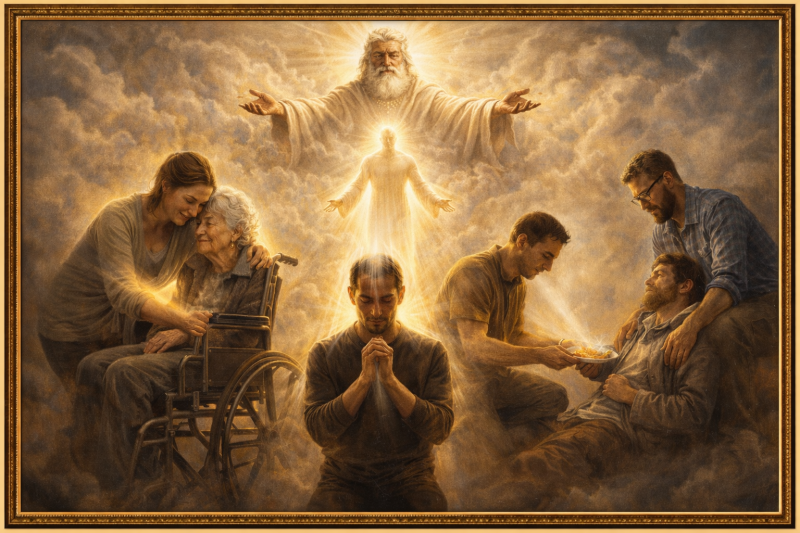
And so what Saint Peter is saying is that the Holy Spirit, who is a witness, is given by God to all those who obey Him. And they received the Holy Spirit as a living, breathing, divine Person who gave them power. And this, of course, only fortified the validity of Jesus's claims, because the Lord had been speaking about how when He would ascend to the Father, He would send the Holy Spirit who would give them power.
Now, of course, liturgically, we are not there yet, right? We are heading towards the Feast of Pentecost. We are in the intermediary stage between the Resurrection and the Ascension. Right? That has to happen first before He sends the Holy Spirit. But here in today's reading, we are already catching a glimpse three chapters after what happened on Pentecost in Acts chapter two. Right? Today's reading is from Acts chapter five.
And so, my brothers and sisters, the Holy Spirit can be given to any one of us by God—if we obey Him, if we obey Him. Ask yourself: am I obeying the Lord? Am I eligible to receive the Holy Spirit? And Saint Peter says, “To all those who obey him” (Acts 5:32). Obey who? Obey God.
Now listen to the Gospel. Listen to what Jesus says: “Whoever believes in the Son has eternal life, but whoever disobeys the Son will not see life, but the wrath of God remains upon him” (John 3:36). So obedience to the Father and obedience to the Son are unanimous because Their will, Their mind, Their love is so united that to obey one is to obey the other.
That's why Jesus says to Philip: “Whoever has seen me has seen the Father” (John 14:9). “Philip, have I been with you this long and you still do not understand?” (John 14:9).
My brothers and sisters, read the Word of God. Read the Gospels. Read Jesus's instructions to you. Obey what He asks you to do, like to forgive, to love your enemy, even to pray for those who persecute you (Matthew 5:44). And the Father will send us the Holy Spirit if we but obey.
Is that not what He said at the Transfiguration, when He spoke from the clouds and the apostles were shocked and marveled? What did He say? “This is my beloved Son… listen to him” (Matthew 17:5).
And of course, our Blessed Mother—the same thing. The last words recorded of our Blessed Mother in Scripture. She doesn't say much, but she says it all with her last words: “Do whatever he tells you” (John 2:5).
Jesus is the Word of God. Jesus is God. And Jesus came into the world to dwell among us, to illuminate our paths, and to guide us wholly.
May Almighty God send you a very special blessing this day. In the name of the Father, and the Son, and the Holy Spirit. Amen.
God love you.
Add comment
Comments