We are now at the second week of Easter, a day just after Divine Mercy Sunday. And on this Monday we rejoice with the events that are happening in the readings that are presented to us at Holy Mass, and we see how we can apply them to our spiritual walk of faith so that we, like the people in the first reading, can praise God for everything he has done through our Lord Jesus Christ. And then also to, like Nicodemus, open our eyes so that the Lord will continue to spiritually enlighten us, and to remind us that unless a man be born again of water and the Holy Spirit, he cannot enter into the kingdom of God.
So, my brothers and sisters, let us start off with the Gospel—a beautiful Gospel from Saint John the Evangelist, where once again Jesus is presented as the Light of the world, the one who breaks through the darkness in order to give us his grace. It is precisely at night, in the darkness, that Nicodemus comes to him. We are told at the beginning of today’s reading: “There was a Pharisee named Nicodemus, a ruler of the Jews. He came to Jesus at night” (Jn 3:1–2). So the first thing we have to realize here is that Nicodemus is scared. Nicodemus is scared because he is shaken to the core, along with many other religious leaders, at what is happening right before their eyes. Jesus, who is God from God, Light from Light, true God from true God, suddenly appeared among them. And the things he was saying, the things he was doing, just turned their world upside down.
Nicodemus is actually a Greek name, and it was not uncommon back then for Jewish leaders to have Greek names, and it is a name that means “victory of the people.” Which is ironic, because he comes to Jesus timidly at night and still struggling to understand spiritual rebirth, because he says to Jesus: “Rabbi, we know that you are a teacher who has come from God, for no one can do these signs that you are doing unless God is with him” (Jn 3:2). Jesus answered and said to him: “Amen, amen, I say to you, unless one is born from above, he cannot see the Kingdom of God” (Jn 3:3). Nicodemus said to him: “How can a man once grown old be born again? Surely he cannot reenter his mother’s womb and be born again, can he?” (Jn 3:4). Jesus answered: “Amen, amen, I say to you, unless one is born of water and Spirit, he cannot enter the Kingdom of God. What is born of flesh is flesh and what is born of Spirit is spirit. Do not be amazed that I told you, ‘You must be born from above.’ The wind blows where it wills and you can hear the sound it makes, but you do not know where it comes from or where it goes. So it is with everyone who is born of the Spirit” (Jn 3:5–8).
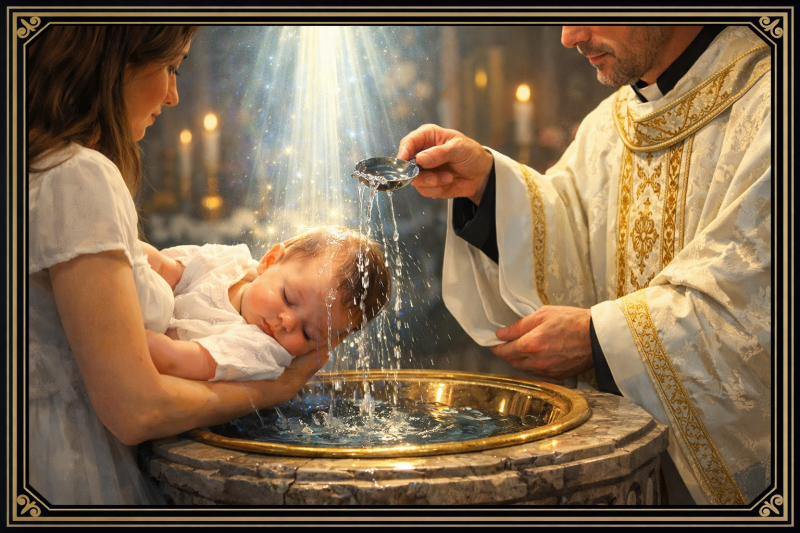
My brothers and sisters, one of the points that I would like to draw our attention to is the expression “being born again,” because the current evangelical Protestant mainstream fixation on this expression meaning a conversion experience—a commitment to the Lord—is taken out of context, because our Lord here mentions not just the Spirit, but water. In other words, he is indicating the gift and the grace which he will later institute when he commissions the apostles to go out and preach the good news of baptism (cf. Mt 28:19). So the Church Fathers had always understood that baptism is what Jesus is talking about here when he is indicating to Nicodemus that something new will happen within a person.
And we know, of course, that baptism, when we do a study on it in Sacred Scripture, has replaced circumcision in such an extraordinary way, superseded it in many ways (cf. Col 2:11–12). But circumcision was that rite in the Old Testament through which an individual was inserted, inaugurated into the household of God, and he was made a partaker of the covenant that God made with his people (cf. Gen 17:10–14). And so our Protestant brothers and sisters—a lot of them—have a problem with infant baptism, not all of them. There are certain denominations that do baptize their infants, but some of them have a problem with it. Normally the objection is, “Well, the child does not have a chance to make its own decision to follow Jesus, and so we should wait until it grows older and then the individual can make their own decision.”
And at first glance, that looks like a good argument. That looks reasonable. But when we think about it a little bit more deeply, we see how it is logically flawed. It is not consistent with what we normally do with our infants, right? We normally make decisions for them when they are not yet able to make a decision. And so we sometimes tend to say to the Protestant, well, at birth, when the child is baptized, they are born again. Because what happens at baptism? The infant receives sanctifying grace, the forgiveness of original sin, incorporation into Christ and the Church, receives the indwelling of the Holy Spirit, and the theological virtues in seed form of faith, hope, and charity (cf. CCC 1262–1266). So the infant is genuinely born again then and there.
We tend to say to the Protestant, well, the child eventually does make its own decision at Confirmation, which is true, but we cannot say that at Confirmation baptism is activated. No. A child who is baptized is born again then. And their Confirmation, strictly speaking, is the completion, the perfection of baptismal grace—a strengthening by the Holy Spirit as sacrament that deepens one’s bond with Christ and the Church, an empowerment for witness and apostolic mission. The Catechism teaches that Confirmation, and I quote, “brings an increase and deepening of baptismal grace” (CCC 1303). So it is more accurate to say to the Protestant that Confirmation strengthens and seals what baptism began, rather than say that Confirmation is when the baptized person finally chooses and ratifies baptism.
Where does personal ratification come in? The baptized child matures. He is expected personally to embrace the faith given to him, to profess it consciously, to live according to it freely. The personal appropriation and ratification happens through catechesis, first confession, first communion, confirmation preparation, and the mature profession of Christian life generally.
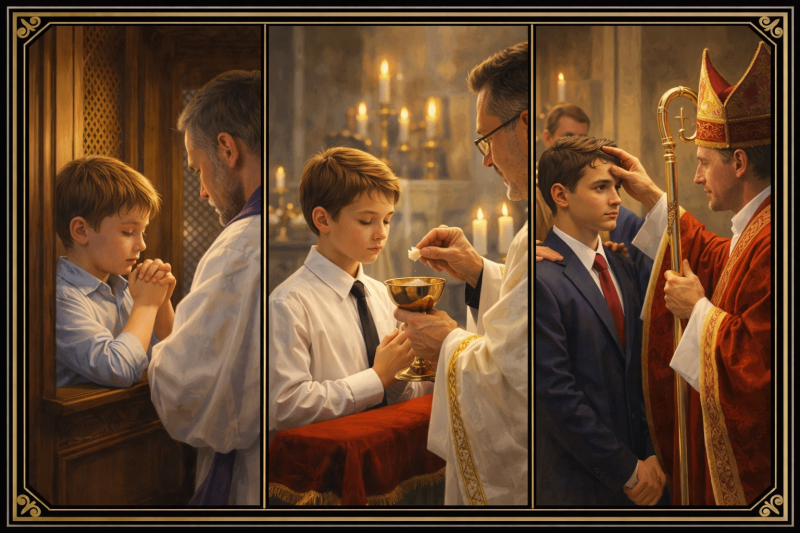
I think this is beautiful, my brothers and sisters, because wherever you are in your walk of faith thus far, the Holy Spirit is continually working within you and trying to deepen your relationship with Jesus. In other words, it is not just a one-time deal. It begins—the door is opened at baptism—but then we continue to strengthen the seal that we received in that beautiful sacrament.
In the first reading, we see the joy that happens within the people of God when Peter and John went back to them, having been released by the chief priests and the elders. And they prayed, and they thanked the Lord for what had happened through Jesus (Acts 4:23–31). As we go on with our Easter journey, let us also continue to praise and thank the Lord that he is risen, that he is with us, that he continues to make us sons and daughters of the Kingdom to which we have been born anew, and to continually see, examine, and appreciate the things in our lives through spiritual lenses, with a supernatural vision that is characteristic of a son and daughter of God.
“Go in peace.”
“Amen.”
Add comment
Comments