Today’s readings are so rich that we have a lot to get to so to explain why, in her wisdom, Holy Mother Church has given us these two passages out of the Scriptures joined together during this Easter season: In the first reading, we hear of a Pharisee in the Sanhedrin named Gamaliel, a teacher of the law respected by all the people. And we are told that Gamaliel gives the Sanhedrin a principle. And he says, “If this endeavor is of human origin, it will destroy itself. But if it comes from God, you will not be able to destroy them” (Acts 5:38–39).
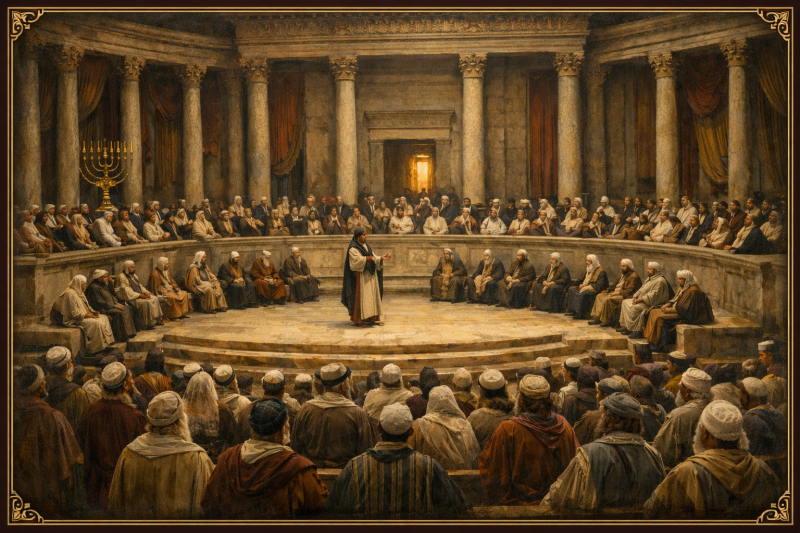
This is actually one of the great resurrection themes throughout all of Acts: the indestructible work of God, which is on full display for anybody who has eyes to see.
Gamaliel unknowingly sets up the entire theological point that validates Jesus’s claim to being the Messiah. Why? Because every false messiah before Jesus died and his movement collapsed, just as Gamaliel alluded to. Theudas died; his followers scattered. Judas the Galilean died; his movement vanished. But Jesus died—and instead of His movement collapsing, it explodes across the world. Why? Because He did not remain dead. Because He is risen.
And that is Luke’s point in the Acts of the Apostles. The Apostles preach fearlessly, they endure scourging joyfully, and they continue teaching because they know Christ is alive. Death did not defeat Him; therefore His Kingdom cannot be stopped.
So the first reading is a direct testimony to the Resurrection’s effect. The Church exists and perseveres because Jesus, in fact, still lives.
In the Gospel, we see that the miracle being described reveals the identity of the One who rose.
The feeding of the five thousand may seem at first like a pre-Easter story, but the Church places it here because Eastertide continually reflects on who the risen Jesus actually is.
This miracle reveals Christ as the new Moses. He goes up the mountain. He feeds the multitude in the wilderness. Passover is near—“The Jewish feast of Passover was near” (John 6:4)—intentionally evoking Exodus imagery.
Jesus is shown as the divine provider. Only God fed Israel with manna in the desert (Exodus 16). Now Jesus feeds thousands miraculously from almost nothing.
The crowd recognizes this and says, “This is truly the Prophet, the one who is to come into the world” (John 6:14).
Thus, the Gospel answers the question: Who is the one whose mission Gamaliel says cannot be stopped? He is the prophet like Moses—“A prophet like me will the LORD, your God, raise up for you” (Deuteronomy 18:15). He is the true Shepherd of Israel, the divine bread-giver, the Messiah, and ultimately the One who conquers death.
So what is the deeper resurrection connection in this story?
It is that the same Jesus who fed the multitude now, alive, feeds His Church.
Therefore, this miracle in these readings also has a Eucharistic and ecclesial layer.
John’s feeding miracle anticipates the Eucharist, of course, and the ongoing nourishment Christ gives after His Resurrection. Notice, in fact, the Eucharistic language: “Jesus took the loaves, gave thanks, and distributed them” (John 6:11).
This mirrors the Last Supper. It mirrors what happened with the disciples when He was known to them “in the breaking of the bread” (Luke 24:35) at Emmaus. And the Church’s Eucharistic worship after Easter is so vividly on display here.
So the Church is saying: the risen Jesus who cannot be destroyed is still feeding His people.
The Apostles in Acts are sustained interiorly by the same Christ who fed the five thousand physically.
Now these two readings together proclaim that the risen Christ provides for His people and protects His mission.
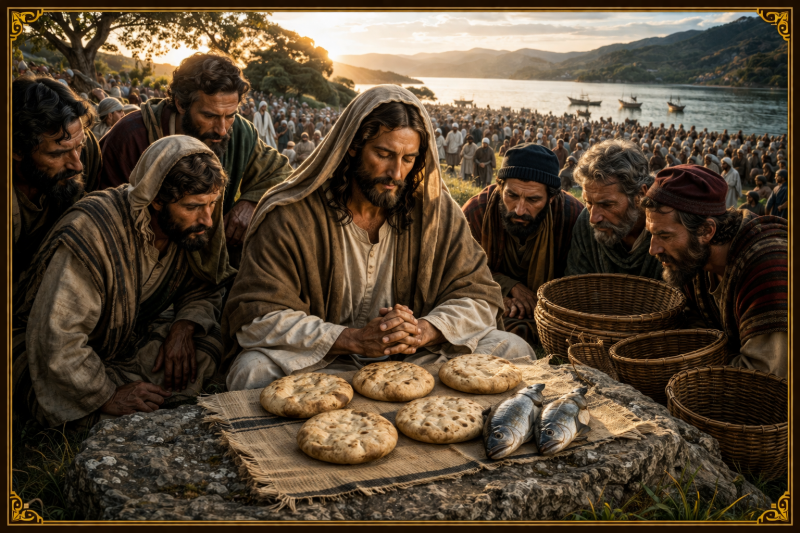
In the Gospel, He provides bread for the crowd. In Acts, He provides courage for the Apostles.
In the Gospel, there is no lack that can prevent Him from feeding His people. In Acts, no persecution can prevent Him from spreading His Gospel.
So Holy Mother Church pairs these two readings to show that the risen Jesus is both the divine provider who feeds His people and the living Lord whose work cannot be destroyed by men.
Now, is this the only multiplication of the loaves and the fish that we have in the Gospels?
No. There are actually two separate occasions in which Jesus miraculously feeds thousands.
All the Gospels record the feeding of the five thousand, and Matthew and Mark also record a second miraculous feeding of four thousand (Matthew 15:32–39; Mark 8:1–10). Later, Jesus explicitly refers back to both of them when He asks the disciples how many baskets were left over.
Regarding the feeding of the five thousand in today’s Gospel, the details are: five loaves, two fish, five thousand men, and twelve baskets left over (John 6:1–13).
The other feeding—the multiplication for the four thousand—has these details: seven loaves, a few fish, four thousand men, and seven baskets left over (Matthew 15:32–39).
Jesus later refers to both miracles after the second feeding. He quizzes the disciples:
“When I broke the five loaves for the five thousand, how many wicker baskets full of fragments did you pick up?” They answered Him, “Twelve.” “When I broke the seven loaves for the four thousand, how many full baskets of fragments did you pick up?” They answered, “Seven.” “Do you still not understand?” (Mark 8:19–21).
Similarly, in Matthew 16:9–10, He does the same.
So yes, Christ Himself specifically asks about the leftover baskets from both miracles.
Now why two multiplication miracles?
The early Church Fathers and many commentators see significance in the distinction.
The first feeding—five thousand, twelve baskets—is often associated with Israel in a Jewish setting. Twelve baskets are symbolic of the twelve tribes, and now in the New Covenant, the Apostles.
The second feeding—four thousand, seven baskets—is often associated with the Gentiles. This occurs in more Gentile territory in many readings of the text. Seven baskets are symbolic of fullness and completion, often linked to the nations.
Thus the symbolism becomes clear: Christ first feeds Israel, and then He feeds the nations.
A beautiful foreshadowing of the Gospel going first to the Jews, then to the Gentiles.
And now, whoever has faith in the risen Lord will have everlasting life, because now there is no longer “Jew or Greek, slave or free, male and female; for you are all one in Christ Jesus” (Galatians 3:28).
Those who believe in Christ now are the true sons and daughters of God.
So that you may always number as one among all of them, the blessed, we ask the intercession of our dearest Mother in Heaven.
A very special blessing from Almighty God for your continued perseverance in the living Lord.
In the name of the Father, and of the Son, and of the Holy Spirit. Amen.
Go in peace.
Add comment
Comments