As we contemplate the readings for the fifth Sunday of Easter in the liturgical year, we come to a common theme, and that is that when things get turbulent in our lives, when we go through certain difficulties, when we are at a loss for words to explain what it is we might be enduring in the bitter current moment, it is always wise and good to lean on the Lord, on Jesus, he who has first suffered before us. He who himself felt the bitterness of rejection and abandonment by those who were even closest to him, his apostles.
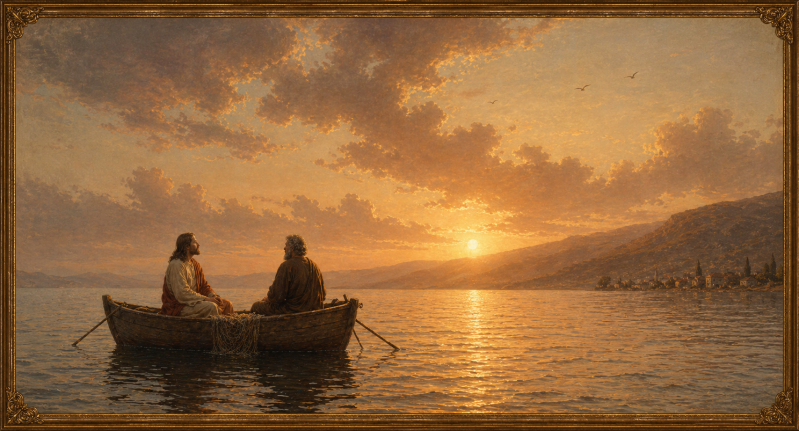
But the Lord had mercy. Our risen Lord appeared to them, and the first thing he did was he offered them his peace, not his wrath, not his indignation, but his peace. And he does that with each and every one of us, even when we lose our faith momentarily, as he said to them in the upper room at the Last Supper, “you will all lose faith” (cf. Mt 26:31). And he says that to us. But he also says the same thing to us, what he said to Saint Peter, “I have prayed for you so that when you rise from your fall, you in turn will strengthen your brethren” (cf. Lk 22:32). And that's what it's all about. We go through a dark moment. We go through bitterness. We cling to the Lord. He strengthens us. He raises us up so that we, in turn, can strengthen one another.
In the first reading from the Book of Acts, we come across that episode in the initial stages and creation of the Church, the early Church, the primitive Church that had to address those very pertinent issues that shaped its beginning charity, the charity that would go out into the world and convert thousands, hundreds of thousands, millions. But it all started with the heart of Christ, the heart of Christ, which stops when there's a problem, is not complacent, is not indifferent, and rather he addresses the situation with mercy, with love, with healing.
So in the first reading from the Book of Acts, we see that there were a number of early Christian converts. Praise be to God. And some of them were Jews, and some of them were Greeks. And what happened is, when the early Christian community got together and they were selling their things so that with the money, they would help those who are less fortunate than themselves within the community, some of the Greeks, some of the Hellenists, noticed that their widows were being neglected, as opposed to the Jewish widows who were well taken care of. And they brought this matter before the apostles. And what did the apostles do? They stopped. They addressed the situation, and there was a lot of healing. There was a lot of charity, a lot of goodness. And we are told what ended up happening was that the number of the disciples in Jerusalem increased greatly. Even a large group of priests were becoming obedient to the faith (cf. Acts 6:1–7).
So when we do this, when we stop, when we address the situation, when we are just in our conduct, when we seek justice and fairness, and to treat everyone with dignity, that has a huge effect on people's faith, whether or not they will believe in Jesus. A lot of times depends on how we are loving one another and how that is manifest to the world around us.
In the second reading, Saint Peter himself says that Jesus was the rejected foundation, the rejected stone. Something solid, a solid foundation rock. He was the rejected cornerstone. Saint Peter says, “Beloved, come to him, a living stone, rejected by human beings but chosen and precious in the sight of God” (1 Pt 2:4). “Like living stones, let yourselves be built into a spiritual house” (1 Pt 2:5). So we too are called to, like Jesus, be a living stone, to be solid in our faith, in our love for one another, and together as these living stones, when we unite as we ought to make this journey together, united in mind and heart.
And that's why it is important that we realize that God has left us an objective truth, a truth that we are all to acknowledge, a truth that we are all to live by, his law that he has inscribed on the heart of every human being. But a lot of times we reject those promptings of the Holy Spirit that are meant to not only make our lives more whole and beautiful and full, but to also unite us as God's people. And so Saint Peter is making the point here that we too are chosen and precious, and that “whoever believes in him will not be put to shame” (1 Pt 2:6). “The stone that the builders rejected has become the cornerstone” (Ps 118:22). And “a stone that will make people stumble, and a rock that will make them fall” (1 Pt 2:8), because our Lord's very presence challenges us to be better.
In the Gospel, Jesus recognizes that the apostles are at a lull. Their spirits are downcast. He is telling them that pretty soon he won't be with them much longer. But then he encourages them: “Do not let your hearts be troubled. You have faith in God; have faith also in me” (Jn 14:1). Because Jesus is God. Jesus is the truth, the way, and the life. As Thomas was told in answer to his question, “Master, we do not know where you are going; how can we know the way?” Jesus said to him, “I am the way and the truth and the life. No one comes to the Father except through me. If you know me, then you will also know my Father” (cf. Jn 14:7).
Jesus is the perfect, visible, tangible image of the Eternal Father who remains unseen by human beings in this world, only in the next. My brothers and sisters, strive for that beatific vision. Strive to number among those saints and martyrs and angels who behold the face of God, the face of the one who holds all things in existence, and who has prepared a place for us, in Jesus, through Jesus, by Jesus, our Lord and Savior, who gives us all that is good and holy.
In the name of the Father, and of the Son, and of the Holy Spirit. Amen.
Add comment
Comments