It is of no accidental purpose that the Church puts together these two readings for us today—one from the Acts of the Apostles and the other from the Gospel of John—where in the Gospel we hear a continued discourse from Jesus on His Body and Blood, the Eucharistic discourse in the sixth chapter of John.
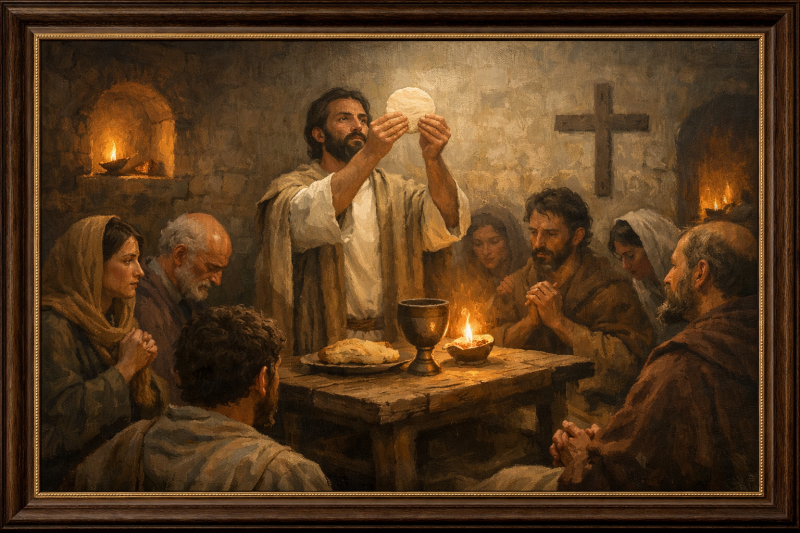
And we read that when the Jews quarreled among themselves, saying, “How can this man give us his flesh to eat?” Jesus actually intensifies His language. He does not try to soften it. Rather, He deepens it and says: “Amen, amen, I say to you, unless you eat the flesh of the Son of Man and drink his blood, you do not have life within you. Whoever eats my flesh and drinks my blood has eternal life, and I will raise him on the last day. For my flesh is true food and my blood is true drink. Whoever eats my flesh and drinks my blood remains in me and I in him” (John 6:53–56).
Now, this last sentence is so important to understand what worthy reception of the Eucharist actually means. First of all, we know that this would have been horrific language to the Jews two thousand years ago, for they considered blood as sacred—the source of life—and to touch it was to commit a sacrilege and become ritually unclean. And so, for example, in the parable of the Good Samaritan, the Jewish countrymen saw the man in pain but passed him by, likely because he was bleeding profusely (cf. Luke 10:30–32). Also, the woman with the hemorrhage would not dare make herself known until called upon by Jesus (cf. Mark 5:25–34). And to this day, Jews do not eat meat unless it has been purified from blood.
And then our Lord says, “Whoever eats me will live because of me” (John 6:57). To them it was shocking—what on earth is this man saying?
So what are we to make of all of this? What do these words of Jesus mean? Obviously, they are not to be taken literally in the sense that He is going to tear parts of His flesh and give them to us. Later on, within the same discourse, He specifies that He is the bread of life, and the bread that He will give for the life of the world is His flesh (cf. John 6:51). And He actually does this at the Last Supper—so He is not speaking merely in metaphor.
There is symbolism, yes—there are connections to be made. Jesus is the bread of life that came down from heaven. Absolutely. But He truly takes bread and becomes present within it, so that those who live by His Spirit can unite themselves to Him always, every day.
Therefore, to eat Jesus’ flesh and drink His blood is to assimilate into our very being the whole way of thinking and acting of Christ—to allow the very Person of Christ to indwell our souls.
And so, to eat the Body of Christ and drink His Blood without living as Christ lived is the wrong way to receive this precious sacrament. That is why the Church teaches that one cannot receive Our Lord in a state of mortal sin.
When we receive the consecrated Host, we are simultaneously declaring that we have allowed Christ’s Spirit to dwell within us. And so we will love our neighbor as ourselves. We will love the poor and want better for them. We will want for them what we want for ourselves. We will love even our enemy, because we are allowing the Spirit of Christ—His mind—to govern our actions. We will pray for those who persecute us (cf. Matthew 5:44). We will avoid sin, impurity, and anything that turns another person into an object for selfish desire. We will reject idolatry—anything that takes the place of God.
For this reason, Paul warned the Corinthians of the sacrilege against the true presence of Christ through unworthy reception when he said: “Whoever, therefore, eats the bread or drinks the cup of the Lord unworthily will be guilty of the body and blood of the Lord” (1 Corinthians 11:27). And again: “Let a man examine himself, and so eat of the bread and drink of the cup. For anyone who eats and drinks without discerning the body eats and drinks judgment upon himself” (1 Corinthians 11:28–29).
And so this passage, my brothers and sisters, is one of the strongest biblical foundations for the Church’s teaching on the worthy reception of the Eucharist.
Now, in today’s first reading, we get our first glimpse into Saint Paul, who eventually allows the Spirit of Christ to live within him. But he comes from a place where he had denied that Jesus is real. And in this encounter that we hear of in Acts, his life is changed. Jesus enters, and everything is made new.
We read: “On his journey, as he was nearing Damascus, a light from the sky suddenly flashed around him. He fell to the ground and heard a voice saying to him, ‘Saul, Saul, why are you persecuting me?’ He said, ‘Who are you, sir?’ The reply came, ‘I am Jesus whom you are persecuting’” (Acts 9:3–5).
And so Paul’s life takes a complete turn in Christ. He becomes so conformed to Christ that later he writes: “It is no longer I who live, but Christ who lives in me; and the life I now live in the flesh I live by faith in the Son of God, who loved me and gave himself for me” (Galatians 2:20).
Oh my brothers and sisters, if we could but make that same declaration in our own lives—“It is no longer I who live, but Christ who lives in me”—how splendid our vocations would be, how much fruit we would bear for the Kingdom of God.
Be of heart. The Lord is risen, and He is with you—one day at a time, in humility and in prayer.
May Almighty God bless you, the Father, the Son, and the Holy Spirit. Amen.
Add comment
Comments