My dear brothers, and sisters in Christ, today we celebrate the memorial of Our Lady of the Rosary. My brothers and sisters, I think we all have experienced the power powerful nature of praying and contemplating the mysteries of the rosary. It's one of the most familiar prayers of the Catholic Church, but sometimes precisely because it is so familiar we can forget what an extraordinary prayer it actually is.
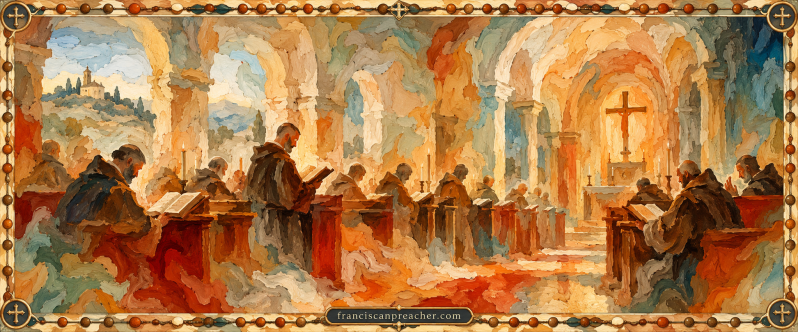
The rosary didn't simply appear overnight in the form we know today. It developed gradually in the prayer and the liturgical life of the church. In monasteries, monks would pray 150 psalms, and so many ordinary Christians, who especially those who could not read, could not afford books and did not know Latin, wished to have something similar for their own personal piety and devotion. And so they're developed this practice of offering 150 prayers in the place of the 150 psalms. Eventually, those 150 prayers turned into Hail Marys. And this is why the Rosary came to be known as Our Lady's Psalter, pointing to the Psalms.
Even the Hail Mary itself is rooted in Scripture. Of course, we repeat the words of the angel Gabriel, “hail, full of grace. The Lord is with you” (Luke 1:28). And then the words of Elizabeth, “blessed are you among women, and blessed is the fruit of your womb” (Luke 1:42).
There is, of course, the ancient Dominican tradition associated with the Rosary and Saint Dominic and Our Lady and historically, however, we know that the rosary developed over centuries with the Dominican order playing an enormous role in promoting and spreading it throughout the church, but it predated both the Dominican and Franciscan orders in the 1200s.
And so here is the most important thing to understand about the Rosary. The Rosary is not principally about our blessed, our blessed mother. It is about Jesus, contemplated with the help of our blessed mother.
Saint John Paul II put it beautifully when he said, “the rosary, though clearly Marian in character, is at heart a Christo centric prayer.” And elsewhere he gives perhaps the simplest definition of the rosary. He says, “to recite the rosary is nothing other than to contemplate with Mary the face of Christ.”
And that is what we are doing. Mary takes us lovingly lovingly as our mother through the gospel. At the Annunciation, she shows us the word becoming flesh. At Bethlehem, she shows us the poverty of God. At Canaan, At Cana she tells us, “do whatever he tells you” (John 2:5). At Calvary she teaches us how to remain beside the cross when everyone else has fled, to remain loyal. At Easter, she shares the joy of the victory of her son with all of us. At Pentecost, she is there with the church waiting for the Holy Spirit.
And so this is why, for example, Saint Paul the sixth, Pope Paul the sixth called the Rosary “the compendium of the entire gospel. Gospel.”
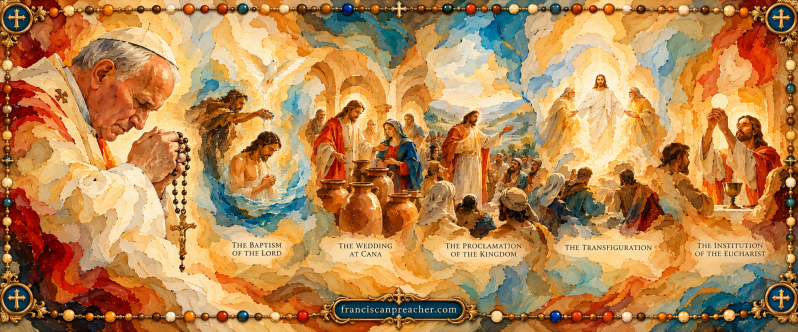
But there's another beautiful historical connection. The traditional Rosary contained 150 Hail Marys corresponding as I said above, to the 150 psalms. In 2002, however, Saint Pope John Paul II proposed the five luminous mysteries so that we could also contemplate the public ministry of Jesus, his baptism, the wedding feast at Cana, when he began to proclaim the Kingdom and his identity became more disclosed. At the Transfiguration and the institution of the Eucharist.
And this is why the Rosary should never become simply 50 prayers rushed through as quickly as possible. No, it's repetition has a purpose. The Hail Mary becomes almost like the background music while the heart looks at Jesus.
At the Annunciation, “Look at him.” In Bethlehem, the cold cave, in the manger, “look at him.” At Gethsemane, “Stay with him, accompany him, watch with him.” At Calvary, “stand beside him. Pray with him.” At Easter, “rejoice in him and everything that he's done for you in his victory over death.”
The church therefore describes the rosary as essentially a contemplative prayer. We contemplate what God has done and what he is doing in our lives.
My brothers and sisters, we need to be on our guard because we can study Jesus. We can preach about Jesus. We can teach theology about Jesus. We can celebrate the mysteries of Jesus every day. And yet there's always the danger that Jesus becomes the subject of our work rather than the person whom we love.
And the rosary is particularly beautiful in this way because it brings us back to him. It brings back our focus, back onto the one who is able to see us through the storms of life.
My brothers and sisters, the rosary is not simply praying to Mary. It is contemplating Jesus with Mary. And it is a gift that she herself has given to us over and over throughout the history of the Church, every time she has been. kind enough and mindful of visiting us, her children, through her intercession, through the power of the most holy Rosary, may she acquire for us a renewed love for the Lord, our God, who is all good and deserving of all our love.
In the name of the Father and of the Son, and of the Holy Spirit. Amen.
Go in peace.
Add comment
Comments