My dear brothers and sisters in Christ, peace be with you. Today we celebrate the memorial of Saint Jerome. And this is an important saint because, as we will see, he was a life given to the Word of God. And here at franciscanpreacher.com, we're all about sharing, spreading, and trying to live the Word of God through grace and through the blessings that God sends us. And Saint Jerome is one of these blessings to us.
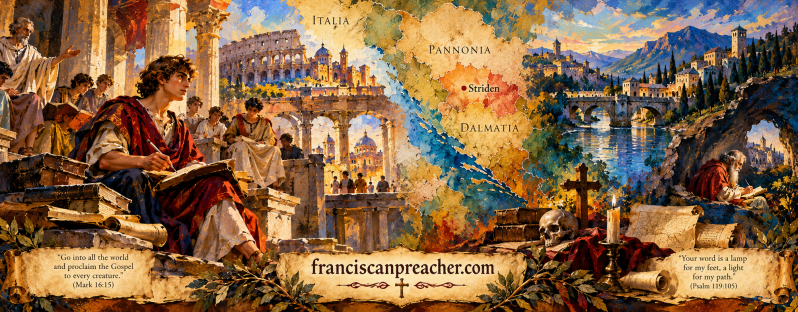
Saint Jerome was born around 347 in a place called Striden. Striden was a town on the border between the Roman provinces of Dalmatia and Pannonia. The settlement was later destroyed and its precise location today is no longer known. In modern geographical terms, scholars generally place it somewhere in the region of the western Balkans, with proposed locations in or near present-day Croatia, Slovenia, or Bosnia and Herzegovina. There is no scholarly consensus, however, precise enough to say that this modern town is ancient Striden.
But suffice it to say that Saint Jerome received an excellent education in Rome, which is where I am right now. And of course, if you want the best education within the Catholic faith, nothing will supersede, nothing will be on offer better than what you will find in terms of the academics in Rome. For example, the Biblicum in Rome is considered the world's foremost university, which delves deep into Scripture. And in fact, one of our Franciscan students is studying at the Biblicum, doing a three-year course, getting a license in sacred biblical theology. Not an easy degree to acquire.
My brothers and sisters, he received his education in Rome, and after a period of ascetical life in the East, he was ordained a priest and eventually settled in Bethlehem, where he spent roughly the last three decades of his life studying, translating, and commenting upon Sacred Scripture. His knowledge of Latin, Greek, and Hebrew enabled him to produce the biblical translations and revisions that became foundational to the Latin Vulgate.
He died in Bethlehem around 420. His famous conviction, a saying of his that you probably already know, is that “ignorance of Scripture is ignorance of Christ.” And this beautifully summarizes his life.
Today's readings could hardly be more appropriate for Saint Jerome. Saint Paul tells Timothy that Sacred Scripture gives us, and I quote, “wisdom for salvation through faith in Christ Jesus” (2 Timothy 3:15). While Jesus describes the disciple as a scribe who brings forth treasures, both new and old. Jerome devoted his life to precisely this task, returning to the ancient biblical texts not merely to acquire knowledge, but to encounter Christ and help the Church hear God's Word more clearly.
In the first reading from Saint Paul's second letter to Timothy, we hear him say, “Beloved, remain faithful to what you have learned and believed, because you know from whom you learned it, and that from infancy you have known the sacred scriptures, which are capable of giving you wisdom for salvation through faith in Christ Jesus” (2 Timothy 3:14–15).
Now, imagine, right? Saint Paul is saying that we, from our infancy, right, our parents, hopefully, they took us to Mass and there every Sunday, maybe even throughout the week, we would hear God's Word proclaimed. We would hear the Gospel narratives, throughout the Mass the beautiful descriptions of what Christ said, what He taught, how He felt, how He acted in certain situations, how He performed signs, miracles that are beyond this world, healings that we have never seen, shaped our spirituality which in turn shaped the trajectory of our lives.
My brothers and sisters, in today's Gospel, Jesus said to the disciples, “The kingdom of heaven is like a net thrown into the sea, which collects fish of every kind. When it is full, they haul it ashore and sit down, to put what is good into baskets. What is bad they throw away. Thus it will be at the end of the age. The angels will go out and separate the wicked from the righteous and throw them into the fiery furnace where there will be wailing and grinding of teeth” (Matthew 13:47–50).
My dear brothers and sisters, Our Lord is reminding us that the Word of God does more than console us. It also judges, corrects, and most importantly, it calls us to conversion. It calls us to that journey of transformation, so that we continue allowing the Holy Spirit to chisel away at the masterpiece which He wishes our souls to be.
So that one day when we breathe our last breath, we'll be ready, we'll be prepared to step into that kingdom of which we are citizens by faith, yet by deed, that might be another story. And so this correspondence between what we believe, our faith, and the way we put it into practice needs to be strengthened.

Jerome's sometimes severe asceticism reflected his conviction that Scripture must challenge the life of the person reading it. And Jesus in the Gospel goes on to ask them, in fact, “Do you understand all these things?” They answered, “Yes,” and He replied, “Then every scribe who has been instructed in the kingdom of heaven is like the head of a household who brings from his storeroom both the new and the old” (Matthew 13:51–52).
This final image that Jesus is using could almost describe Saint Jerome himself, because he became a Christian scribe, drawing from the ancient treasures of Scripture, and bringing them forth afresh for the Church. The old Word continually speaks in you when it is received in the light of Christ.
My brothers and sisters, Saint Francis approached Scripture very differently from the great scholar Jerome, but they shared the same fundamental conviction. The Word of God must change the person who receives it.
Early in Saint Francis's conversion, he heard the Gospel in which Jesus sends His disciples out in poverty without gold, silver, money, traveling bag, or extra clothing (Matthew 10:9–10). Thomas of Celano records Francis's response when he said, “This is what I want, this is what I seek, this is what I desire with all my heart.”
That is perhaps one of the most Franciscan ways imaginable of reading Scripture and celebrating this feast of Saint Jerome. Because like him, we desire to live every studied word of Jesus because only He, as Saint Peter reminds us, “has the words of everlasting life” (John 6:68).
In the name of the Father and of the Son and of the Holy Spirit. Amen.
Go in peace, thanking the Lord.
Below are the readings suggested for today's Memorial. However, readings for the Memorial may also be taken from the Common of Doctors of the Church, #725-730, or the Common of Pastors, #719-724.
Reading 1
Beloved:
Remain faithful to what you have learned and believed,
because you know from whom you learned it,
and that from infancy you have known the sacred Scriptures,
which are capable of giving you wisdom for salvation
through faith in Christ Jesus.
All Scripture is inspired by God
and is useful for teaching, for refutation, for correction,
and for training in righteousness,
so that one who belongs to God may be competent,
equipped for every good work.
Responsorial Psalm
Psalm 119:9, 10, 11, 12, 13, 14
- (12) Lord, teach me your statutes.
How shall a young man be faultless in his way?
By keeping to your words.
R. Lord, teach me your statutes.
With all my heart I seek you;
let me not stray from your commands.
R. Lord, teach me your statutes.
Within my heart I treasure your promise,
that I may not sin against you.
R. Lord, teach me your statutes.
Blessed are you, O LORD;
teach me your statutes.
R. Lord, teach me your statutes.
With my lips I declare
all the ordinances of your mouth.
R. Lord, teach me your statutes.
In the way of your decrees I rejoice,
as much as in all riches.
R. Lord, teach me your statutes.
Alleluia
- Alleluia, alleluia.
Open our hearts, O Lord,
to listen to the words of your Son.
R. Alleluia, alleluia.
Gospel
Jesus said to the disciples:
"The Kingdom of heaven is like a net thrown into the sea,
which collects fish of every kind.
When it is full they haul it ashore
and sit down to put what is good into buckets.
What is bad they throw away.
Thus it will be at the end of the age.
The angels will go out and separate the wicked from the righteous
and throw them into the fiery furnace,
where there will be wailing and grinding of teeth."
Jesus asked them:
"Do you understand all these things?"
They answered, "Yes."
And he replied,
"Then every scribe who has been instructed in the Kingdom of heaven
is like the head of a household who brings from his storeroom
both the new and the old."
Add comment
Comments