Today, we celebrate the memorial of a saint who has become so well known in the world of today that sometimes, even when you go to Assisi, he almost overshadows Saint Francis himself. And it's not Carlo Acutis, but it's Padre Pio, Saint Padre Pio. Now, few saints illustrate today's readings as visibly as this one. Saint Paul says, “I have been crucified with Christ,” while Jesus says, “Deny himself, take up his cross, and follow me.”
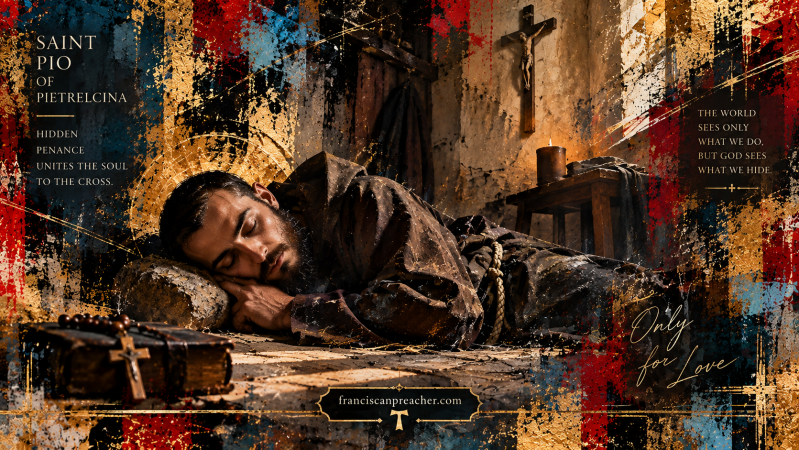
Saint Padre Pio's life was certainly marked by the extraordinary phenomenon of the stigmata, but the Church's own accounts emphasize something deeper, that is, decades of prayer, demanding ascetical discipline, obedience amid painful restrictions, long hours hearing confessions, intense devotion to the Mass, and concrete service to the sick.
His holiness was not simply that he bore the wounds of Christ. Those were merely the seal of everything else that he was doing, but that he continually sought to allow Christ to live in him.
Saint Paul begins today's reading from his Letter to the Galatians in this way: “Brothers and sisters: Through the law I died to the law, that I might live for God. I have been crucified with Christ; yet I live, no longer I, but Christ lives in me” (Galatians 2:19-20).
These words were extraordinarily concrete and manifest in Padre Pio's spirituality. The Church records that his life was deliberately centred upon conformity to the crucified Christ, and Saint John Paul II specifically connected Padre Pio's demanding ascetical practices from his youth with his desire for ever deepening his connection and his imitation of Christ.
Saint Paul goes on, “Insofar as I now live in the flesh, I live by faith in the Son of God, who has loved me and given himself up for me” (Galatians 2:20).
This is perhaps the key to understanding Saint Padre Pio's spirituality correctly. His penances and sufferings were not an end in themselves. Right? Our penances, our fasting, our observances must never be an end in themselves. Right? Rather, they flowed from faith in the one who “has loved me and given himself up for me.”
His spirituality of sacrifice was meant to be a response of love to Christ's prior self-gift, and so should all of our own penances. They should be a response to Christ's giving of himself to us, to the generosity of God, if you will.
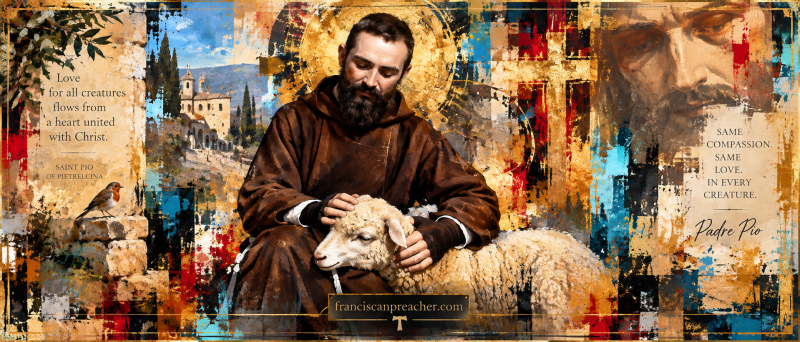
And then in the Gospel, Jesus said to his disciples, “Whoever wishes to come after me must deny himself, take up his cross, and follow me” (Matthew 16:24).
Here, through these words, Saint Padre Pio's life begins to shine ever more brightly. His cross, the cross that he carried, was not limited to physical suffering. He experienced chronic poor health, the wounds associated with the stigmata, demanding ascetical practices, and painful ecclesiastical censures and restrictions and misunderstandings.
Saint John Paul II emphasized that his obedience during these trials became a means of purification and conformity to Christ.
Our Lord goes on to say in today's Gospel, “For whoever wishes to save his life will lose it, but whoever loses his life for my sake will find it” (Matthew 16:25).
Padre Pio eventually became internationally famous. Yet the striking contrast is that he continued to understand himself fundamentally as a friar, a priest, and a servant of souls, never seeking to elevate his own life, but always seeking to elevate the life of others. Always carrying his cross so that he may make the cross of others lighter.
Pope Saint Paul VI later summarized his life not by emphasizing celebrity, but by pointing to a priest who celebrated Mass humbly, heard confessions for long hours, and lived as a man of prayer and suffering.
Padre Pio stands firmly within the spirituality of Saint Francis because, like Francis, he understood that following the crucified Christ means much more than admiring the Cross or thinking that a crucifix is especially striking. No, it means allowing the Cross to reshape our life.
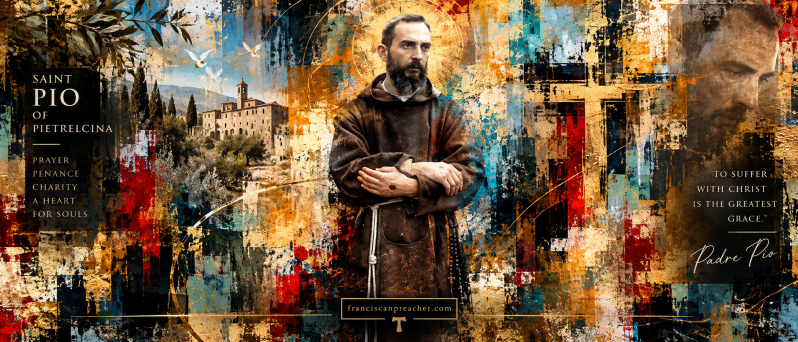
Padre Pio undertook serious ascetical practices from his youth. He endured poor health. He accepted obedience when obedience was painful. He allowed the Mass to be the pinnacle of his apostolic and pastoral activity.
Perhaps the most important thing we can preach is that the stigmata that he received were not Padre Pio's greatest possession. They were an extraordinary phenomenon associated with his life, make no mistake. But his holiness lay in the faith, hope, charity, obedience, and self-giving with which he responded to God's call.
Like Saint Francis, he left everything and tried to give himself, his entire self, to God and his people.
His union with the suffering Christ eventually produced the Casa Sollievo della Sofferenza, the House for the Relief of Suffering, opened on May 5th, 1956. The man who embraced suffering himself devoted enormous energy to relieving the suffering of others.
This hospital still exists in full functioning order, and it is a testament to the power of God when we desire to serve him in his people.
My brothers and sisters, if Padre Pio were able to speak to us, he would say perhaps these words: Take that cross into prayer. Take it into the Mass. Take it into the confessional. Take it to the sick. Take it into obedience, and allow Christ to use it, to use the cross you have been given for others.
Because the deepest verse we read in today's readings is not simply, “I have been crucified with Christ.” It is what comes immediately afterward: “Yet I live, no longer I, but Christ lives in me” (Galatians 2:19-20).
Through the intercession of Saint Padre Pio of Pietrelcina, may Almighty God continue to bless you on your journey and in the road to your own sanctification.
In the name of the Father, and of the Son, and of the Holy Spirit. Amen.
Go in peace.
Thanks be to God.
Add comment
Comments