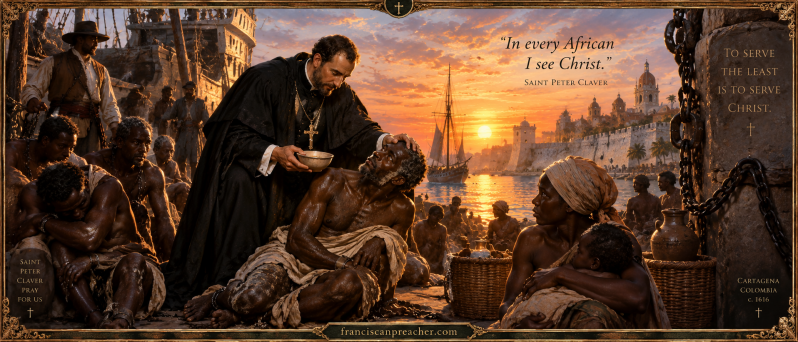
Saint Paul reminds us that the world in its present form is passing away. While Jesus declares blessed precisely those whom the world considers unfortunate: the poor, hungry, sorrowful, and rejected. Saint Peter Claver, whose memorial is celebrated in the United States but can be made a point for our reflection wherever we may be found, especially here in Canada and most especially in places like Colombia, made this Gospel startlingly concrete. He left security behind and spent more than 40 years serving the enslaved Africans arriving in Cartagena, Colombia, identifying himself with those whom society had placed at the very bottom.
In today's first reading from Saint Paul's First Letter to the Corinthians, we hear Saint Paul saying, “In regard to virgins, I have no commandment from the Lord, but I give my opinion as one who by the Lord's mercy is trustworthy. So this is what I think best because of the present distress: that it is a good thing for a person to remain as he is. Are you bound to a wife? Do not seek a separation. Are you free of a wife? Then do not look for a wife. If you marry, however, you do not sin, nor does an unmarried woman sin if she marries. But such people will experience affliction in their earthly life, and I would like to spare you that. I tell you, brothers, the time is running out” (1 Corinthians 7:25-29).
So, my brothers and sisters, this is the key that unlocks Paul's message. He is not declaring marriage or ordinary human joys as unimportant. He is just reminding Christians that everything in this life must be viewed in the light of eternity. Nothing earthly, however good and however beautiful, can become our ultimate possession.
He goes on to say, “From now on, let those having wives act as not having them, those weeping as not weeping, those rejoicing as not rejoicing, those buying as not owning, those using the world as not using it fully” (1 Corinthians 7:29-31).
Paul here is calling for an interior freedom. We live in the world, we love within it, we work within it and use its goods, but we must never allow these things to possess us. The Christian holds earthly things with an open mind and open hand in freedom.
“For the world in its present form is passing away,” Saint Paul continues (1 Corinthians 7:31). And this is his central point. The present world is not our final destination, and a lot of times we treat it as such. We think this is the be-all and end-all of all existence.
What appears permanent—wealth, suffering, reputation, success, and even earthly sorrow—will pass. Therefore, the Christian learns to measure the present according to the kingdom that is coming.
In the Gospel, we are told, and I quote, “Raising his eyes toward his disciples, he said: ‘Blessed are you who are poor, for the Kingdom of God is yours. Blessed are you who are now hungry, for you will be satisfied. Blessed are you who are now weeping, for you will laugh’” (Luke 6:20-21).
Saint Luke's Beatitudes are strikingly direct. You who are poor, you who are now hungry, you who are now weeping. Our Lord is not romanticizing suffering. He is proclaiming that poverty, hungry people, and sorrowful people are not to be so forever. God's kingdom overturns the judgments and the thoughts of this world.
And then Jesus goes on even to the deeper levels of our pain at times when he says, “Blessed are you when people hate you, and when they exclude and insult you, and denounce your name as evil on account of the Son of Man. Rejoice and leap for joy on that day! Behold, your reward will be great in heaven” (Luke 6:22-23).
So here our Lord is giving us the same perspective as Saint Paul: to look beyond the present moment. Rejection now must be measured against your reward in heaven.
Now, my brothers and sisters, Saint Peter Claver was born in 1580 in Catalonia, Spain, and he entered the Society of Jesus. He became a Jesuit and was ordained a priest in Cartagena in 1616. Cartagena was then one of the principal ports through which enslaved Africans were brought into Spanish America.
For more than 40 years, Claver went to the arriving slave ships carrying food, water, medicine, and other necessities. He entered the horrific conditions in which the enslaved had been transported, cared for the sick and the dying, and he instructed those he served in the faith and defended their human dignity.
His famous description of his vocation was, “Peter Claver, servant of the Africans.” And this is where today's Gospel becomes flesh. The world looked upon those arriving in chains and saw property, objects. Peter Claver looked upon them and saw persons, sons and daughters beloved by God.
Oh, that our vision would change in this way. That we may make the shift to see in everyone we encounter our brother, our sister, because we share a common Father, the eternal Father, who is in heaven.
Today's first reading could almost have been written as a commentary on the conversion of Saint Francis himself: “Those buying as not owning, those using the world as not using it fully, for the world in its present form is passing away” (1 Corinthians 7:30-31).
Saint Francis discovered that freedom did not come from acquiring more, but from no longer allowing possessions, status, and worldly ambition to possess him.
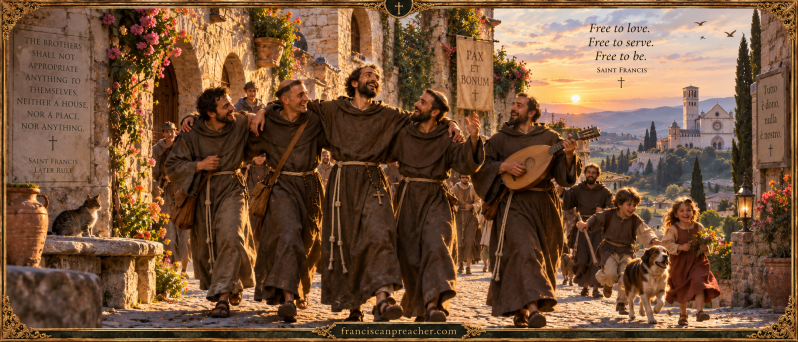
In his Later Rule, Francis gives the brothers one of his clearest instructions: “The brothers shall not appropriate anything to themselves, neither a house, nor a place, nor anything.” That is more than a rule about material poverty. It expresses a way of looking at the world, that everything is a gift, but nothing earthly is our final possession.
My brothers and sisters, through the intercession of these wonderful saints, these men who allowed themselves to be moved by the Spirit of God, may that same Spirit illuminate and enlighten our hearts.
In the name of the Father, and of the Son, and of the Holy Spirit. Amen.
Go in peace.
Add comment
Comments