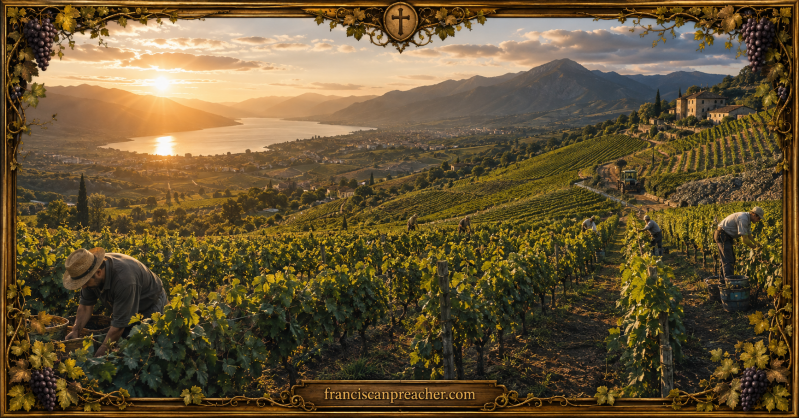
My dear brothers and sisters in Christ, peace be with you. In today's readings during Holy Mass, there is a very strong thread running throughout all of them And that is that God entrusts His vineyard and His flock to us, not so that we may serve ourselves and our own interests, but so that we may labor for others and help bring them into his kingdom. The first reading emphasizes the responsibility. While the gospel emphasizes the labor. And the Psalm Psalm 23 reveals the model; God Himself is the Good Shepherd.
So let's start off with the first reading. Historically, Ezekiel is speaking especially against Israel's leaders, the kings, the rulers, yes, even the priests, and others that are entrusted with the care of God's people. Their sin is not simply that they failed administratively. They used the flock for themselves.
One can understand a simple mistake in trying to govern. But when the people themselves are being exploited and abused, then the Lord addresses the situation. “You have fed off their milk, worn their wool, but the sheep you have not pastured” (Ezekiel 34:3).
So that makes this an especially sobering passage for us as priests, even as bishops, religious superiors, for you as parents, and for the teachers listening to this. And anyone else entrusted with the spiritual or temporal welfare of others.
But it would be a mistake for the ordinary Christian to hear Ezekiel 34 and think, "This reading is about priests. It's not for me." No. It's for all of us.
Through baptism, every Christian has been entrusted with something of God's vineyard. A parent shepherds children, a husband or wife, has the responsibility toward a spouse. A teacher shepherds students. A Christian can shepherd a friend. A friend who might be struggling, or a neighbor who is lonely, a person who has wandered from the faith.
And Ezekiel gives us almost an examination of conscience. We can ask ourselves, did I strengthen the weak? Did I help heal the wounded? Did I bring back someone who has strayed? Did I seek someone who was lost? Or was I, as of late, only concerned about myself? Am I living just for myself?
Now, this connects beautifully with the laborers in the vineyard that we hear of in the gospel for today. It changes the imagery from shepherding to working, working in the vineyard.
What is striking is that the landowner keeps going out looking for labors at dawn, at 9:00 in the morning, at noon, at 3:00 in the afternoon, and at 5:00 God apparently cannot tolerate seeing people standing idle when there is work to be done in his vineyard.
My brothers and sisters, a little word about idleness. Saint Francis of Assisi used to tell his friars, and by extension of them, all of us friars who have continued in his footsteps, that the greatest enemy of their souls? He said, was not Satan was not the corruption of leaders but the greatest enemy of one's soul is idleness.
Sitting around, not knowing what to do, Not keeping ourselves employed in the good things of the Lord's vineyard. Not praying idleness which leads to boredom, which leads to all kinds of sins.
And notice the repeated invitation. This is not just for the priests, for the bishops, for the shepherds. But Jesus in the parable has the owner of the land saying, “you too go into my vineyard.” (Matthew 20:4). You too.
In other words, it's not just for the priests. God says it to the priests for sure. You too go into my vineyard. He says it to the religious. You too. But he also says it to the mother and father, the young person, the elderly person, the professional, the sick person who can offer prayer and suffering. You too go into my vineyard.
My brothers and sisters, Saint Francis is an excellent example for us because he strongly rejected, as I hinted to just now, spiritual laziness. In his own testament, Francis writes, “I worked with my hands, and I still desired to work.”
So his testament he wrote close to the end of his life. And yet he said he still desired to work. And he wanted the friars who knew how to work to continue working, not principally for financial gain, but as an expression of humility, simplicity, good example, and service.
His rule also gives a beautiful formulation concerning the friar's work. They should work, and I quote, “faithfully and devotedly.” The fifth chapter of the approved rule. Those two words could preach an entire homily, faithfully and devotedly.
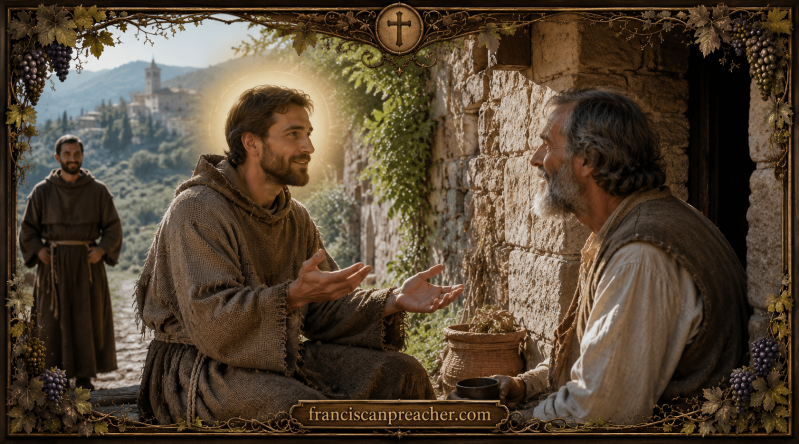
Francis did not imagine the kingdom of God being built by people who merely talked about holiness. Prayer had to become life. It had to be incarnate. It had to give tangible expressions of what we hold dear in our hearts. Love of neighbor, because in our neighbor we see the image, the likeness of God. We see our brother and sister.
My brothers and sisters, let us go out into the world. And remember, it is an honour to be called by God to work in His vineyard, an honor so great that we might not be aware of it. we might not be aware of how much of a blessing it is to follow Jesus and to serve Him in our brother and sister.
And we will only be aware of what it was all worth, when we close our eyes in this life and open them in the next. And then we will know that he has always loved us. and given us graces beyond what we could ever count and understand.
In the name of the Father, of the Son, and of the Holy Spirit. Amen.
Add comment
Comments