In today's readings, we will see how God seeks to restore His own people first, and the false shepherds versus the true shepherds that play a big part in that. We will hear about how interior conversion is more important than external success, and how God's authority versus human self-reliance must always be kept in mind.
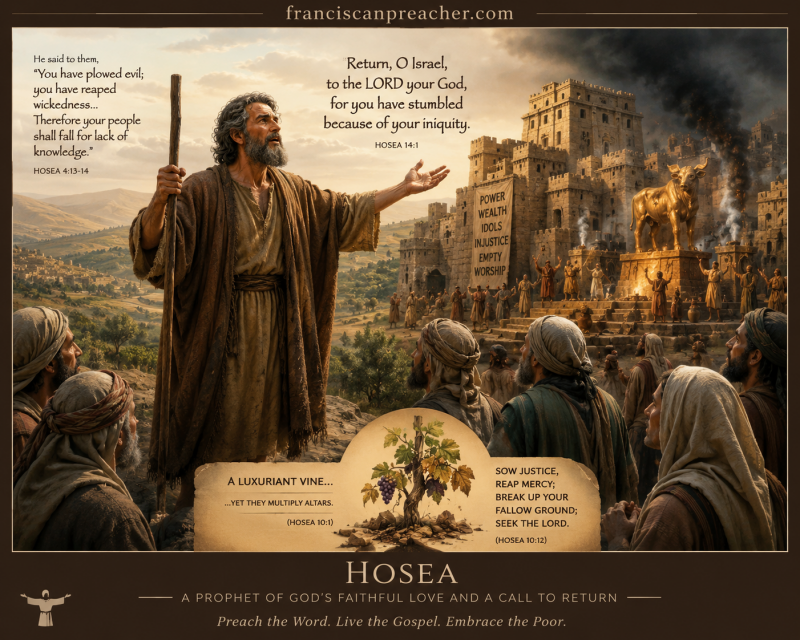
My dear brothers and sisters, in today's first reading from the Book of the prophet Hosea, this is given to us during a period when the prophet Hosea was ministering during the final decades of the northern kingdom of Israel, around 750 to 722 BC, a period that was marked by outward prosperity, but profound spiritual decay. If we look around to many of our affluent countries throughout the world, we see the same thing happening. Prosperity on a material level, but death on a spiritual level.
Politically, the nation was unstable, with a succession of kings who often seized power through conspiracy and assassination. And of course, we see that playing out in our very own day in so many countries. Spiritually, the people had abandoned the exclusive worship of the Lord, mixing the covenant faith with the fertility cults of Baal. Hosea likens Israel to a luxuriant vine that produces abundant fruit, yet instead of offering that fruit to God, the people use their prosperity to multiply altars to the idols, to the false gods, the non-existent gods.
Imagine what a profound sorrow that is to God. Imagine that you create a painting or a sculpture, or you erect a building that is beautiful and magnificent. And at the end, people will attribute it to someone else, someone who doesn't even exist. How would you feel? The people of God often replaced the true Lord God of Hosts with empty and false idols, who could not speak, who could not see, who could not hear, because they were only a figment of the imagination.
The prophet announces that because their hearts are divided, both their monarchy and their false religion will collapse. He then calls them to a profound conversion, and I quote: “Sow justice for yourselves, reap the fruit of mercy; break up for yourselves a new field.” (Hosea 10:12) Reminding them that God desires not external ritual, but transformed hearts.
In today's Gospel, which we read out of the tenth chapter of Saint Matthew's Gospel, Jesus' public ministry has reached an important turning point. He has been preaching throughout Galilee, healing the sick, cleansing lepers, casting out demons, and revealing that the Kingdom of God has drawn near. And at the end of chapter nine, seeing the crowds as sheep without a shepherd, He declares that the harvest is plentiful but the labourers are few. The Gospel immediately answers that need. Jesus calls the Twelve Apostles by name, grants them His own authority over evil spirits and disease, and sends them out to continue His mission.
Can you imagine the reactions of people being healed, being given sight, being raised from the dead, and their loved ones, and all the people of the various towns the Apostles went to? Imagine what their reaction would have been when, upon asking and celebrating with these men who had just changed their lives forever, where they got their power from. Imagine their reaction when the Apostles would say, “No, no, the power does not come directly from us, but it comes from One who placed His hands on us and gave us the power. It comes from the One who alone can, with His Father, give the Holy Spirit. It comes from Jesus. He's over there. Look.”
And they would flock to Him. And that's why we read in the Gospels that thousands upon thousands of people were following Jesus at any given time. His fame, His holiness, His aura had grown to such an extent that He couldn't even go into some places and preach the Good News.
My brothers and sisters, this is the God whom we serve. A God who is often exchanged for so many other things, immaterial things and material things. A God who, instead of being thanked and reverenced, is continually blasphemed and offended.
My brothers and sisters, let us be the ones to give to God what is God's, to live a life that is full of truth and virtue and goodness and holiness, so that we, too, one day, can join the Apostles that we hear of in the Gospel, in heaven, to bask in the love and in the mercy of God forever.
In the name of the Father, and of the Son, and of the Holy Spirit. Amen.
Add comment
Comments