As we celebrate today's Mass on this Wednesday in the 13th Week of Ordinary Time, we come across two readings which give us beautiful points for reflection regarding how God is concerned, not merely with external religion, but with the transformation of our hearts and of our lives. And that wherever Christ truly reigns, evil is driven out and authentic life begins. Life as the good Lord has intended it for us.
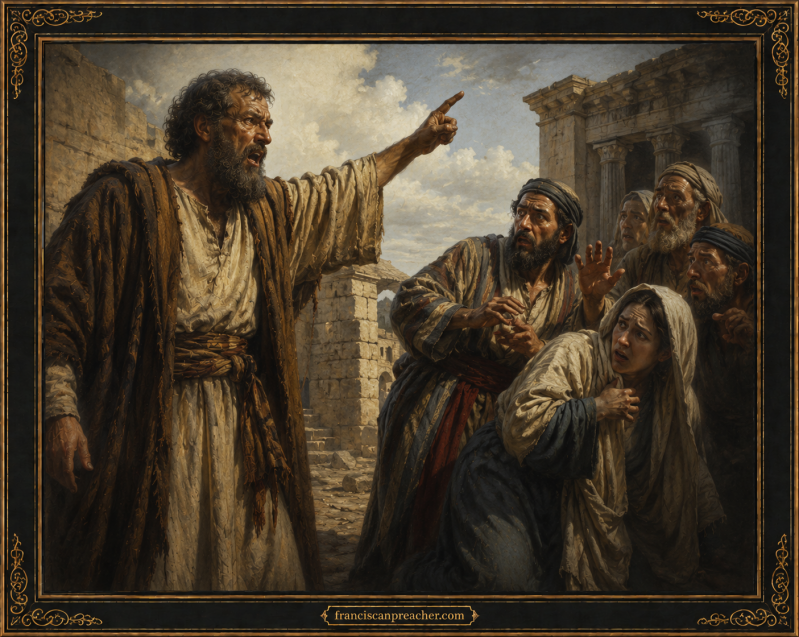
In the First Reading, we hear from the prophet Amos, who preached during the middle of the eighth century BC, primarily in the northern kingdom of Israel at a time of incredible political stability and economic prosperity under Jeroboam the Second. Outwardly, Israel appeared blessed. Yet beneath the surface, society was marked by corruption, exploitation of the poor, dishonest courts and widespread religious hypocrisy. A lot of this, unfortunately, is what we see playing out before our eyes in today's world, all around us, in almost every culture.
And although the people in this First Reading faithfully attended the Temple, offered sacrifices and celebrated religious feasts, their lives contradicted the covenant they claimed to honour. Amos boldly proclaimed that God desired neither empty ritual nor impressive liturgies divorced from moral integrity. The Lord's famous call in the reading, "Let justice surge like water, and goodness, like an unfailing stream" (Amos 5:24), reveals a fundamental biblical truth. Authentic worship always overflows into justice, mercy, and holiness of life. God rejects religion that remains within the sanctuary but never transforms the heart.
And then in today's Gospel, Jesus crosses the Sea of Galilee into the predominantly Gentile territory of the Gadarenes, an area influenced by Greek and Roman culture where the raising of pigs, animals considered unclean according to Jewish law, was common. There He encountered two men possessed by demons who lived among the tombs, places associated with ritual impurity and, of course, death. These men represent humanity enslaved by the destructive power of evil, isolated from family and society and deprived of their dignity.
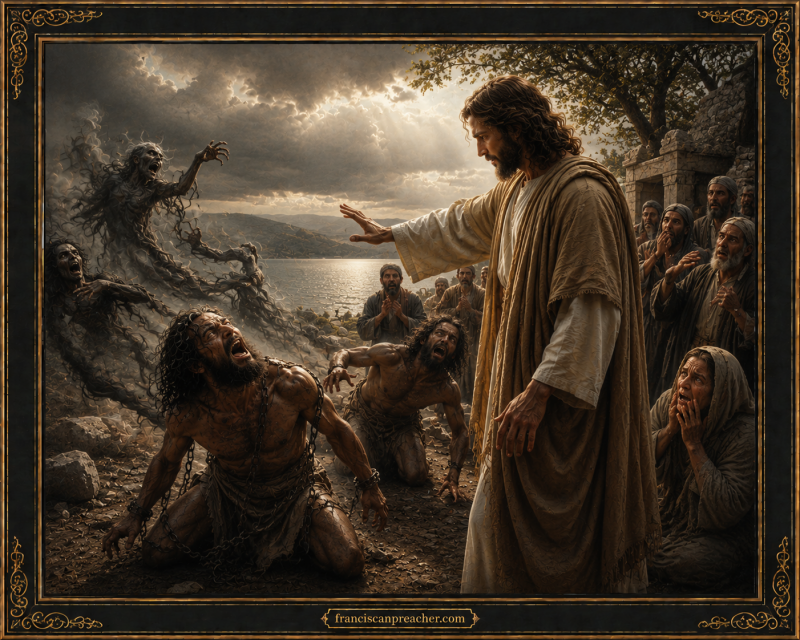
Significantly, the demons immediately recognised Jesus as the Son of God, and they acknowledge His divine authority even before many human beings do. With a single command, Jesus frees the men completely, demonstrating that no force of darkness can withstand His sovereign power.
Now, this is incredible, my brothers and sisters, especially for somebody like me who has lived with exorcists who have told me that demons don't simply just go away. Sometimes they have to struggle and fight with a team of prayer warriors over the same person, over and over and over again. Sometimes it lasts months, sometimes it lasts years. But Jesus, in today's Gospel, with a single command, He frees these men completely. This is God in our midst.
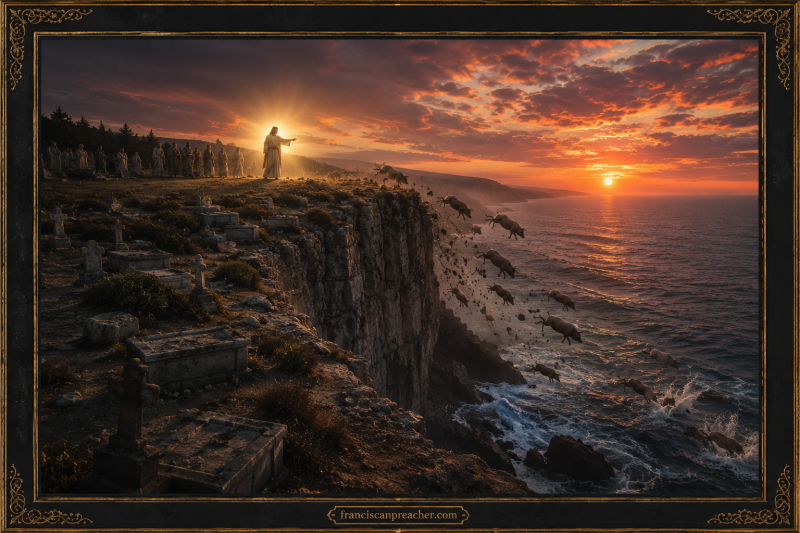
Yet the tragic irony of the passage, my brothers and sisters, is that the townspeople are more concerned about their economic loss rather than the liberation of these two fellow countrymen. They ask Jesus to leave. They value their possessions more than what He has just done in the presence of their own eyes.
That's why in one part of the Gospel, Jesus says, "If you do not believe the words that I speak, believe the works that you see." (cf. John 10:37–38)
My brothers and sisters, God is concerned not merely with external religion. But He wishes to see deep change in each and every one of us.
The people addressed by Amos believed that offering sacrifices fulfilled their religious obligations, yet they ignored justice and righteousness in daily life. They'd see beggars by the street and they'd walk on by. Never once strategising to perhaps help these people on the following day.
Likewise, in the Gospel, the townspeople witness an extraordinary miracle of liberation. But instead of rejoicing that two broken men have been restored, they focus on the loss of the pigs.
Both readings warn us that it is possible to appear religious and blessed, while in fact resisting the deeper work of conversion that God is trying to work in our hearts.
My brothers and sisters.
Amos calls Israel to "Seek good and not evil, that you may live." (Amos 5:14)
And Jesus fulfils that call perfectly by confronting evil directly and liberating those held captive by it. But He wishes to do this for each and every one of us.
Not only does He die on the Cross to take away our sin, but He is risen. And even more so, He becomes tangibly present in the Eucharist. He is there in the tabernacle, waiting for each and every one of us, so that He may bless us, illuminate our hearts and our minds, and heal us of all our brokenness.
Little by little, turn to Him always, the only One who can truly liberate us from all those things which keep us from living life to the full. He Himself once said, "It is for this that I have come, that they may have life and life in its fullness." (cf. John 10:10)
May Almighty God bless you.
In the name of the Father, and of the Son, and of the Holy Spirit. Amen.
Add comment
Comments