I certainly hope you had a wonderful and blessed Pentecost. Sunday, fifty days after the crucifixion of Our Lord, we celebrated the fulfillment of Christ’s promise to send the Holy Spirit once He reunited with the Eternal Father. The Holy Spirit, the Third Person of the Divine Trinity, comes to set our hearts on fire: for goodness, for holiness, and for truth.

Today we celebrate an amazing saint who exemplifies what true devotion to the Holy Spirit means: Saint Philip Neri. Born in Florence on July 21, 1515, and dying in Rome on May 26, 1595, he became known as the “Apostle of Rome” because of the extraordinary fruitfulness of his ministry there. He founded the Congregation of the Oratory and was ordained a priest in 1551. After years as a layman deeply dedicated to prayer, charity, and catechesis, he became famous for his joy, his humor, his simplicity, and his remarkable ability to attract young people to Christ. That is a very special charism indeed.
Saint Philip had a profound devotion to the Holy Spirit and to Eucharistic prayer. That is why it is so appropriate that we celebrate his feast only days after Pentecost. He worked especially among pilgrims, the poor, and ordinary Romans during a period of corruption and spiritual mediocrity in Rome. Yet rather than relying upon harsh severity, he encouraged holiness through friendship, conversation, music, pilgrimages, confession, and joyful Christian living. Through this spirit-filled approach, he greatly influenced the spiritual renewal of Rome during the Counter-Reformation.
One of the most fascinating and lesser-known moments in Philip’s life occurred during Pentecost while he was praying in the Catacombs of Saint Sebastian in Rome. While praying intensely to the Holy Spirit, he experienced what seemed to be a supernatural fire entering his chest. Afterwards, his heart began beating with extraordinary force, and during prayer his body often became physically hot. After his death, doctors discovered that two of his ribs had actually enlarged and bent outward in order to accommodate an enlarged heart. This became one of the great symbols of Saint Philip Neri: not merely a man of emotional enthusiasm, but a saint whose heart had literally been enlarged by divine love.
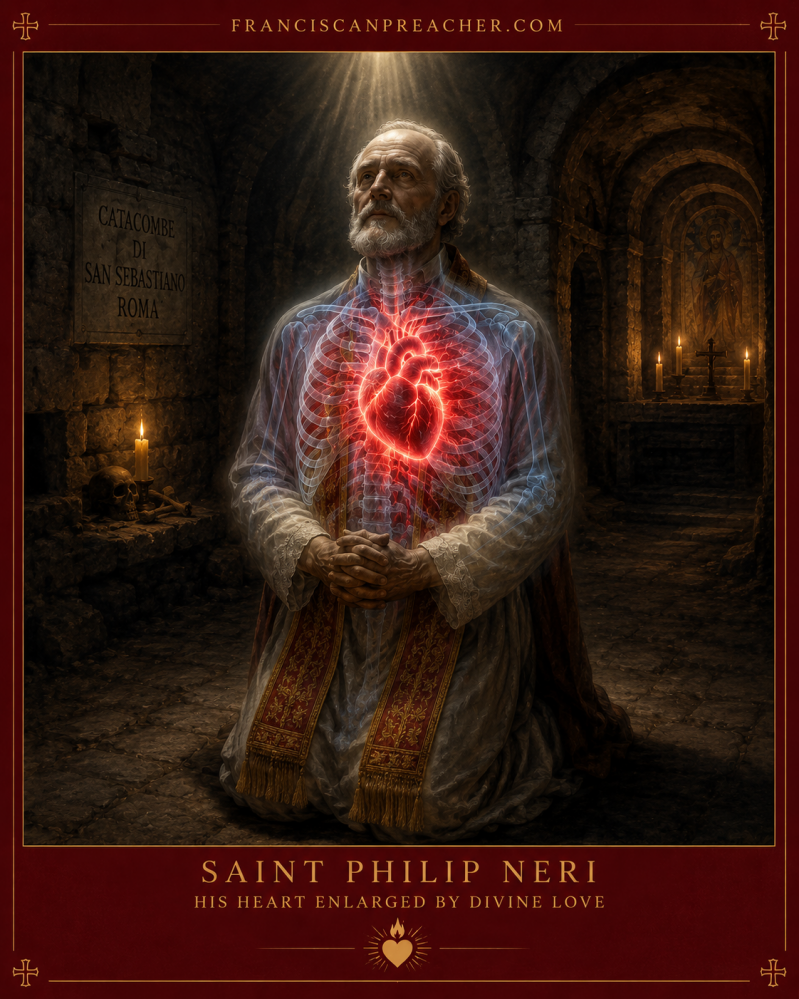
This beautifully connects with today’s first reading from the First Letter of Saint Peter. “Be holy because I am holy” (1 Peter 1:16). Saint Peter speaks about the Spirit of Christ already active within the prophets and about the grace now revealed through the Holy Spirit sent from heaven. Saint Philip Neri was profoundly a man of the Holy Spirit. He shows us that holiness is not necessarily gloomy or severe. He became holy through joy, humility, humor, prayer, charity, and a deep intimacy with Christ.
Saint Peter tells us: “As he who called you is holy, be holy yourselves in every aspect of your conduct” (1 Peter 1:15). Saint Philip understood this perfectly. Holiness is meant to penetrate every aspect of life: our friendships, our meals, our conversations, even our laughter. Through his prayer and ministry, he often warned people against artificial holiness and spiritual pride.
Our Lord Himself warned against superficial religion. In the Gospel, Christ speaks to the apostles after Saint Peter had once again reflected upon reward and recompense: “We have given up everything and followed you” (Mark 10:28). Saint Philip Neri truly lived this passage. He left behind wealth, prestige, career ambitions, comfort, and even many ecclesiastical honors. In fact, he repeatedly refused high positions in the Church because he feared pride. In this sense, he was Franciscan at heart. Saint Francis founded the Friars Minor precisely so that the brothers would seek the lesser places rather than positions of prestige and domination.
Jesus responds in today’s Gospel: “There is no one who has given up house or brothers or sisters... for my sake and for the sake of the Gospel, who will not receive a hundred times more” (Mark 10:29-30). Saint Philip’s life demonstrates the truth of Christ’s promise. Yet Jesus also adds something important: “with persecutions.” Christ never promises blessings without suffering. He promises joy in the midst of suffering.
Saint Philip Neri experienced misunderstanding. He was mocked, doubted, and at times viewed with suspicion. Some thought his joyful style irreverent; others distrusted his popularity. Yet the Holy Spirit gave him a joy that survived suffering and persecution.
And so too, my brothers and sisters, the Holy Spirit will give that joy to us if we persevere in obeying God’s commands. The Holy Spirit is God. Listen to His voice. Live according to His promptings. And you will discover a joy that is beyond this world.
In the name of the Father, and of the Son, and of the Holy Spirit. Amen.
Add comment
Comments