My dear brothers and sisters in Christ, may this week, the start of this new week, be one of blessings and graces from God on high. Today in the Mass, during the readings, we will hear God speak to us about the need to examine our motives, to always think about why it is we are doing the things that we are doing, especially the good things that we try to do. Because sometimes behind that goodness, there might lie a little bit of self-ambition, selfishness, basically. And so we scrutinize everything according to the Spirit of God.
In fact, Saint Paul begins in today's first reading from his First Letter to the Corinthians by saying this: “Brothers and sisters: The Spirit scrutinizes everything, even the depths of God” (1 Corinthians 2:10). That's an incredible statement.
Saint Paul is writing to a Christian community which was always fascinated by eloquence, intellectual sophistication, and worldly wisdom. And Corinth was a prosperous and cosmopolitan city. And Paul deliberately contrasts merely human wisdom and ambition with the wisdom that comes from God. The deepest mysteries of God cannot simply be reasoned out or learned in a university. God must reveal himself in order for us to know certain things about him.
Saint Paul goes on, “Among men, who knows what pertains to the man except his spirit that is within?” (1 Corinthians 2:11). So here Paul begins with something very familiar to us: what happens within our very selves, our very own minds, hearts, and souls.
Another person may observe our actions, but they cannot completely penetrate our interior thoughts. Only we know what we are thinking, what we're feeling. And sometimes even we struggle with why it is we behave the way we do. And so we have recourse to psychologists and psychiatrists and professional help, which is good.
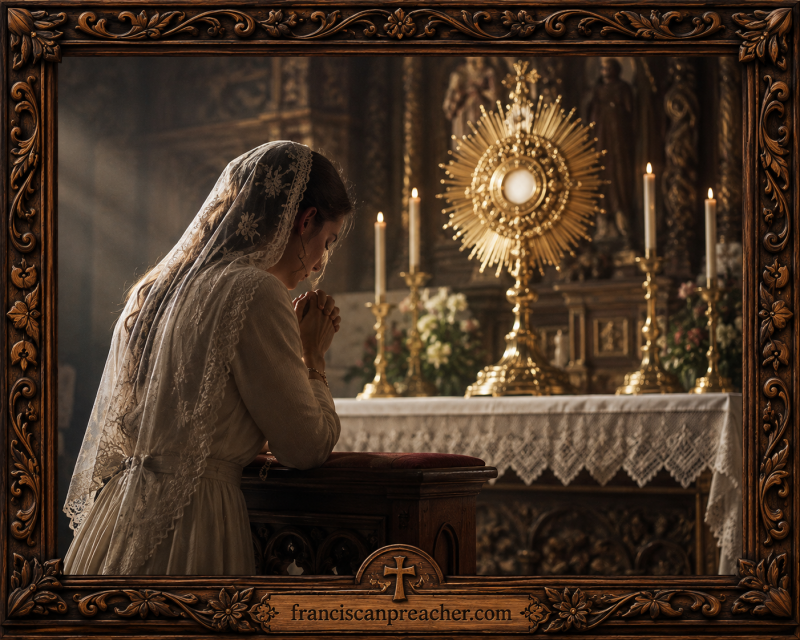
But in the same way, but infinitely more profoundly, the inner mystery of God is known perfectly only by God's own Spirit. How much more are we known more perfectly only by God's Spirit? And so that is why we should always take ourselves before the Lord in his presence, before the Blessed Sacrament, to pray and allow the Lord to work in us.
So this is extraordinarily important: our relationship with the Holy Spirit. The Spirit is not merely an external messenger bringing information about God, but he knows the depths of God because he belongs to the divine mystery itself.
Saint Francis possessed a profound awareness that the Christian life must be generated by God's Spirit, rather than by human ambition. In the Later and Approved Rule, he tells the friars that above everything else, they should desire, and I quote, “to have the Spirit of the Lord and his holy activity” (Later Rule, X).
To have the Spirit of the Lord and His holy activity. So we lay aside what the world offers us. We put that aside, all the distractions, all the worldly ambition. And we listen to Saint Paul as he continues with these words: “We have not received the spirit of the world but the Spirit who is from God” (1 Corinthians 2:12).
The spirit of the world evaluates things according to prestige, power, success, and human advantage. This is what Saint Paul is trying to remind us. But the Spirit of God teaches us disciples, followers of Jesus, to see with God's eyes, to think as God thinks. Mercy, sacrifice, purity, innocence.
Saint Paul goes on to say that we do this “so that we may understand the things freely given us by God” (1 Corinthians 2:12). Notice the word freely. Grace is the pure love and gift of God that is given to us. The Christian does not conquer the mysteries of God through intellectual achievement. He receives them as a gift, for we are nothing. And without Him, as Jesus says in the Gospels, “We can do nothing” (John 15:5).
In today's Gospel, Jesus went down to Capernaum, a town of Galilee. Capernaum stood on the northwestern shore of the Sea of Galilee. It became one of the principal centres of Jesus's Galilean ministry. Archaeological remains preserve the site of an ancient synagogue there, although the prominent limestone synagogue visible today dates from centuries after Jesus. But he taught them from there, and he taught them on the Sabbath.
Now they were astonished at his teaching, we're told, because he spoke with authority (Luke 4:32). Luke does not first tell us what Jesus taught, but how the people experienced him. Not so much what he was saying, but the way he was saying it. Right?
We remember that Saint Augustine was converted by Saint Ambrose. Not so much by what the great Patristic Father was teaching, the words he was saying, but how he was saying it. With what passion, with what power of the Holy Spirit behind those words.
So, my brothers and sisters, even us, when we are speaking to one another, when we're actually evangelizing and speaking about the Word of God, it's not so much what we say, although what we say is very, very important. But sometimes it's more of how we're saying it. People will sense if it's coming from the heart and the Spirit of God, or just the mind and the ambition of being recognized and being honoured.
My brothers and sisters, that is how fine a line the Lord is asking us to examine ourselves today. Are we seeking honour, our self-honour, or are we seeking the honour of God by trying to discern, to embrace, and to live by his most Holy Spirit?
May God bless you all in the name of the Father, of the Son, and of the Holy Spirit. Amen.
Add comment
Comments