In today's readings, we hear of different kinds of warnings, one from Saint Paul and one from our Lord Himself. One is concerned with false teachings. The other one is concerned with false living and a duplicity in our lifestyle.
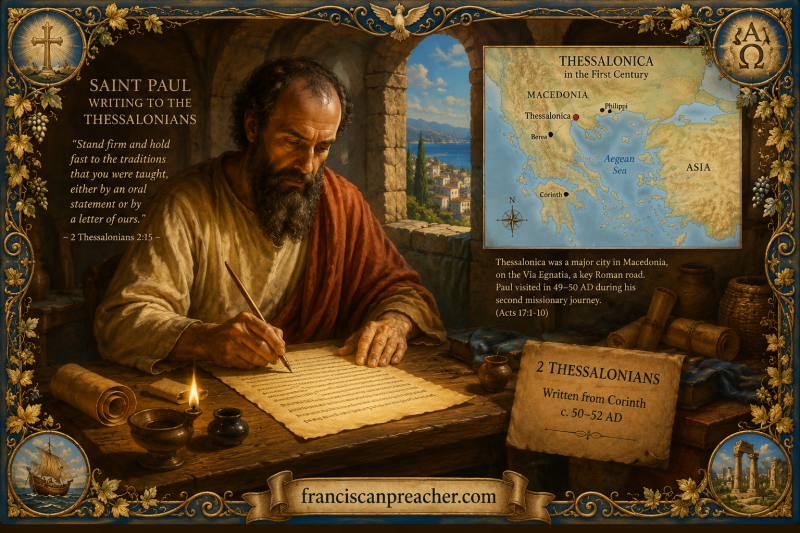
The first reading is from Saint Paul's second letter to the Thessalonians. Now my brothers and sisters, it is important to keep in mind that by the time that Saint Paul is writing these letters to the Thessalonians, he has already undergone much suffering. But he is still very far from that day where he will be martyred in Rome. So we are still early on in his conversion, in his public ministry, and yet he has already suffered considerably.
We remember that after his conversion he spent years preaching and encountering at the same time, opposition to the message that he was bringing to the people that God was sending him to. On his first missionary journey, for example, he was persecuted and driven from cities. At Lystra he was stoned, almost left for dead. And so we see that he has already undergone considerable suffering for the name of our Lord Jesus Christ.
And his authority now is being recognized more and more. And so that is why we have a very forceful tone in his writings that we pick up in today's first reading to the Thessalonians, where he says, “Do not be alarmed” (2 Thessalonians 2:2).
Some Thessalonians had apparently come to believe that the day of the Lord was already upon them, because of false writings that were circulating in their midst. Worse, that someone may have been claiming the authority of Saint Paul himself for this teaching. And so, Saint Paul says that either “by a spirit or by an oral statement or by a letter allegedly from us,” do not pay them any heed (2 Thessalonians 2:2).
Paul is effectively saying, Even if someone shows you something supposedly written by me, do not automatically believe it. The young church is being bombarded by rumours, alleged revelations, interpretations, and perhaps even forged communications, and false gospels like, for example, the Gospel of Thomas.
And all these false writings that were scrutinized by the true and legitimate authority that Jesus has left us in the place of the bishops and the pope, they were all rejected as being inspired word of God. For they showed that they were anything but. And they didn't have the testimony of the apostles to back them.
My brothers and sisters, in the heart of today's reading, we hear Saint Paul therefore saying to us, “Stand firm and hold fast to the traditions that you were taught, either by an oral statement or by a letter of ours” (2 Thessalonians 2:15).
Now, Saint Paul is referring to the Christian traditions, the traditions about the Eucharist. He himself says to the Corinthians later on, don't forget, he's writing this letter today to the Thessalonians from Corinth. Scholars are in agreement that he's writing from Corinth.

So when he leaves Corinth, he then also says to them, “I handed on to you what I myself received,” that on the night he was betrayed, our Lord took into his hands bread, He gave thanks. He broke the bread and gave it and said, “This is my body” (1 Corinthians 11:23-24).
So, Saint Paul is handing on what he knows for a fact to be the truth, especially about the resurrection of Jesus.
Our Lord, who is challenged, who is mocked, who is ridiculed, who is continually stifled by His persecutors. And so his tone is very angry and sad at the same time. When he says in today's gospel, “Woe to you, scribes and Pharisees, you hypocrites. You pay tithes of mint and dill and cumin, and have neglected the weightier things of the law: judgment and mercy and fidelity” (Matthew 23:23).
The two readings fit together remarkably well around one central idea, the authentic fidelity to truth, to God, and to what he has revealed to us.
Now, my brothers and sisters, St. Francis of Assisi was certainly not a man who rejected the church's tradition, quite the contrary. He had an enormous reverence for the church, the priesthood, the Eucharist, scripture, ecclesial authority. He begins the rule that he left to us friars by writing that we will always pledge our allegiance to the successors of Saint Peter.
So Francis understood precisely what Jesus means by cleaning the inside of the cup first. Christianity is not a show. Christianity is not all talk. Christianity is not solely concerned with the exteriors. But more importantly, it penetrates deep into our interior person, into our heart. That is why Jesus always emphasizes the heart.
Saint Francis did not simply exchange his rich clothing for poor clothing merely as a show of poverty. But rather it reflected his interior humility, the humbling of his pride, and his desire now to seek to do God's will first and foremost, so that when Jesus says, “You have neglected the weightier things of the law: judgment and mercy and fidelity” (Matthew 23:23), these now become the focus in the mind and the heart of Saint Francis.
My brothers and sisters, for the sake of everything that the Lord suffered, that the Saints suffered like Saint Paul, that Saint Francis himself suffered, for he was shunned even by his father and many friends, let us take time today to stop and reflect on what matters the most in our lives.
May our Lord illuminate your heart and your mind, and give you the courage and the strength to make the changes necessary.
In the name of the Father, of the Son, and of the Holy Spirit. Amen.
Add comment
Comments