In today's readings, the Lord wishes to speak to us about humility, about a turning away from pride. a pride which often blinds us to our proper relationship and place before God and others. Because you see, once we lose our way, once we allow distractions to take over our lives and the temptation of worldly allurements We easily slip into the sin of idolatry, which makes of things and of others false gods, but much more than that which makes out of ourselves a replacement for God. We become gods unto ourselves. We begin to think of ourselves as gods.
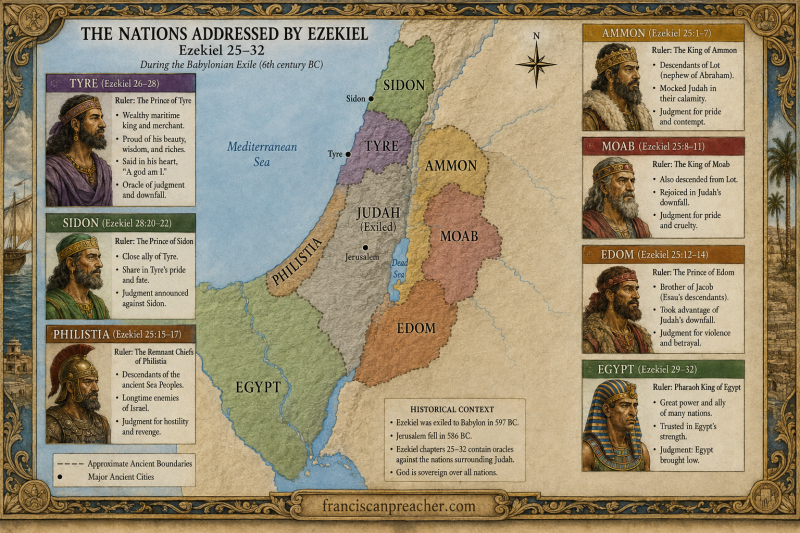
And so we catch a glimpse of this in the first reading from the book of the prophet Ezekiel in chapter 28. And Ezekiel is used by God to address whom is described here in the reading as the prince of Tyre. And the reading begins in this way. “The word of the Lord came to me, son of man. Say to the prince of Tyre, thus says the Lord God. Because you are haughty of heart, you say, A God am I.” (Ezekiel 28:1-2). So you see, this prince began to think of himself as a god.
Now, it becomes much clearer once we understand tyre and its ruler, who this person actually is. Ezekiel is already living in exile in Babylon during this writing. He had been deported from Judah in 597 BC. Uh during the first major Babylonian deportation, Jerusalem itself would finally fall to Nebuchadnezzar in 586 BC.
And so in chapters 25 to 32, however, Ezekiel turns away from Judah temporarily and delivers a series of oracles against the surrounding nations Ammon, Moab, Edom, Philistia, Tyre, Sidon, and Egypt. But chapters 26 to 28 concentrate especially on Tyre.
Why was Tyre so important. Tyre was a tremendously wealthy Phoenician maritime trading city located on the Mediterranean coast in what is today Lebanon. Ancient Tyre had an offshore island city that was exceptionally difficult to conquer. Its geographical position helped make it one of the great commercial centers of the ancient Near East. and its merchants traded throughout the Mediterranean world dealing in precious metals, luxury goods, textiles, timber, and other commodities.
This is why Ezekiel says, “By your wisdom and your intelligence, you have made riches for yourself. You have put gold and silver into your treasuries.” (Ezekiel 28:4). So the wealth itself is not presented as the fundamental sin. The wealth has produced an illusion of self-sufficiency.
Who is the prince of Tyre that is being addressed? This ruler is commonly identified historically with Ithobal III, king of Tyre during the period of Nebuchadnezzar II. Notice, however, that Ezekiel calls him a prince, ruler in this passage. Later in the chapter, beginning at verse 11, Ezekiel addresses a king of Tyre, Malek, in an even more poetic and mysterious lament.
This is the heart of today's reading. And I quote, “Because you are haughty of heart, you say, A God am I. I occupy. A godly throne in the heart of the sea, and yet you are a man and not a god.” (Ezekiel 28:2).
The expression heart of the sea makes particular sense for Tyre. Its island stronghold appeared almost untouchable, surrounded and protected by the Mediterranean. The king has not only wealth, but commercial power, intelligence, prestige, and extraordinary natural defenses. And all of this produces the great spiritual temptation. I no longer need anyone. I control my own destiny. I am secure.
My brothers and sisters, it is for this very reason that Saint Francis chose poverty, that Saint Francis chose vulnerability, that Saint Francis chose not to rely on the things of the world for his security. But rather, giving all that up, he was able to more readily and easily rely on God's providence, humbling himself before God instead of declaring himself a false God in his presence.
Now, what is going to happen to Tyre? God announces that foreign armies will come. “They shall draw their swords against your beauteous wisdom. They shall thrust you down to the pit.” (Ezekiel 28:7-8). The great irony is deliberate. When the king is surrounded by soldiers and facing death, God essentially asks, “Will you then say, I am a god? When you face your murderer, murderers,” (Ezekiel 28:9). death exposes the illusion. A god cannot be killed, yet this man can.
Number Nebuchadnezzar II, king of Babylon, subsequently conducted a long siege against Tyre, traditionally dated approximately 585 to 572 BC. Tyre survived as an important city afterward, but its supposed invulnerability was shattered. Much later, in 332 BC, Alexander the Great famously conquered the island city by constructing a causeway from the mainland.
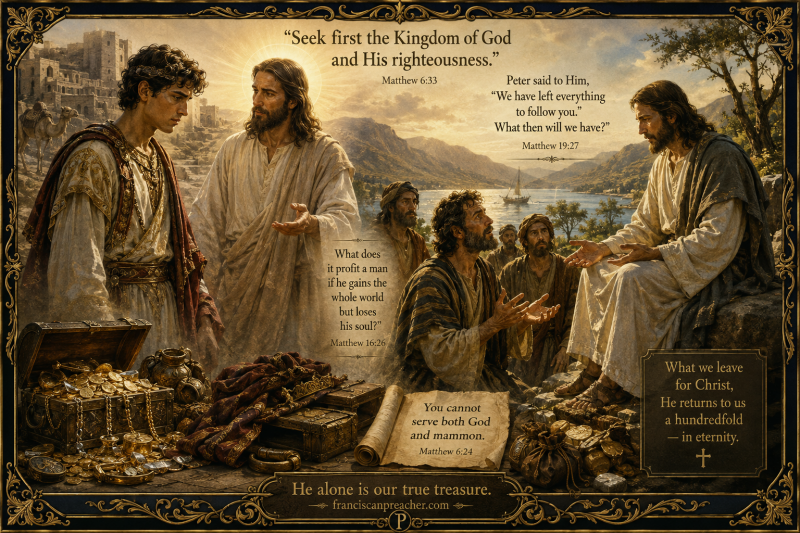
Now, the beautiful connection with today's gospel is this Jesus's warning about wealth, the rich young man who comes to him, depending on his own security, shall I give up everything my father has slaved for? Every everything I worked so hard in my life for? To follow you?
See, my brothers and sisters, we often think that following Jesus will make our life more difficult, more burdensome. But actually, it's when we get rid of those things we're attached to, overly obsessive about overly possessive of, that we find true freedom if we allow Christ to give it to us.
Saint Peter, in today's gospel, asks Jesus, “We have left everything to follow you.” (Matthew 19:27). What do we get in return? Well, the everything that Peter and the apostles and all of us have left most of the time are of temporal value. But when we follow the Lord, we enter into the realm of the eternal. We receive life everlasting.
And you tell me what can be worth more than your soul. That's why Jesus says, “What does it profit a man? That he gains the whole world but loses his soul.” (Matthew 16:26).
May Almighty God strengthen you, give you wisdom and the courage to continue to place Him first and foremost before any of your possessions, and even your own independence. so that you can more readily depend on his loving generosity and providence. Amen.
Add comment
Comments