Today we celebrate the Memorial of Saint Kateri Tekakwitha, who was a consecrated virgin to the Lord, and who remained faithful to Him till the end of her days. She's an important saint for us, especially in these our times, because she models for us holy perseverance, fidelity to our relationship with the Lord, and to walk in a way which humbly remains in His grace each step of the way.
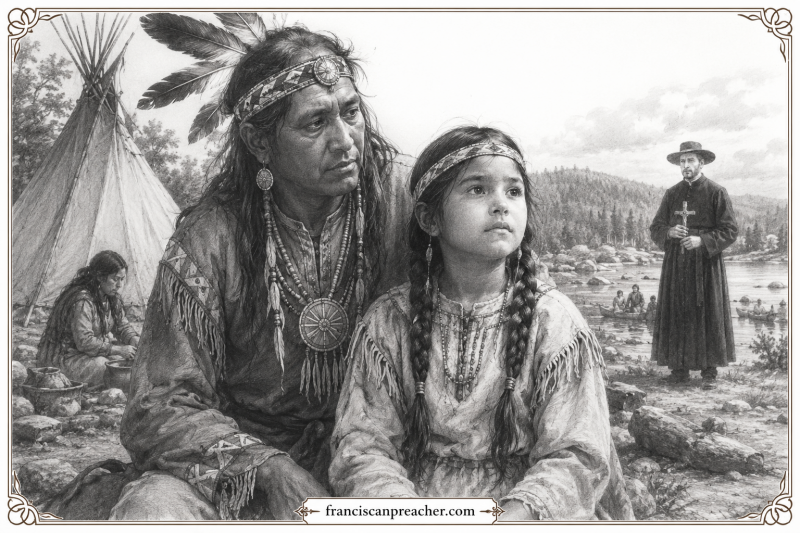
My dear brothers and sisters, Kateri Tekakwitha was born in 1656 in the Mohawk village of Ossernenon, present-day Auriesville, New York. Her father was a Mohawk chief, while her mother was an Algonquin Christian who had been baptized by French missionaries. When she was only about four years old, a devastating smallpox epidemic swept through the village. It killed both her parents and little brother. Yet Kateri survived, but her face was permanently scarred and her eyesight weakened. From then on, she often kept her head lowered, and she avoided attention.
In the readings that we have for her Mass today, we first hear from the prophet Hosea, who describes God seeking back an unfaithful bride and pledging Himself to her forever. Kateri's life was one of discovering that God desired her before she ever desired Him. Having lost everything humanly secure at such a young age, she eventually found her deepest identity, not in her tribe, family, or status, but in belonging entirely to Christ. She literally became the bride spoken of by Hosea. I quote: “Thou shalt call me Ishi.” (Hosea 2:16)
Ishi means my husband. Hosea contrasts this with Baali, meaning my master. So what we see immediately is that God doesn't want slaves, but a bride. It's something like what Jesus said to the Apostles on the night that He was betrayed: “I no longer call you servants... but I have called you friends.” (John 15:15) Friends, we are dear to the heart of God, each and every one of us.
When Jesuit missionaries finally reached her village, Saint Kateri was fascinated by Christianity. And this is where the North American Martyrs and their story intertwines with this beautiful saint that we've memorialized today. Because the town of her birth, Ossernenon, present-day Auriesville in New York, was the very town which was seeded by the blood of some of these first North American Martyrs, in particular Saint Isaac Jogues.
Saint Isaac Jogues had gone to that territory to evangelize the Mohawks. Probably the mother of Saint Kateri was converted by him and the others. But he suffered. He was tortured. His hands were mutilated, and he had to depart for a while to heal. But only a few months later, contrary to the advice of his closest friends, he returned to the territory, only to, a few days later, be butchered with an axe. And his head was placed on a pike as a warning to all other missionaries.
But that sparked a flame in the hearts of many. And it was only a few years later that Saint Kateri was born, hearing of these marvellous stories of courage and passion and love for God. For years, when the missionaries had arrived at her village once again, she secretly observed them. And she asked them many questions. And she learned about Jesus before she was baptized at the age of twenty.
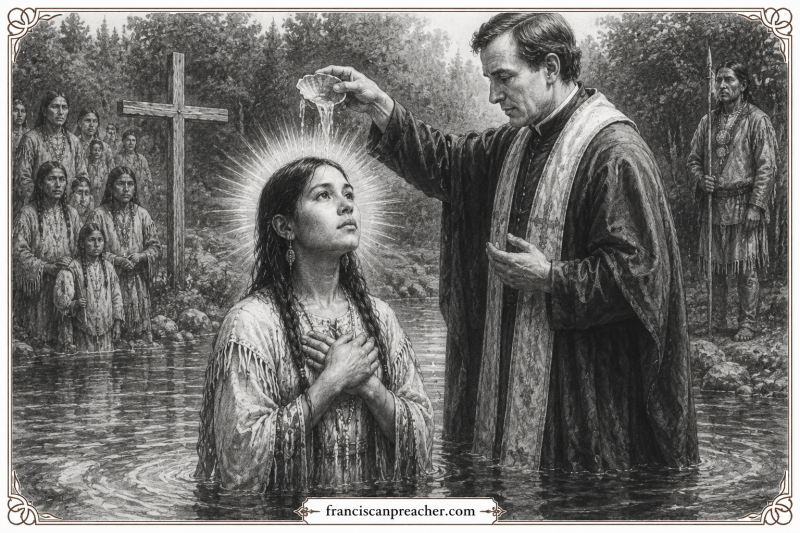
So we see that she was not coerced. She freely chose Christ. This was a process that she gladly embraced. Contrary to what a lot of people are trying to make us believe regarding the missionaries, that they went and they forced the people to change and to speak in English and to let go of their traditions. Not at all. Not at all. They merely brought Christ into the culture. And it didn't denigrate the culture. Rather, it exalted it. It enhanced it. It made it more beautiful.
This is precisely the movement that the prophet Hosea describes. Christianity became for Kateri not merely a religion but a relationship. And I quote: “I will betroth thee unto me in faithfulness.” (Hosea 2:20) Faithfulness became the defining virtue of Kateri.
She was forced to work seven days a week because she refused to work on Sundays. She was insulted, threatened, pressured into marriage, but she remained faithful. Eventually she fled nearly two hundred miles on foot and by canoe through forests to reach the Christian Mission of Saint Francis Xavier near Montreal.
My dear brothers and sisters, in Psalm 45, the King sees a beauty. Jesus sees this beauty in her: purity, humility, courage, holiness. May that be what He sees in us. Through her intercession, may we too become people of beautiful virtue.
In the name of the Father, and of the Son, and of the Holy Spirit. Amen.
Add comment
Comments