I would like to start today by reminding you, our faithful listeners and readers of our homilies, that the emphasis of this website is to proclaim the Gospel to you in a way that resonates with your lives and which the life of Saint Francis of Assisi himself can illuminate. And so we decided to call this website FranciscanPreacher.com because we would like to intersperse within our homilies examples from the life and teachings of Saint Francis.

So too we will do today. From the First Book of Kings, in the first reading, we pick up from yesterday's story about Naboth, who had that vineyard close to the palace of King Ahab. And Ahab really wanted that vineyard in order to transform it into a vegetable garden. But after offering Naboth money and perhaps even a greater vineyard, Naboth refused. And he said, God forbid I should get rid of this vineyard because it was bequeathed to him through his ancestors by God. And so instead of Ahab admiring that and accepting that, no, he went home and sulked, and his sadly to say evil wife said, “Don't worry, honey, I'll get that vineyard for you.” And instead of Ahab stopping her, he allows her her own devices. And so she plots the murder of Naboth.
My brothers and sisters, today's reading picks up from that murder, and we read: “After the death of Naboth, the Lord said to Elijah the Tishbite, start down to meet Ahab, king of Israel, who rules in Samaria. He will be in the vineyard of Naboth, of which he has come to take possession. This is what you shall tell him: The Lord says, ‘After murdering, do you also take possession? For this, the Lord says: “In the place where the dogs licked up the blood of Naboth, the dogs shall lick up your blood too.” Ahab said to Elijah, “Have you found me out, my enemy? Yes, he answered, “because you have given yourself up to doing evil in the Lord's sight, I am bringing evil upon you, and I will destroy you and will cut off every male in Ahab's line, whether slave or free man in Israel.” (1 Kings 21:21) And then he says against Jezebel: “The dogs shall devour Jezebel in the district of Jezreel.” (1 Kings 21:23)
My brothers and sisters, our passions, our greed, our coveting, our jealousy, our envy, if left unchecked, can lead to horrific tragedies, sins that are unspeakably evil. What does Ahab do? How does he respond? When Ahab, and I quote again, “heard these words, he tore his garments and put on sackcloth over his bare flesh. He fasted, slept in sackcloth, and went about subdued.” (1 Kings 21:27) And this touched the heart of the Lord, because then the Lord said to Elijah the Tishbite: “Have you seen that Ahab has humbled himself before me? Since he has humbled himself before me, I will not bring the evil in his time. I will bring the evil upon his house during the reign of his son.” (1 Kings 21:29)

Okay, so back to Saint Francis. For Saint Francis of Assisi, penance, as we see exemplified in Ahab's response to the prophet Elijah, was not primarily about punishment or a kind of self-hatred, or merely performing acts of mortification. No. It was a lifelong conversion of heart. For Saint Francis, penance was a turning back to God with one's whole life. One of the most important sentences Francis ever wrote is found in his Testament, the testament that he left to be read after his death, where he says: “The Lord gave me, Brother Francis, thus to begin to do penance.”
Notice he didn't say that he began to pray, preach, or even found three Orders. No. He said he began to do penance. For him, the entire Christian life flowed from that beginning because Francis understood penance according to the Gospel call: “Repent and believe in the Gospel.” (Mark 1:15) The Latin word poenitentia meant a change of mind and heart, a radical turning toward God. For Francis, someone doing penance abandons sin, seeks God's will, lives the Gospel sincerely, and continually allows God to transform them from within. This is why the earliest Franciscans were often called the Brothers of Penance.
Penance includes reconciliation. Francis saw penance as inseparable from restoring relationships. And the greatest relationship that is restored through penance, after we forgive our enemies, after we love those who are difficult, after we reconcile divisions, is that relationship with God Himself.
My brothers and sisters, in today's Gospel our Lord speaks of the heroic virtue that we need in order truly to live penance the right way. “You have heard that it was said, ‘You shall love your neighbour and hate your enemy.’ But I say to you, love your enemies.” (Matthew 5:43-44) “For if you love those who love you, what recompense will you have? Do not the tax collectors do the same?” (Matthew 5:46)
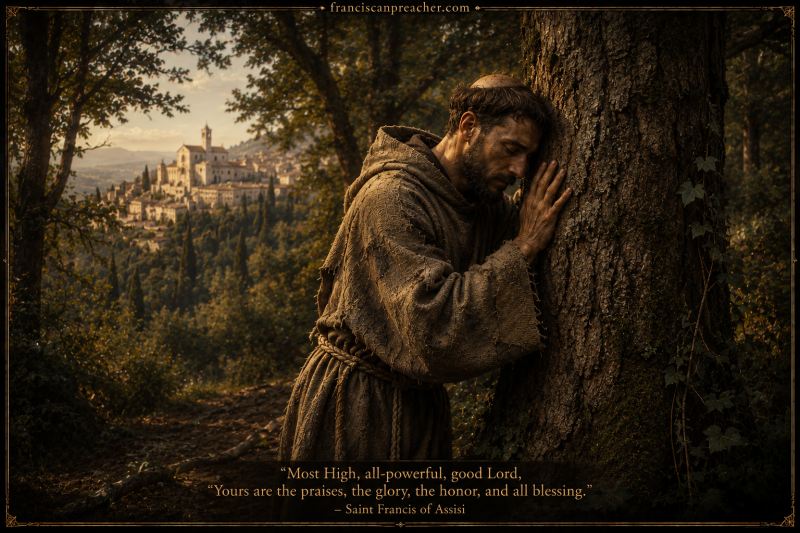
Saint Francis never uses the modern theological expression “heroic virtue” the way we use it, for example, throughout canonisation processes. Did that individual possess heroic virtue? Did he manifest a virtue that goes above and beyond the virtue of just human kindness? However, his writings are filled with examples of what we would today call heroic virtue. For example, Francis believed that the greatest virtue was love, and he writes in the Admonitions: “Blessed is the servant who loves his brother as much when he is sick and unable to repay him as when he is healthy and can repay him.”
It is easy to love those who are pleasant or useful. And so, my brothers and sisters, heroic virtue begins when we love those who can give us nothing in return, or even evil for good. Heroic virtue, according to Francis, involves humility. He famously taught: “A man is only as great as he is before God and no more.” For Francis, heroic holiness was not thinking great things about oneself, but recognizing that every good gift comes from God, who alone knows the thoughts of our hearts. In fact, Saint Francis feared praise more than suffering itself.
Heroic virtue for Saint Francis was perseverance in trials. It wasn't about converting nations or working miracles or possessing great knowledge. It was to remain faithful to Jesus even when we are pressured, when we are persecuted, when we are hated. This is true penance. Heroic virtue is obedience. He repeatedly praised obedience. He considered obedience one of the highest forms of imitating Christ because Christ Himself was, and I quote, “obedient unto death, even death on a cross.” (Philippians 2:8)
My brothers and sisters, penance means we become a living crucifix. That we are so otherworldly. In other words, we so belong to the Kingdom of Heaven that we do everything in light of this. That is why: you want my coat? Here, take my jacket as well. You want to throw me in prison? I am free in the Lord. I am free in the Lord. You want me to forgive somebody who has hated me and done me wrong? Of course. Because this life is but a few years compared to eternity, time without end in eternal bliss with God.
My brothers and sisters, may the Lord give us all the spirit of penance and heroic virtue for the glory of His name, day by day, one day at a time, as He Himself says: “Let the day's own troubles be sufficient for the day.” (Matthew 6:34) Tomorrow will bring troubles of its own. Let us humbly walk before Him, and He will bless us with a spirit of penance, true penance, and true heroic virtue.
In the name of the Father, and of the Son, and of the Holy Spirit. Amen.
Go in peace.
Add comment
Comments