My dear brothers and sisters in Christ, today we celebrate the beautiful feast of Saint Monica, the mother of Saint Augustine. We take our readings for today's Mass from the book of Sirach and from the Gospel of Luke, Saint Luke. And my brothers and sisters, first of all, Sirach is also called Ecclesiasticus. Perhaps if you'd like to find it under that heading in your Bible, Sirach chapter 26 verses 1 to 4 and 13 to 16. And it was composed in Hebrew by Jesus Ben Sirah in Jerusalem, probably around 180 years before Christ.
So, these verses for today's reading praise the faithful wife whose virtue becomes a blessing not merely to herself but to her entire household and to everyone in her life. The Church's choice of this passage for St. Monica is especially fitting, because St. Monica's holiness was lived largely within the difficult realities of marriage and family life.
So the first thing we hear is, “Blessed the husband of a good wife. Twice lengthened are his days” (Sirach 26:1). St. Monica was born around AD 331 to 332 in Tagaste in Roman North Africa in present day Algeria. According to her son, Augustine, she was raised in a Christian household and from childhood was formed in discipline and faith.
Notice already it is what we have received that a lot of times we pass on to our own children. What such an important note for our parents, our beloved parents, and we know how difficult it can be for you sometimes, but the effort that you make to pass on the faith to your children will bear fruit with their children when the time comes.
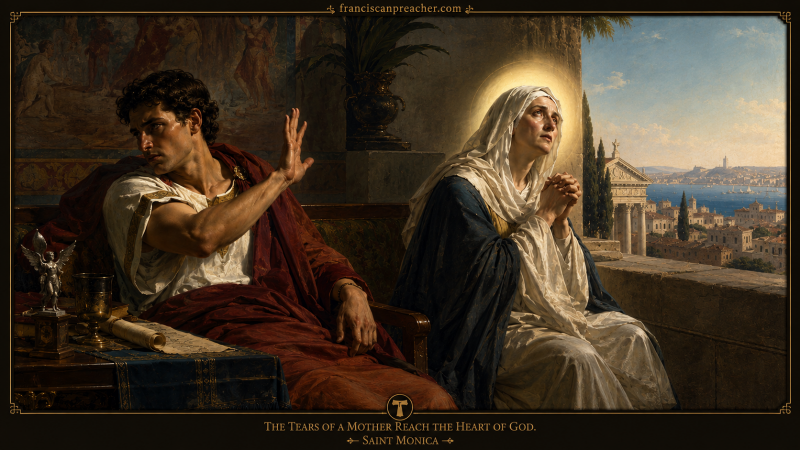
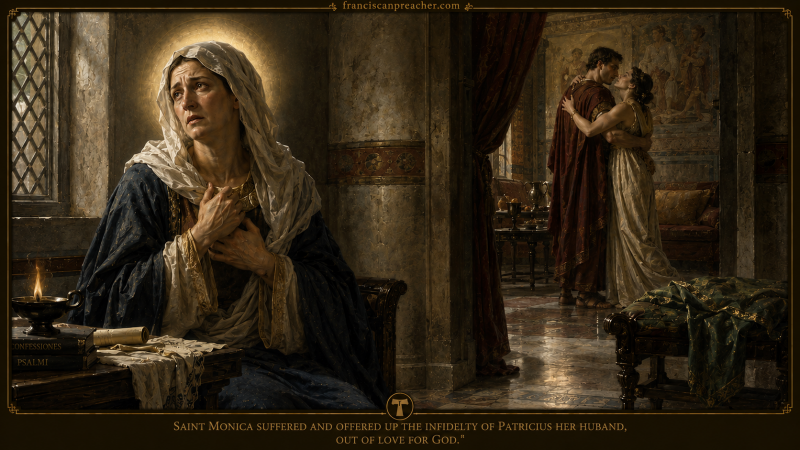
Then we hear from the book of Sirach, “A worthy wife brings joy to her husband, peaceful and full is his life” (Sirach 26:2). Saint Monica's own marriage was anything but easy. Her husband, Patricius, was a pagan and was known for his volatile temper and marital infidelity. And so you already have a woman that is heartbroken in Saint Monica, and yet nevertheless Saint Augustine tells us that Monica patiently endured her husband's faults without responding to his anger with anger.
Then we read on in the reading for today from Sirach. “A good wife is a generous gift bestowed upon him who fears the Lord” (Sirach 26:3). Saint Monica's influence eventually bore remarkable fruit. Patricius ended up becoming a Christian, and he was baptized shortly before his death, traditionally dated around 371. Her perseverance, therefore, concerned not only Saint Augustine, but also the conversion of her husband. This is an important point that many of us forget in the retelling of her beautiful story.
“A gracious wife delights her husband; her thoughtfulness puts flesh on his bones” (Sirach 26:13). Look at how beautifully Sirach describes the blessing of a good mother, a good wife.
St. Augustine records something particularly striking about Monica's marriage. Other wives, her friends, wondered how she endured Patricius' temper without suffering the domestic conflicts they experienced. St. Monica explained to them that from the moment she heard the marriage contract read, she regarded it seriously and learned not to confront her husband's anger while he was angry, but to speak when calm had returned.
So important for us, right? We get caught up in the heat of the moment. And yet St. Monica tells us to take a step back, take a breather, let things settle, and then you address it when things get calmer.
The reading goes on, “A gift from the Lord is her governed speech, and her firm virtue is of surpassing worth” (Sirach 26:14). Right? How often today do we speak with a language which revolves around rights? It's my right. It's my right. It's my body. I do what I want. I do what I wish.
There needs to be a language of virtue. What is your concern? Let me help you. What are you going through? Let me spend some time with you. Do you need some help? Let me give you some assistance. Let me retain my purity for the sake of retaining a good relationship with my spouse, my Lord, my God. So her firm virtue is of surpassing worth, to focus on a life of virtue.
In the Gospel, we move from the image of the holy wife to the image of a suffering widow, the suffering of a mother over her deceased son. And the unnamed woman of Nain weeps for a son who is physically dead, yet Monica wept for a son whom she regarded as spiritually lost. Monica too became a widow, and the destiny of her son became the great burden of her heart.
We're told in the Gospel that a large crowd from the city was with this widow. But when the Lord saw her, he was moved with pity, and said to her, “Do not weep” (Luke 7:13). The initiative comes entirely from Jesus. Notice that the widow did not ask him for a miracle. Luke says that the Lord sees her suffering and is moved with compassion.
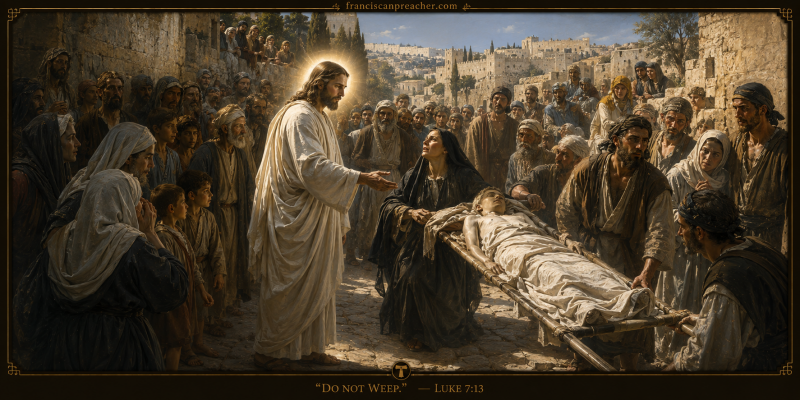
This offers an important connection with Saint Monica. Before Saint Augustine began seeking to live the spirit of Christ more deeply, Christ was already seeking Augustine. Monica's tears participated in a grace that had already begun moving toward her son.
Jesus says to the young deceased man, “Young man, I tell you, arise” (Luke 7:14). Jesus does not pray for the young man to rise. He commands him directly. Saint Luke is revealing something greater than prophetic intercession here. But Jesus has mastery, power over death. He is God in our midst. And this is what Saint Augustine recognized and gave his entire life as a consequence to promulgating, evangelizing, preaching in the world within which God had placed him.
There's a beautiful connection we can make as well with Saint Francis and his own mother. How important it is when we think of our mothers, how beautiful a gift they are to us.
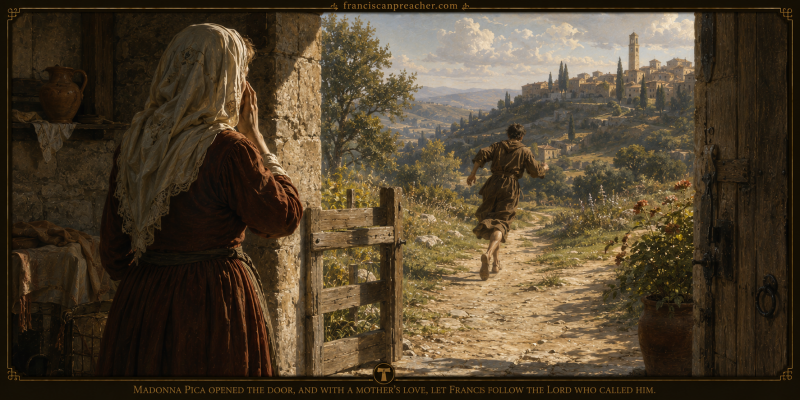
Francis's mother was traditionally known as Pica, often called Madonna Pica, Lady Pica. The early sources tell us far less about her, much more about his father, Pietro di Bernardone. But we know that his father was very severe with him at his conversion, even locked him up in the house. But while Pietro was away, she released Saint Francis and allowed him to return to the service of God.
This gives us a very powerful connection with Saint Monica. Monica loved Augustine enough to pursue him with tears and prayer until he found God. Saint Francis's mother faced almost the opposite situation. Her son had already been seized by God, and she loved him enough eventually to release him.
Pietro, his dad, tried to restrain Francis, but his mother opened the door and allowed him to follow the inspiration of the Lord in his heart.
Let us pray for all those who feel a vocation to consecrated life, so that their parents may be supportive, encouraging, grateful, on such a spiritual level so as to give them great joy that one of their children is being called.
Not every priest or sister in the world, or religious, has had that blessing to have the support of his parents. I myself know many friars and priests who are actually shunned by their parents, who had nothing to do with them. For various reasons, they had a huge animosity towards the priesthood, and the thought of their son renouncing marriage, which would have continued their family name and line, was repulsive to them.
And so, my brothers and sisters, pray. Pray for those who feel a calling and for their parents. And pray for all mothers so that the Lord will continue to bless them and through them bless us all.
Saint Monica, pray for us.
In the name of the Father, and of the Son, and of the Holy Spirit, Amen.
Go in peace.
Lectionary: 632
Below are the readings suggested for today's Memorial. However, readings for the Memorial may also be taken from the Common of Holy Men and Women, #737-742.
Blessed the husband of a good wife,
twice-lengthened are his days;
A worthy wife brings joy to her husband,
peaceful and full is his life.
A good wife is a generous gift
bestowed upon him who fears the LORD;
Be he rich or poor, his heart is content,
and a smile is ever on his face.
A gracious wife delights her husband,
her thoughtfulness puts flesh on his bones;
A gift from the LORD is her governed speech,
and her firm virtue is of surpassing worth.
Choicest of blessings is a modest wife,
priceless her chaste soul.
A holy and decent woman adds grace upon grace;
indeed, no price is worthy of her temperate soul.
Like the sun rising in the LORD's heavens,
the beauty of a virtuous wife is the radiance of her home.
Gospel
Jesus journeyed to a city called Nain,
and his disciples and a large crowd accompanied him.
As he drew near to the gate of the city,
a man who had died was being carried out,
the only son of his mother, and she was a widow.
A large crowd from the city was with her.
When the Lord saw her,
he was moved with pity for her and said to her,
"Do not weep."
He stepped forward and touched the coffin;
at this the bearers halted,
and he said, "Young man, I tell you, arise!"
The dead man sat up and began to speak,
and Jesus gave him to his mother.
Fear seized them all, and they glorified God, exclaiming,
"A great prophet has arisen in our midst,"
and "God has visited his people."
This report about him spread through the whole of Judea
and in all the surrounding region.
Add comment
Comments