Today, we celebrate the memorial of Saint Bernard of Clairvaux, who was born in Burgundy, France, in 1090, and entered the Cistercian monastery of Citeaux as a young man, bringing with him a remarkable number of relatives and companions. Imagine that, usually an individual enters religious life on their own, knocking at the doorstep of one congregation or another. And yet St. Bernard arrives with his relatives and companions.
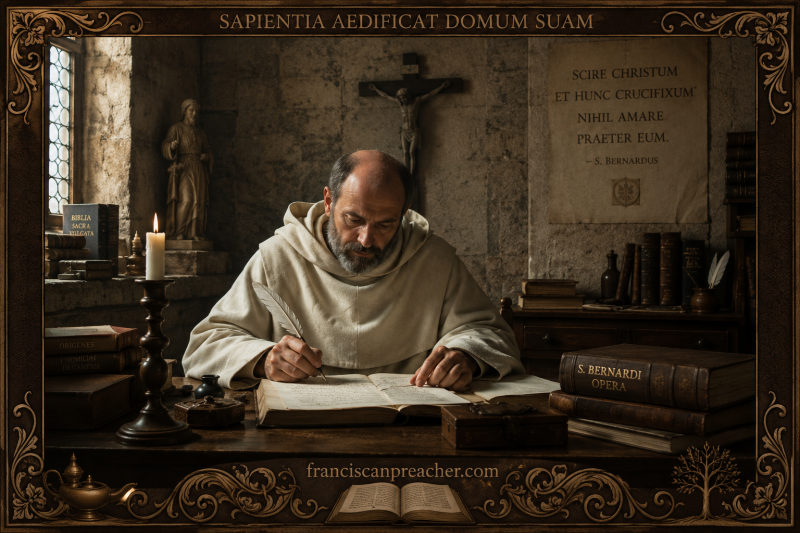
In 1115, he was sent to found a new monastery at Clairvaux, where he became abbot and remained for the rest of his life. Bernard became one of the most influential spiritual figures of the 12th century. A preacher, theologian, advisor to popes and rulers, defender of the church, and above all, a man deeply devoted to Christ and the blessed Virgin Mary.
His writings are marked by a profound understanding of Scripture and by his conviction that true knowledge of God must lead to love. He died in 1153 and was later declared a Doctor of the Church.
In the first reading that is given to us for his memorial from the Book of Syrac, We have presented for us wisdom, almost as a mother and bride who welcomes the person who fears the Lord and faithfully seeks him. And I quote, “Nourish him with the bread of understanding, and give him the water of learning to drink” (Sirach 15:3).
Now, we know from other parts of the Book of Wisdom and the Book of Proverbs that wisdom is not something that is merely learned naturally through the sciences, through education. But it comes to us from above. In fact, we here declared in Scripture, “The beginning of wisdom is fear of the Lord,” fear of the Lord (Proverbs 9:10).
In other words, you can have a genius, but if he's an atheist, he doesn't possess wisdom. Because when you discount the existence of God, you're basically doing away with the greatest part of reality and living in a delusion.
Now, this describes St. Bernard remarkably well because, although one of the great intellectual figures of his age, Bernard did not pursue knowledge simply for its own sake. For him, wisdom was born from prayer, from scripture, from contemplation, from humility, and love of God.
He immersed himself so deeply in the Bible that its language is seen all over his writings and sermons. Cirac promises that wisdom “will open his mouth and fill him with the spirit of wisdom and understanding” (Sirach 15:5). St. Bernard's extraordinary preaching and spiritual writings became precisely such a gift of wisdom to the Church, earning him the title Dr. Melliflou. Melliflus, the Honey Sweet Doctor.
In today's Gospel, Jesus prays that His disciples “may all be one, as you, Father, are in me and I in you” (John 17:21). And he concludes with the desire that the Father's love may be in them, and that he himself may dwell in them (John 17:26).
This longing for communion with God stands at the very heart of St. Bernard's journey and spirituality. For St. Bernard, the Christian life was not merely knowing things about God, but coming to love God so completely that the human heart becomes increasingly united with Him.
My dear brothers and sisters, we have so many opportunities that are given to us in order to unite ourselves more closely to our Lord. First and foremost, is prayer, the time we set aside for placing ourselves in God's presence.
But in order to pray, like St. Barnabas writes in his early Christian writings, and as we hear from the apostles as well in the New Testament, we need to pray with a clean conscience. So another gift that is given to us in order to unite closer to God is the sacrament of reconciliation.
To be reconciled with God, where he cleans our conscience, so that we can communicate with him and with others in a way that He has ordained with love, with trust. We place our faith in Him because we know that he is the source of all our healing, our forgiveness, our joy, all things that are good.
Through the intercession of Saint Bernard, may the Lord who comes to us in the Eucharist every day, find within you a house of peace. The temple prepared for His Sacred Heart.
In the name of the Father, and of the Son, and of the Holy Spirit.
Add comment
Comments