In today's readings, we have a very serious reminder of God's love, but how that love often can entail justice. A justice which in then culminates in God's mercy, which in turn is extended by His command to others. In the first reading from the prophet Ezekiel, we see that the prophet is already in Babylon when he performs this prophetic action. Because the people of God do not forget were exiled in phases. And he was among the Jews that were deported to Babylon in the first major deportation of 597 BC, when King Jehoiakin, members of the Royal Court, craftsmen, soldiers, and other prominent Judeans were taken away by Nebuchadnezzar. So he takes away the governing body, so to speak, first. As Ezekiel chapter 1 places the prophet explicitly among the exiles. And I quote, “By the river Chebar in Babylonia” (Ezekiel 1:1-3).
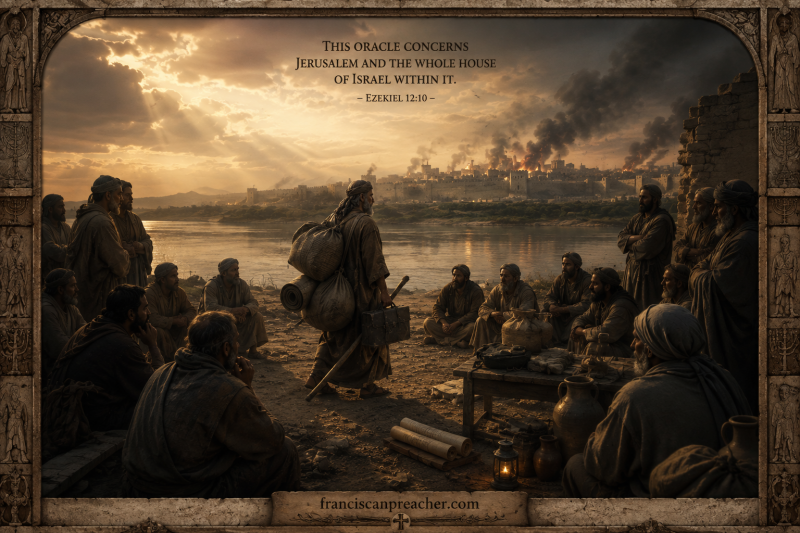
So in Ezekiel 12, from which we have today's first reading, something fascinating is happening. Ezekiel is already an exile, living among the exiled Jewish community in Babylon. But he acts out what is still going to happen to those remaining in Jerusalem. He packs his baggage. He walks out as though being driven into exile. He digs through the wall. He shoulders his burden. He goes out into the darkness, and the other exiles in Babylon are watching him thinking essentially, What is he doing?
God then explains, “This oracle concerns Jerusalem and the whole house of Israel within it” (Ezekiel 12:10). In other words, what you are watching Ezekiel do here in Babylon is what is about to happen to your brothers and sisters back in Jerusalem. And especially to King Zedekiah, the prince of Ezekiel 12:12.
The chronology is important. In 597 BC, Jerusalem is captured. Jehoiakin and many Judeans, including Ezekiel, are deported to Babylon. Then, four years after, in 593 BC, Ezekiel begins his prophetic ministry among the exiles in Babylon. By the time we get to Ezekiel chapter 12, he is warning that Jerusalem's remaining inhabitants and ruler will also experience exile.
Then in 586 BC, seven years later, Jerusalem falls completely. The temple is destroyed. Zedekiah attempts to escape at night. He's captured and his sons are murdered, executed, right in front of his eyes. And it's the last thing he will ever see. Because Nebuchadnezzar would pluck out Zedekiah's eyes before he is taken into exile into Babylon.
That makes Ezekiel's strange performance much more powerful. He is standing in Babylon acting out Jerusalem's future before it actually happens. And there's another important dimension. Because some of the first exiles apparently hoped that their exile would be brief and that Jerusalem would survive. Ezekiel's message is devastating to that false hope. The judgment is not over. Jerusalem itself is going to fall.
So when God says, “Perhaps they will see that they are a rebellious house” (Ezekiel 12:3), he is speaking to people who have already experienced catastrophe, but still have not fully understood why it happened.
By the time we get to the gospel, we are seeing Peter who's asking how many times he ought to forgive. In other words, he's holding on to things, things that God wishes he would see. How many times do we hold on to things and the Lord just wishes we could see that there's a better way, there's a better way the way of faith, the way of penance, the way of sacrifice, mortification. But we remain blind, obstinately blind.
Same too, our Lord says to Peter, Forgive always. Why? Because God has forgiven you every single time you have asked him. And so Jesus, in answering Saint Peter, he says, “I say to you, not seven times, but 77 times,” always (Matthew 18:22).
And then Jesus goes on with the beautiful parable about the debtor who owed a huge amount to the king. He had no way of paying back that amount, "... and so his master ordered him to be sold along with his wife, his children, and all his property. And at that the servant fell down, did him homage and said, “Be patient with me, and I will pay you back in full.” Moved with compassion, the master of that servant let him go and forgave him the loan (Matthew 18:25-27).
But when that servant had left, he found one of his fellow servants who owed him a much smaller amount. He seized him and started to choke him, demanding “Pay back what you owe.” And falling to his knees, his fellow servant begged him, “Be patient with me and I will pay you back.” But he refused. Instead, he had the fellow servant put in prison until he paid back the entire debt (Matthew 18:28-30).
Now when his fellow servants saw what had happened, they were deeply disturbed and went to their master and reported the whole affair. His master summoned him and said to him, “You wicked servant, I forgave you your entire debt because you begged me to. Should you not have had pity on your fellow servant?” (Matthew 18:32-33).
My brothers and sisters, how many times do we go to confession? We beg God for mercy. He gives it to us through the ordained priest who has been given that ministry to extend to us God's mercy? When we leave the confessional, do we leave harboring anger towards somebody else? Do we leave expecting recompense from those who owe us an apology?
So we are asked to open our eyes, to reason, to think before we act, so as not to lose our sight entirely like Zedekiah, who refused to acknowledge his sin. And when we do not forgive, we are equally remaining blind in the eyes of God, not acknowledging the sin that we know that we have committed before him.
My brothers and sisters, may the Lord give you the courage the faith, and the strength to be able to listen to His Word, to open our eyes, and to follow Him who guides our way.
In the name of the Father, of the Son, of the Holy Spirit, Amen.
Add comment
Comments