Saint Peter Chrysologus, which means Peter of the Golden Words, is one of the most important yet often overlooked Fathers of the Western Church. He was not a speculative theologian like Saint Augustine, but rather he was a master preacher whose gift was explaining profound doctrine in simple language that ordinary Christians could understand. This is precisely why Pope Benedict XIII declared him a Doctor of the Church in 1729.
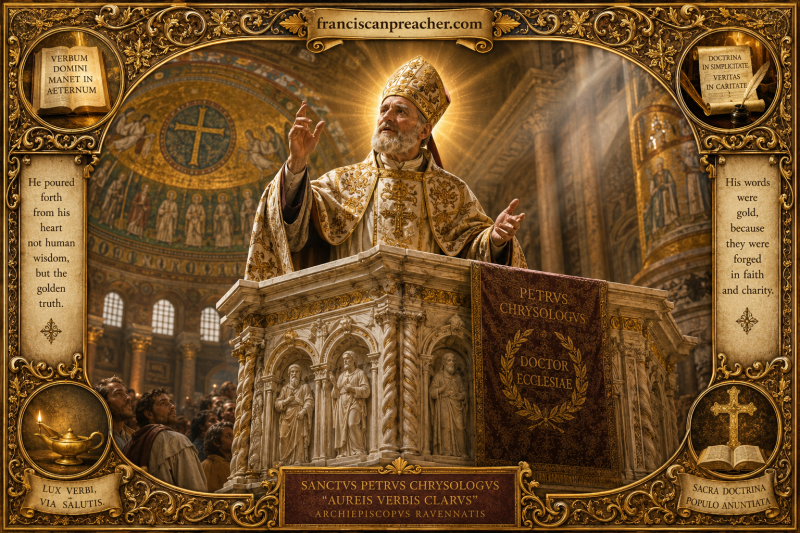
Who was Saint Peter Chrysologus? We're not quite sure of the date of his birth, but it is approximately between 380 and 406 AD. He was born in Imola, northern Italy, and he was ordained by Bishop Cornelius of Imola. He became the Bishop of Ravenna in 433.
Who else did we hear this week had become the first bishop of Ravenna, having been sent there by Saint Peter himself? If you will recall, Saint Apollinaris made the journey north, and there he became the first bishop of Ravenna. Well, one of Saint Apollinaris's successors is, in fact, Saint Peter Chrysologus.
Ravenna was then the capital of the Western Roman Empire. And so this made him one of the most influential bishops in the West, after, of course, the Bishop of Rome. He died around AD 450, probably back in Imola. Of approximately 183 surviving sermons, about 168 to 176 are considered authentic, making him one of the best-preserved Latin preachers of the fifth century.
Why is he called Chrysologus? The Greek title Chrysologus means golden-worded or golden speaker. Tradition tells us that Empress Galla Placidia bestowed the title after hearing his remarkable preaching. Unlike Saint John Chrysostom, the Golden Mouth, Peter intentionally kept his sermons brief, believing people should leave remembering the Gospel rather than the preacher. This is also our goal here at franciscanpreacher.com. We hope that you leave our site reflecting on the Gospel.
What are his major contributions to Catholic theology? First and foremost, the Incarnation. His greatest theological contribution was explaining that Christ truly became man without ceasing to be God. One of his most incredible statements was this, and I quote: “The Creator is in His creature, and God is in the flesh, bringing dignity to man without dishonour to Him who made him.”

He continually returned to this mystery. God truly became man. Christ possesses both a complete divine nature and a complete human nature. The Incarnation elevates human dignity because God visited our humanity and assumed unto Himself a human nature. This emphasis prepared the Church for the great Christological definitions that culminated shortly afterwards at the Council of Chalcedon.
Another major contribution from Saint Peter Chrysologus was his defence against Monophysitism. One of his greatest historical contributions came during the controversy surrounding the monk Eutyches. After Eutyches was condemned for teaching that Christ possessed only one nature after the Incarnation, Peter wrote him an extraordinary letter.
Instead of setting himself above Rome, he wrote, and I quote: “We exhort you in every respect, honourable brother, to heed obediently what has been written by the most blessed Pope of the city of Rome. For blessed Peter, who lives and presides in his own See, provides the truth of faith to those who seek it.”
Now, my brothers and sisters, this sentence has become one of the strongest patristic witnesses to the authority of the Bishop of Rome, to the Petrine succession, and to the doctrinal unity of the Church.
He taught that Christ's mysteries are entrusted, in fact, to the Church that He Himself instituted. One beautiful passage states: “In the Holy Catholic Church, neither are the members separated from the head, nor the spouse from her husband.” This expresses the Church as the Mystical Body of Christ, the Bride of Christ, inseparable from her Lord.
Finally, his greatest contribution also surrounded the Eucharist. One of his most famous passages reads: “He is the bread sown in the Virgin, leavened in the flesh, moulded in His Passion, baked in the furnace of the sepulchre, and then placed upon the altars, and daily supplies heavenly food to the faithful.”
My brothers and sisters, few Fathers describe salvation history through the imagery of bread more beautifully than this.
He also spoke about the universal priesthood and human dignity. One of his most beloved quotations is this: “Why then, man, are you so worthless in your own eyes and yet so precious to God?” He continues by asking why we spend so much effort wondering how we were created instead of why we were created. This theme runs throughout his preaching.
He also gives us a lot of Marian insights, as he preached extensively on Our Lady. One beautiful line reads: “The gentle maiden, having lodged God in her womb, asks as its price peace for the world, salvation for the lost, and life for the dead.” Mary is presented as the Mother of God, an intercessor, the New Eve, and the instrument of peace and salvation.
My dear brothers and sisters, themes that you're therefore going to find throughout his sermons concern the mystery of the Incarnation, Christ's two natures, the Cross as the supreme revelation of divine love, daily conversion, mercy before judgment, the unity and authority of the Church, the dignity of every baptized Christian, the Eucharist as heavenly nourishment, the Virgin Mary in salvation history, and Scripture as God's living voice to the Church.
Perhaps the most moving summary of his spirituality is this: “My body was stretched upon the Cross, not merely to show how much I suffered, but to reveal the measure of my love.”
That single sentence beautifully captures the pastoral heart of Saint Peter Chrysologus. Every doctrine he preached, whether the Incarnation, the Eucharist, or the Church, was ultimately meant to lead people to encounter the boundless love of Christ.
Through his intercession, may Almighty God bless you, the Father, the Son, and the Holy Spirit. Amen.
Add comment
Comments