The Book of Isaiah spans a long period of Israel's history, my brothers and sisters, and it is generally divided into three sections. Today's reading comes from what scholars commonly call the Isaiah Apocalypse, that is, the chapters of the Book of the prophet Isaiah from 24 to 27. And these are a collection of prophetic poems that look beyond the immediate historical crisis, the historical crisis of Judah, toward God's final victory over evil and the ultimate restoration of His people.
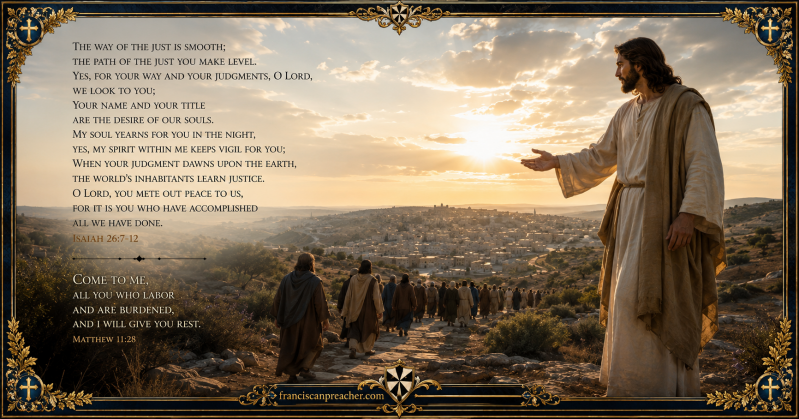
The prophet is Isaiah, who exercised his ministry primarily during the reigns of Kings Uzziah, Jotham, Ahaz, and Hezekiah, approximately forty years from 740 to 700 BC. Isaiah witnessed the rise of the Assyrian Empire, the destruction of the northern kingdom of Israel in 722 BC, and the continual threat posed to Judah. While much of Isaiah addresses immediate political and spiritual circumstances, chapters 24 to 27 lift the reader's gaze beyond history itself to God's final judgment and salvation.
So why was it written?
Israel had repeatedly experienced disappointment. Military alliances had failed. Human kings that they so desperately wanted had failed. Political strategies that we read about all over the Old Testament had failed. Even Israel's own efforts at righteousness had failed.
Today's reading expresses the prayer of a faithful remnant who have finally learned that only God can save. Notice the contrast. And I quote: “We conceived and writhed in pain, giving birth to wind.” (Isaiah 26:18) In other words, we tried through our own strength to bring about peace and salvation but produced nothing.
But then comes one of the Old Testament's most remarkable declarations: “Your dead shall live, their corpses shall rise.” (Isaiah 26:19)
My brothers and sisters, this is one of Scripture's clearest and earliest affirmations that death will not have the final word. Death, which ultimately is described as Jesus's last and final enemy in the New Testament. Because, my brothers and sisters, think about it. He can save us from a ruthless dictator, a murderous mob, an accident even. But unless He saves us from death, what is it all worth?
He can save us from an illness. We can live a few years longer. But ultimately, if we face death and that is our final end, we are to be pitied among all the creatures on the face of the earth, because we have hoped in the resurrection.
Saint Paul speaks about this when he speaks about how if the dead do not rise, and if Jesus has not been risen from the dead, who is a sign of this rising from the dead, then our faith, all of it, going to church, the sacraments, living a good life, all of it ultimately ends up in nothing.
And this is the greatest nightmare for the atheist. The atheist dreads the last breath because in the atheist's mind that's it. It's finished. It's all over. You shut your eyes, and it's darkness that you will not experience, you will not feel. You simply vanish.
How sad a worldview can that be? A view where there is no hope, no promise, no saviour.
The famous poet and genius by the name of Philip Larkin wrote amazing poetry. And yet he did not believe. And so all his poetry took on a very dark, sad, and gloomy tone. He ultimately ended up losing his mind because he so dreaded dying. The prospect of death so terrified him that he could neither sleep nor function normally.
My brothers and sisters, in today's Gospel, Saint Matthew in the eleventh chapter marks an important turning point. Jesus has just experienced widespread rejection. Remember, John the Baptist has sent disciples from prison asking whether Jesus is truly the Messiah. And Jesus praises John. The crowds remain indifferent. The Galilean cities, Chorazin, Bethsaida, and Capernaum refused to repent despite witnessing countless miracles.
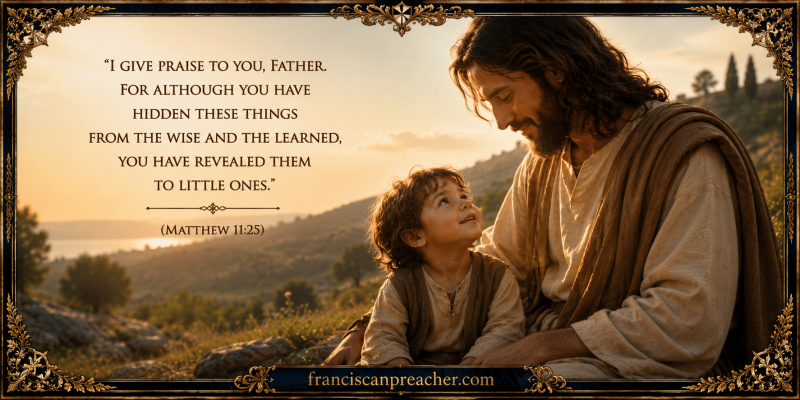
Immediately before today's Gospel, Matthew chapter 11, verses 25 to 27, Jesus offers His beautiful prayer: “I give praise to you, Father. For although you have hidden these things from the wise and the learned, you have revealed them to little ones.” (Matthew 11:25)
Only then does He extend His invitation from today's Gospel: “Come to me.” (Matthew 11:28)
The invitation therefore comes immediately after rejection.
Jesus speaks about the yoke. What is the yoke? Is it the yoke of an egg? No.
For a first-century Jew, the word yoke immediately suggested several ideas. A yoke was the wooden beam joining two oxen. The yoke was a common Jewish image for obedience to God's law. The yoke was often used by rabbis to describe submission to the Torah.
Jesus does not abolish the yoke. Instead, He replaces the crushing burden imposed by legalism with His own. His yoke is still discipleship, but discipleship rooted in love rather than fear.
A number of the early Church Fathers commented on this Gospel. And they give us some pretty deep and beautiful insights that we can ponder ourselves.
Saint John Chrysostom, for example, observes that Jesus does something very extraordinary. He does not merely command. He invites. Christ does not say, "Serve me." Instead, He says: “Come to me.” (Matthew 11:28) It's a gentle invitation, which reveals God's tenderness.
Saint Augustine understands the burden of the yoke primarily as the burden of pride. Pride exhausts our human hearts, my brothers and sisters, because through pride we fall into so many sins and we struggle and we bring heaviness into our lives. Humility gives rest.
Therefore Christ says: “Learn from me.” (Matthew 11:29) Notice what Jesus does not say. He does not say, "Learn to create the world. Learn to raise the dead. Learn to perform miracles." No. He says: “Learn from me, for I am meek and humble of heart.” (Matthew 11:29)
Saint Augustine remarks that humility is the foundation of all Christian discipleship.
So if we want to rest in Christ, let us be humble, my brothers and sisters, and taste and see the goodness and tenderness of God.
Add comment
Comments