My dear brothers and sisters in Christ, peace be with you. Today we celebrate the beautiful 34th Sunday in Ordinary Time, which is the solemnity of Our Lord Jesus Christ, King of the Universe. And my friends, we reflect today on how this King is different from any other king that we may know in history, or that we may have admired through the telling of numerous stories about numerous kingdoms. But this is the King of kings and the Creator of all things. And we're going to see how his kingdom is revealed to us not through power so much, but through love, mercy, and the victory over death. So a different kind of power, not worldly power.
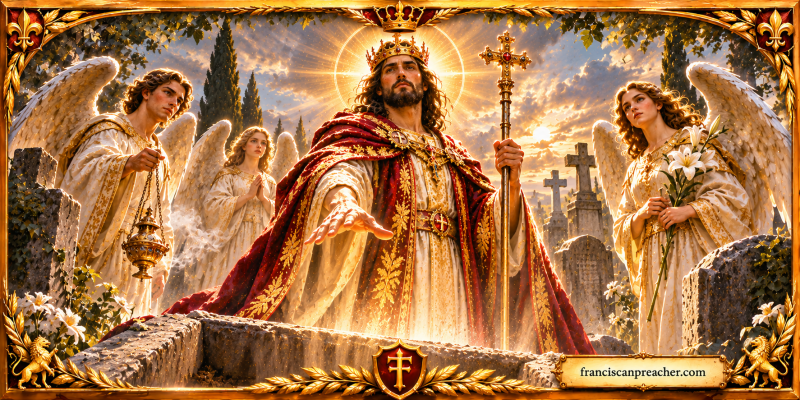
And this is the point, my brothers and sisters, that in the Old Testament, the people of God, under the guidance of the prophet Samuel, through that prophet asked God Almighty, the King of kings, for a king. Imagine that. They wanted a king, they said, like every other nation. And God was, to put it in human language, grieved. Grieved because he is the King. How could you want any other king when you have God as your King? And my brothers and sisters, this is the first message that perhaps the Lord is passing on to each of us. We have the greatest of all kings in our heavenly Father, our Lord Jesus Christ, and the Holy Spirit. How could we replace him with so many other things and so many other gods? And idolatry becomes almost second nature in each and every one of us, replacing Him for this and for that, and for so many things that not only cannot give us what He gives us, but cannot love us the way He loves us. That emptiness that we each have in our hearts, we try to fill with so many transient things, but it is only God who can fill our hearts.
In today's first reading from the book of the prophet Ezekiel, God promises personally that he himself would shepherd his scattered people. He'd rescue the lost, he'd heal the wounded, and judge his flock with justice. In other words, those things that the earthly kings cannot do, that his Old Testament people asked and begged for, he himself will come and will do. “The lost I will seek out, the strayed I will bring back, the injured I will bind up, and the sick I will heal” (Ezekiel 34:16). Now, my brothers and sisters, this prophecy finds its perfect fulfillment in the coming among us of the Second Person of the Divine Trinity, Jesus, the Master of the Seas, who comes to us humble and lowly, born in an abandoned cave, and at the age of 33 riding on the humble donkey entering triumphantly into Jerusalem.
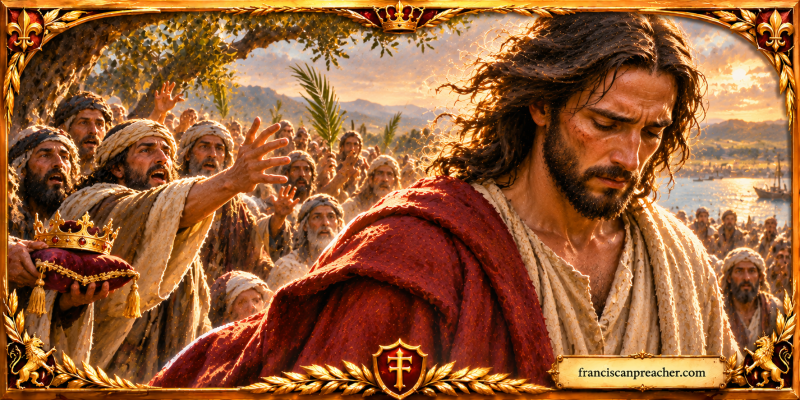
He always chose humility, so much so that after he multiplied the loaves and the fish, and the people were shocked, and they gave praise and thanks to God, they wanted to grab Jesus and make him a king. Now think of what could be wrong with that. So they're taking him who is already a King beyond any other king, but they want to make him a human king. In other words, they unknowingly thought they were wanting to give him a promotion. But in reality they were giving him a demotion. The King of kings humbled himself to be in our midst, and then you want to humble him even more by making him an earthly king? So limited, not only in what he can do, but in the way he can love us. And so we're told that Jesus, distressed at this pleading of theirs, walks through their midst and vanishes out of their sight. Jesus rejects earthly glory. Of course he would, because he knows what heavenly glory is. And that is the kind of glory he is asking us to aspire to: to not place our hearts, our trust, our attachment, in earthly things that pass, but rather to secure our eternal destiny.
Saint Paul, in his first letter to the Corinthians, says to us in today's second reading that Jesus' “last enemy to be destroyed is death” (1 Corinthians 15:26). Precisely, my friends, other kings wanted to conquer other kingdoms, and they would set their people free only for a time, until each and every individual had to face the reality of the grave. But Jesus rides into battle to conquer that final enemy for each and every one of us, kings and queens included. For at the end of the day, no matter how healthy we have been, how protected we may have found ourselves, we will still have to face the inevitable reality of the grave. There's only one way we might be spared seeing the grave, and that is if we're still alive when Jesus returns in glory, which is what the Gospel of today is hinting at: that Christ will return in glory as the universal King and Judge.
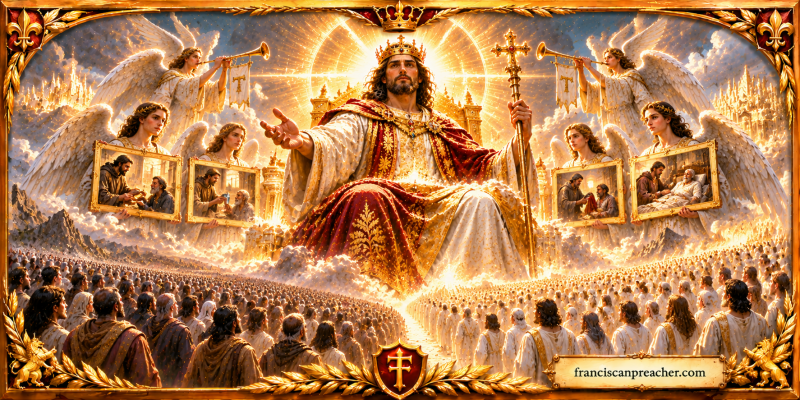
And he told us what he will do. He will separate the righteous from the wicked according to their response to the hungry, the thirsty, strangers, those who needed clothing, the sick who needed healing, the imprisoned who needed visiting. And he will say to the righteous on that day, “Amen, I say to you, whatever you did for one of the least brothers of mine, you did it for me” (Matthew 25:40). My brothers and sisters, may we respond as the saints did, saints like Saint Francis of Assisi, who says in his Testament that he was moved to grace to reach out to those who were unfortunate. And he writes, “And the Lord himself led me among them, and I showed mercy to them.” Well, we know from today's Gospel that Jesus, when Saint Francis' spirit descended to his throne, said to him, “My good and faithful servant, come, enter the kingdom prepared for you from the foundations of the world, for I was hungry and you gave me food. I was thirsty, you gave me to drink. I was imprisoned, and you took the time. Come, my good and faithful servant.” My brothers and sisters, may that be the sweet invitation to all of us here at the end of our earthly pilgrimage.
Add comment
Comments