My dear brothers and sisters in Christ, peace be with you on this 29th sunday in ordinary time. And today's readings remind us that God is Lord over all creation over all human history and over our own very lives. Through the prophet Isaiah, God shows us that he can accomplish his purposes even through those who do not know him. Saint Paul reminds us that faith must become visible through love and action and then in the gospel Jesus makes a profound distinction between our earthly responsibilities and what we owe to God. The central question is, if everything comes from God, what do we truly owe him?
In the first reading we hear God almost speaking to Cyrus the second, the king of Persia, who reigned from 559 to 530 BC that's 29 years. And God says, “I have called you by your name, giving you a title though you knew me not” (Isaiah 45:4). king cyrus the second conquered babylon in 539 b c and subsequently permitted the jewish exiles there to return to their homeland and rebuild the temple in Jerusalem. Remarkably, Isaiah calls this pagan king God's anointed. God uses him as an instrument of liberation even though Cyrus does not worship the God of Israel.
My brothers sisters, this is so important for us to remember that God's providence extends beyond the visible boundaries of his people. He can work through rulers, nations, and individuals who do not even recognize him. Because when I say his people I mean the new Israel of God, the new people of God, molded and sustained within the new covenant of the precious blood of Jesus. God remains sovereign over all human history, human circumstances, even the evils of the world and no earthly authority is independent of his ultimate lordship. So remember that when you see all the craziness that's happening around us when every political leader seems to fail its citizens. seems to be enticed and hypnotized by self gain. Remember that God is still in charge. And he can still use such people, just as he used king Cyrus, who wasn't even worshipping him.
In the second reading we hear from Saint Paul's first letter to the Thessalonians, where he says, “unceasingly calling to mind your work of faith and labor of love and endurance in hope of our Lord Jesus Christ” (1 Thessalonians 1:3). So Saint Paul describes three characteristics of genuine christian discipleship here faith that works, love that labors, and hope that perseveres. So we see my brothers and sisters that belonging to God cannot remain some abstract religious ideal and then we get on with the realities of our normal everyday life no. Our belonging to God must become visible in our daily conduct, our responsibilities, and the way we serve others. Through love faith and hope.
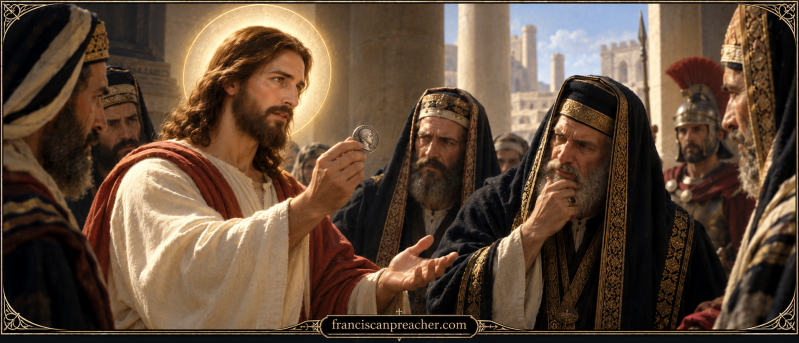
In the gospel we hear Jesus ask “whose image is this and whose inscription?” (Matthew 22:20). And then Jesus's response to this question is “then repaid to Caesar what belongs to Caesar and to God what belongs to God” (Matthew 22:21). You see he goes far beyond a question about taxation the roman coin yes bears caesar's image but whose image do we bear in our souls? Genesis tells us in Genesis chapter one verse 27 “God created mankind in his image” (Genesis 1:27). The coin therefore bears Caesar's image, but the human person bears God's image, and Caesar was a human person. So Caesar too owes to God. therefore, while we owe legitimate civil authorities their due, our lives, our hearts, our conscience, and our ultimate allegiance belong to God.
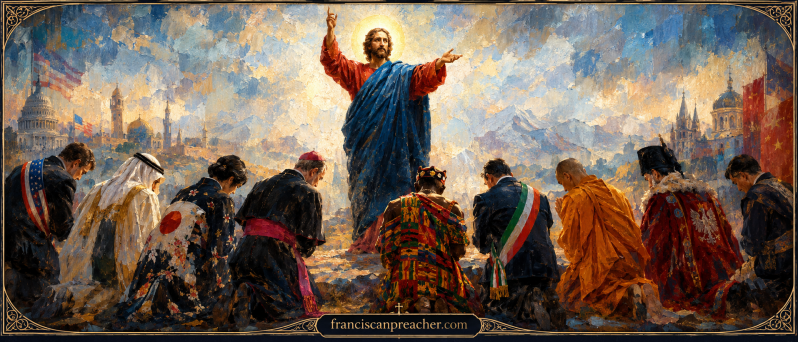
My brothers and sisters, we have to let this sink in a little bit. Jesus is not merely separating religion from politics. He is reminding us that no earthly authority can claim what belongs ultimately to God. And that's what you're going to see happening around you mere human mortal beings trying to dominate over you, taking the place of God, trying to replace God becoming little gods unto them themselves the most extreme form of idolatry.
Saint bonaventure, who was a follower of saint Francis, a Franciscan, once wrote, “If you ask how such things can occur, seek the answer in God's grace.” He says this in his writings entitled The Journey of the Mind into God chapter seven verse six. And here he is reminding us that belonging to God is not simply a matter of intellectual conviction because there's going to be things we won't understand. Mystery is necessarily part of our Catholic faith. Why? Because we are finite and God whom we love whom we adore is infinite. He's beyond our parameters. He's beyond our limitations. He's beyond anything we can ever imagine. So belonging to God requires the surrendering of our hearts to him, to trust him.
King Cyrus unknowingly served God's purposes, whereas we, with conviction and with awareness, serve him and love him and try to get closer to him every day. The thessalons Thessalonians consciously served him through faith, love, and hope, just as we do. And Jesus reveals that we belong to God because we bear his image. We may give Caesar his coins, but we must give God something infinitely more precious. We must give him ourselves.
In the name of the Father, and of the Son, and of the Holy Spirit. Amen. Go in peace to love, and serve The Lord. Thanks be to God.
Add comment
Comments