My dear brothers and sisters in Christ, peace be with you, and a blessed 27th Sunday in ordinary time to you and your families. The image joining today's readings, all three of them, is the vineyard, something carefully planted, protected, and cultivated by God, from which he rightly expects fruit, just as Jesus saw the fig tree in leaf, and therefore expected to find fruit behind those leaves, so too, the Lord behind our exterior righteousness, desires to find a clean heart, that which is honorable and good.
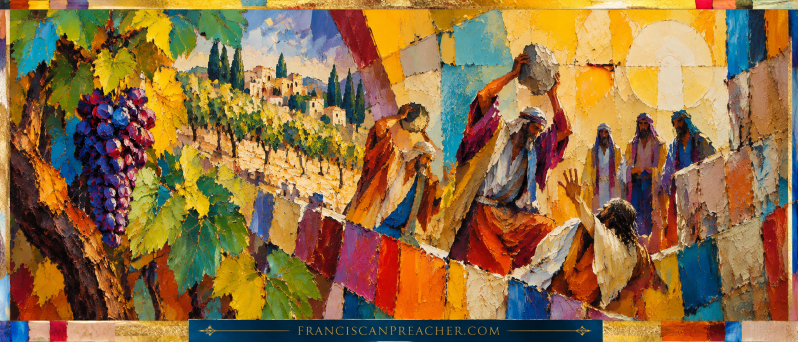
Isaiah speaks in fact of God's disappointment when his vineyard produces only wild grapes. Jesus develops this image further. The problem is no longer only bad fruit, but tenants who begin behaving as though the vineyard belongs to them.
The question running throughout the entire set of readings is therefore simple. What fruit is God finding in the life he has entrusted to me?
Saint Paul gives that fruit a name: whatever is true, honorable, just, pure, lovely, and gracious.
In the first reading from the book of the prophet Isaiah, God laments the fact that he had entrusted his vineyard to his people, and yet no pure fruit was produced. Listen to what he says, “Now, inhabitants of Jerusalem and people of Judah, judge between me and my vineyard: What more was there to do for my vineyard that I had not done? Why, when I looked for the crop of grapes, did it bring forth wild grapes?” (Isaiah 5:3–4).
“What more was there to do?” This is almost the cry of a disappointed love. God is not an indifferent landowner demanding profit. He has given himself, his very self, to his people.
And then he goes on to say, “Now I will let you know what I mean to do with my vineyard: Take away its hedge, give it to grazing, break through its wall, let it be trampled! Yes, I will make it a ruin: It shall not be pruned or hoed, but overgrown with thorns and briars; I will command the clouds not to send rain upon it. The vineyard of the Lord of hosts is the house of Israel, and the people of Judah are his cherished plant. He looked for judgment, but see, bloodshed! For justice, but hark, the outcry!” (Isaiah 5:7).
Isaiah finally tells us what the fruit should have been: justice and righteousness. Religion that produces no transformation in the way we treat others has failed to produce the fruit God desires.
In the second reading from Saint Paul's letter to the Philippians, we hear him exhort the brothers of Philippi in this way: “Brothers and sisters, have no anxiety at all, but in everything, by prayer and petition, with thanksgiving, make your requests known to God. Then the peace of God that surpasses all understanding will guard your hearts and minds in Christ Jesus” (Philippians 4:6–7).
My brothers, notice that Saint Paul reminds us that Christian fruitfulness begins inside the heart. Instead of allowing anxiety to dominate us in our fears, we bring everything to God in prayer. The fruit of this time spent with God is peace that does not depend upon having everything under control.
How often do we obsess about being in control of everything, and we fail to spend the time entrusting it all to God.
Saint Paul goes on to say, “Finally, brothers and sisters, whatever is true, whatever is honorable, whatever is just, whatever is pure, whatever is lovely, whatever is gracious. If there is any excellence, and if there is anything worthy of praise, think about these things” (Philippians 4:8).
Here we hear Saint Paul almost giving us a description of the good grapes God desires. What we repeatedly allow into our minds eventually shapes who we become. Christian discipleship, therefore, includes learning where we allow the mind to dwell.
Saint Paul says, “Think about these things”: truth, honor, justice, purity, love, graciousness, anything that is worthy of praise in the eyes of God. That's the good fruit that we're in search of.
Finally, today's Gospel, where Jesus once again draws upon the analogy of the vineyard. Jesus deliberately echoes Isaiah. Again, everything necessary has been provided, but he introduces another issue. The vineyard is entrusted to tenants. It does not belong to them. This is stewardship.
And he says, “When vintage time drew near, he sent his servants to the tenants to obtain his produce. But the tenants seized the servants, and one they beat, another they killed, and a third they stoned. Again he sent other servants more numerous than the first ones, but they treated them in the same way. Finally, he sent his son to them, thinking, ‘Surely they will respect my son’” (Matthew 21:34–37).
My brothers and sisters, when Jesus speaks about the servants in this parable, he is evoking the prophets, the prophets who were repeatedly sent by God.
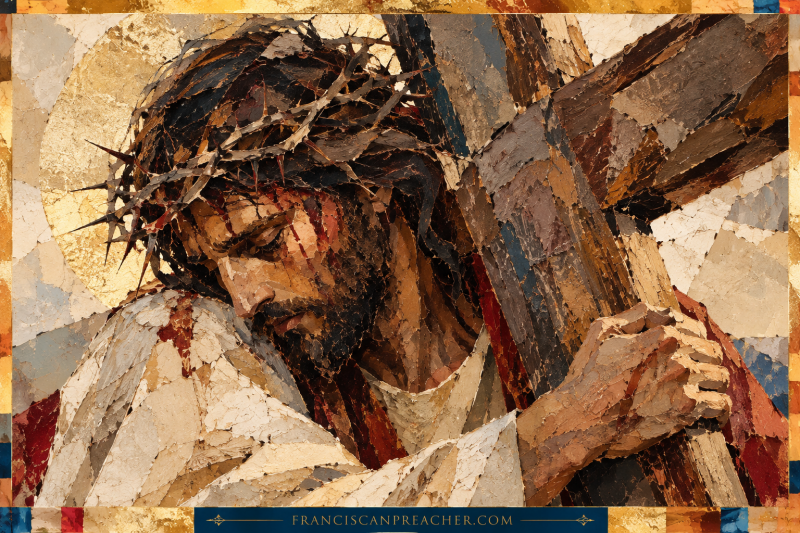
Then comes the extraordinary escalation: “Finally, he sent his son to them” (Matthew 21:37).
Jesus is already revealing what will happen to him and how far the Father's love is willing to go.
The rejected son becomes the cornerstone. Human rejection cannot frustrate God's purpose. Even the cross will become the place where everlasting life is born.
My brothers and sisters, the great sin of the tenants is that they forget one fundamental fact: the vineyard is not theirs. They are tenants who begin behaving like owners.
Saint Francis fought precisely this temptation through his insistence that the brothers live, and I quote, “without anything of their own.”
This meant more than just possessing no property. Francis wanted a deeper interior poverty, a freedom of the heart and spirit which comes through the recognition that ultimately everything belongs to God.
My abilities, my time, my ministry, the people placed in my care, my very life, all of it is entrusted to me.
Saint Francis writes in Admonition number 18, “Blessed is the servant who returns all his goods to the Lord God.”
Isaiah asks, after everything God has done, where is the fruit? And Saint Paul tells us what some of that fruit looks like: “Whatever is true, whatever is honorable, whatever is just, whatever is pure, whatever is lovely, whatever is gracious” (Philippians 4:8), anything in the eyes of God that is commendable.
Let us ask the Lord to give us the grace to be able to live in such a way that the Lord will allow us to produce extraordinary fruit to the glory of His name.
May he bless you and strengthen you.
In the name of the Father, the Son, and the Holy Spirit. Amen.
Add comment
Comments