My dear brothers and sisters in Christ, peace be with you. Today we come to the 24th Sunday in Ordinary Time. Wow, time seems to be flying by, but the Church asks us to pause and consider how important it is that we continue being the people that Jesus asked us to be, and that is a people of mercy, a people who are quick to forgive and slow to harbour anger.
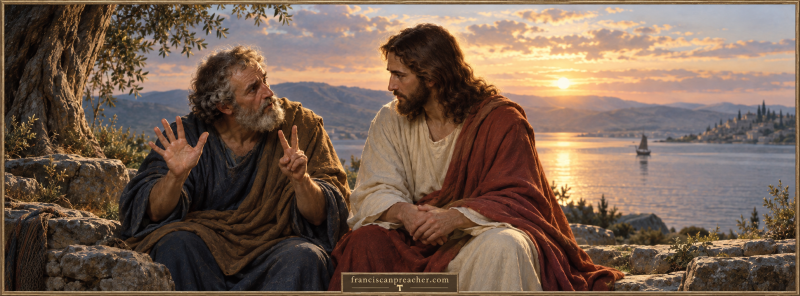
In today's Gospel, Saint Peter famously approaches Jesus and asks him, “Lord, if my brother sins against me, how often must I forgive? As many as seven times?” And Jesus answered and said, “I say to you, not seven times but seventy-seven times” (Matthew 18:21-22).
And our Lord is basically saying we should be ready to forgive always. Now, if we don't succeed, in other words, or if we have trouble, when we see the person and emotions are evoked within us, we can forgive anew. In other words, it's not just a one-time deal. If it takes you seven times, it takes you seven times. If it takes you seventy-seven times, it takes you seventy-seven times. If even after seventy-seven times you're still struggling, keep on trying your best.
Now this is important. Why? Because we are a people who are called to think differently, right?
As we heard in the first reading from the Book of Sirach, we hear the words, the opening line, “Wrath and anger are hateful things, yet the sinner hugs them tight” (Sirach 27:30). Think about how much our Lord stressed that we need to love. We need to love. We need to love everyone.
We have to make sure there is no trace of hate in our hearts and in our minds and in our souls, because in heaven these things do not exist. They will be incompatible with the life of heaven, and we begin our citizenship. We begin to be the people of heaven here and now, through the Lord's grace, through the Lord's power, so that things like wrath and anger that are hateful things shouldn't be a part of our lives.
And that is why we need to forgive, but we need to think differently.
As Saint Paul reminds us in the second reading from his Letter to the Romans when he says, “Brothers and sisters: None of us lives for oneself, and no one dies for oneself. For if we live, we live for the Lord, and if we die, we die for the Lord” (Romans 14:7-8).
In other words, listen to how our mind is transformed in the life-changing presence of the Lord. When we spend time with him, when we meditate and truly chew on his Word, and really digest it in our souls, so it becomes a part of us, there will be no room for hate, wrath, anger.
My brothers and sisters, Saint Francis, as we know, was a saint that was enamoured with peace, with love, with mercy. And for him, forgiveness was not just a feeling that we need to resolve. It was a Gospel decision, refusing to let another person's sin determine what kind of person I will become, and what kind of a person I will be in the eyes of the Lord.
One of the strongest texts that Saint Francis ever wrote was in response to a minister who—and when we say a minister, we're talking about a guardian in Franciscan terminology, a guardian who's appointed to look after the brothers that are within his care—and this guardian wrote a letter to Saint Francis because some of the friars under his care were making his life miserable.
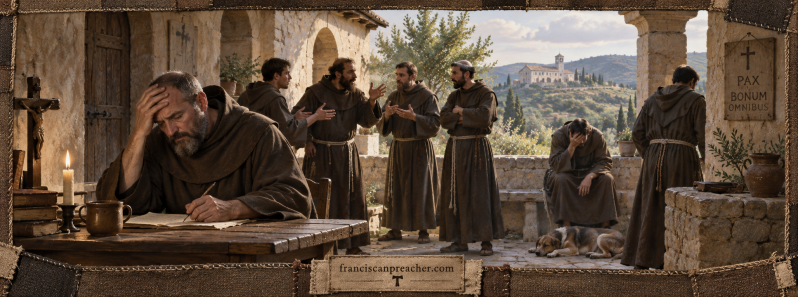
And we know, we who are brothers and who live together under the same roof, how sometimes that is very much a part of our journey. But this guardian was having a really difficult time, and he seems to have wanted to escape the situation and, like, retire to a hermitage and just give himself to prayer.
But Francis's response in his Letter to a Minister is astonishing. And I quote, “Those things which impede you in loving the Lord God, whether brothers or others, even if they lay hands on you, you should accept as a grace.”
And then he writes, “And love those who do these things to you.”
In other words, Francis does not see a tragedy, something to bemoan in the bad behaviour of others towards us, but rather an opportunity. An opportunity to grow in holiness, in mercy, in patience, in that heroic virtue that Jesus calls us to when he says, you know, your love has to go beyond just the love of those who belong to this world.
For even the atheists and those who hate God know how to love those who love them. But you, “love your enemies.” “Pray for those who persecute you,” and “to those who hate you, do good” (Matthew 5:44; Luke 6:27).
But such a person who will be able to do these things needs to be grounded in an intimate and personal and loving and trusting relationship with God. He needs to spend a lot of time with our Blessed Mother, who was tender and beneath the Cross forgave not just one person or two or three, but hundreds. And so she forgave not seven times but thousands of times.
The Mother who is imbued with such holiness and virtue teaches us that we cannot allow hate, bitterness, anger to get a hold of us.
May Almighty God give us all the grace to remain free, but to continue to put on the mind of Christ, as Saint Paul encourages us, to continue to think the way Jesus thinks. Thoughts of compassion, thoughts of mercy, thoughts of forgiveness.
In the name of the Father, and of the Son, and of the Holy Spirit. Amen.
Go in peace.
Add comment
Comments