My dear brothers and sisters in Christ, peace be with you. On this Sunday, the Lord gives us to understand the meaning of authority as he institutes it in the world. Whenever he gives authority to someone, we must always remember, especially through a Franciscan lens of understanding what authority means, that it will always entail service.
If God gives an authority to someone, it is in order to serve His people. Take police officers, for example. Proper authority is given to them to serve, doctors to serve, teachers to serve, parents to serve in a way, bring up their children, and help them in so many ways. Priests given authority, bishops, cardinals, popes, in order to serve.
In the first reading from the Old Testament by the prophet Isaiah, we can understand Jesus's words to Peter in the gospel. Shebna, the unfaithful master of the royal palace, is removed from office, and Eliakim is appointed in his place.
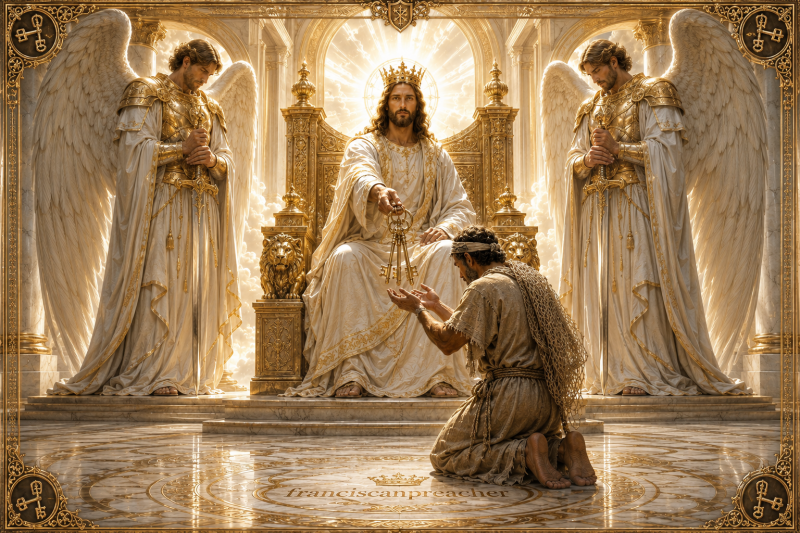
Eliakim does not become the king, but rather he receives an office of authority under the Davidic king. The signs of that office are his robe, sash, and especially the key of the house of David. With that key comes the power to open and shut. And I quote, “When he opens, no one shall shut. When he shuts, no one shall open” (Isaiah 22:22).
This prepares directly for Christ's words to Peter. “I will give you the keys to the kingdom of heaven. Whatever you bind on earth shall be bound in heaven” (Matthew 16:19). Jesus is the Davidic king, while Peter is entrusted with a unique office within his kingdom.
Thus the prophet Isaiah helps us see that the keys are not merely a symbol of Peter's personal faith. They signify an office, carrying real authority, entrusted by the king to his servant.
We know that from the succession of popes, all the successors of Saint Peter, who take his office as Bishop of Rome, become the universal pastor, visible head of Christ's church, representing Jesus. That's why we call the Holy Father the vicar of Christ, the standing for Christ. Not that he is one and equal to Christ, no. But that he has been given the authority by Jesus to speak in his name.
And then the official title of the pope, remember, is always the servant of servants. That's authority. Authority in the biblical sense is always connected to diaconia, service.
In the second reading, Saint Paul takes us behind everything happening in Isaiah and the Gospel and points us toward the mysterious wisdom of God himself. “How inscrutable are his judgments, and how unsearchable his ways” (Romans 11:33).
God chose Eliakim rather than Shebna. God chose Peter, an ordinary fisherman with all his weaknesses, to become the rock upon which Christ would build his church. Why does God act in precisely these ways and choose precisely these people? Ultimately, his designs surpass human understanding. “For who has known the mind of the Lord, or who has been his counsellor?” (Romans 11:34).
This also connects beautifully with Jesus telling Saint Peter that his confession did not originate merely from human intelligence. “Flesh and blood has not revealed this to you, but my Heavenly Father” (Matthew 16:17).
My dear brothers and sisters, this reveals a beautiful intimacy with the Heavenly Father, which is reflected in the life of Saint Francis himself.
One of the prayers traditionally associated with Saint Francis's conversion at San Damiano begins with these words: “Most high, glorious God, enlighten the darkness of my heart, and give me true faith, certain hope, and perfect charity.”
Notice how Saint Francis is hoping and trusting that God himself will enlighten his heart, just as God our Father enlightened the heart of Saint Peter to know for a fact that Jesus is His Son, the Son of the Eternal Father.
So too, my brothers and sisters, this prayer before the crucifix at San Damiano, which Saint Francis once made over 800 years ago, should be a prayer that's close and dear to our hearts. “Most high glorious God, enlighten the darkness of my heart.”
Because the world around us, and perhaps the circumstances in our lives, sometimes overshadows all the beauty that God wishes to reveal to us. Jesus says to Saint Peter, “Flesh and blood has not revealed this to you, but my Heavenly Father” (Matthew 16:17). How many beautiful truths of our faith? How many beautiful insights into our own personality does God wish to enlighten within our hearts?
Do you know that one of the most frequently heard prayers that the disciples of Saint Francis would hear him uttering as they dwelled beneath his cave in the mountain, in their own little caves? They would hear him often reciting this prayer, very short but very powerful, which we can make our own.
“Lord, who are you? And Lord, who am I?”
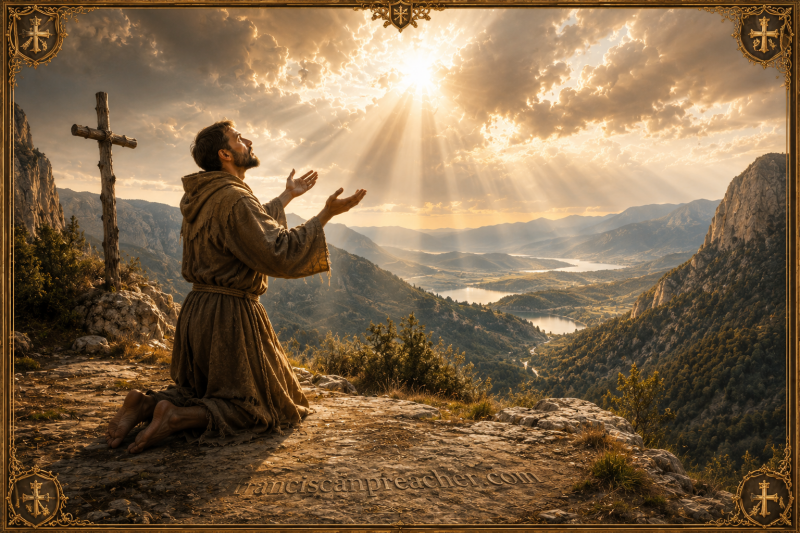
In other words, all the work that a psychologist, for example, or a psychiatrist does with a client, in order to help them to understand why it is they're behaving the way they do. All of that can be most beautifully and even more perfectly addressed if we take all of our concerns, if we take ourselves and become present more frequently with God in prayer.
Especially us as Catholics in front of the Eucharist, just sitting in His presence, we can be enlightened, and He will reveal things to us, beautiful things that we can carry with us always.
My brothers and sisters, through the intercession of Saint Francis, through the intercession of all the Apostles, especially Saint Peter, may we ask the Lord our God always to enlighten the darkness of our hearts.
In the name of the Father, and of the Son, and of the Holy Spirit. Amen.
Add comment
Comments