In today's blessed Sunday readings, we get a glimpse of one of the most beautiful Eucharistic and hope-filled combinations of readings in the Sunday Lectionary, where we learn, as it is impressed upon us, that God not only satisfies our deepest hunger, but He Himself becomes our food.
Our first reading is taken from the Book of the Prophet Isaiah, chapter 55. These verses come from the closing chapters of Isaiah, often called Second Isaiah, that is, chapters 40 to 55, where the people of Israel are living in exile in Babylon, and they have lost everything: their homeland, their Temple, the king, and much of their hope. And so, into this despair, God speaks not of condemnation or punishment, but of an invitation: “Come to the water.” (Isaiah 55:1) Notice who is invited. Not the wealthy in this passage, not the successful, not the worthy, but those who are thirsty, those who have nothing, those who cannot pay. And so the banquet God offers is completely free, because salvation is always God's gift before it is ever our collaboration with Him. The everlasting covenant recalls God's promise to David, King David, now fulfilled not in an earthly kingdom, but ultimately in Christ.
In our second reading, Saint Paul is writing to Christians in Rome who are beginning to experience hostility and persecution. We know that up until the fourth century, Christians were persecuted for not bowing to the gods of the state, false gods, nonexistent gods. And yet they were thrown to the lions in the Colosseum for this. Saint Paul's question is rhetorical: “What will separate us from the love of Christ?” (Romans 8:35) Then he lists the very things that frightened Christians, especially back then: persecution, lack of food, famine, danger, death itself. And yet Saint Paul answers with extraordinary confidence. Why? Because he himself had an experience with the Risen Christ, the living God, the One who is, who was, and who will always be by our side. Saint Paul reminds the early Christians that Christ's love is stronger than every suffering, and that Christian life is not the absence of hardship. It is the certainty that Christ is with us through every difficulty, through every dark moment that we encounter in our lives.
In the Gospel, Jesus has just learned that John the Baptist was beheaded by King Herod, and He withdraws to grieve, even in His human nature, even though He knows that great glory now surrounds John the Baptist in the afterlife. But in His humanity, Jesus grieves over the suffering that John had to endure. And instead of sending the masses of people away, Matthew records that “his heart was moved with pity.” (Matthew 14:14) The Greek word that is used here describes compassion that comes from the depths of one's being. The word pity that is used is the same word often used to describe God's mercy.
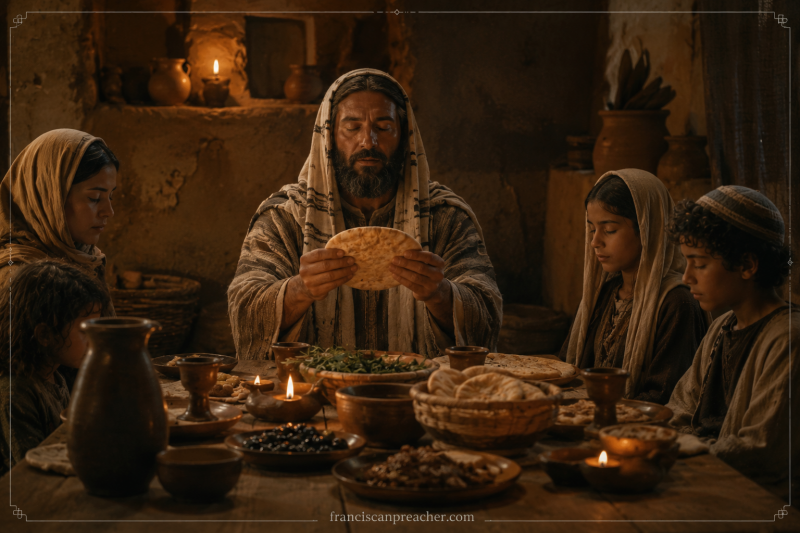
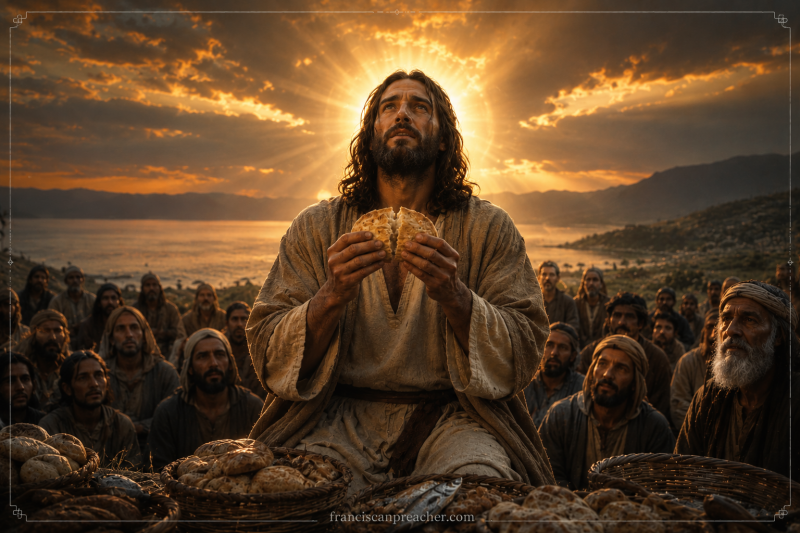
The miracle is about far more than just multiplying bread, as miraculously shocking and beautiful as that is. Matthew intentionally presents Jesus acting like the father of a family at the Passover meal. Notice the sequence. He takes the bread. He blesses it. He breaks it. And He gives it. These are exactly the same four actions Jesus performs at the Last Supper. Saint Matthew wants us to recognize that this miracle points toward the Eucharist. Our Lord, who is always with us, ever so humbly, ever so silently, but omnipresent in time and in eternity, is a great pillar to whom we can have recourse when the going gets tough, but also for prayer, for simply spending moments in silence in His presence.
He's always there in every tabernacle of every Catholic church around the world. When you see that red light, the sanctuary lamp, burning, you know that Jesus is present within that tabernacle. Christ feeds us with His Body, His Blood, His Soul, and His Divinity. He doesn't merely heal physical maladies, but He also heals our souls. This miracle reminds us that God cares for us as a whole person, not just part of us, but all of us. The Eucharist is God's answer to our deepest hunger.
My dear brothers and sisters, as you receive the Eucharist today, and in the Sundays, weeks, months, and years to come, always know that each time you go up for Holy Communion, Our Lord is healing you in ways you cannot imagine.
May He continue to bless you this day, in the name of the Father, and of the Son, and of the Holy Spirit. Amen.
Add comment
Comments