Today, on this 14th Sunday in Ordinary Time, we get a deeper glimpse into the identity and the beauty and the grace of who Jesus actually is. In the first reading from the prophet Zechariah, in the ninth chapter, we hear him preaching after the Babylonian exile. The people are returning to Jerusalem full of hope, and yet soon they become discouraged. Jerusalem was rebuilt, yet the glorious kingdom they expected had not arrived. Into that disappointment God announces an astonishing promise: “See, your king shall come to you, a just saviour is he, meek, and riding on an ass.” (Zechariah 9:9) Unlike earthly kings who displayed power through armies and war horses, this King, the new King, the King of kings, would banish the chariot, the horse, the warrior's bow. His kingdom would not be established by violence, but by peace extending from sea to sea.
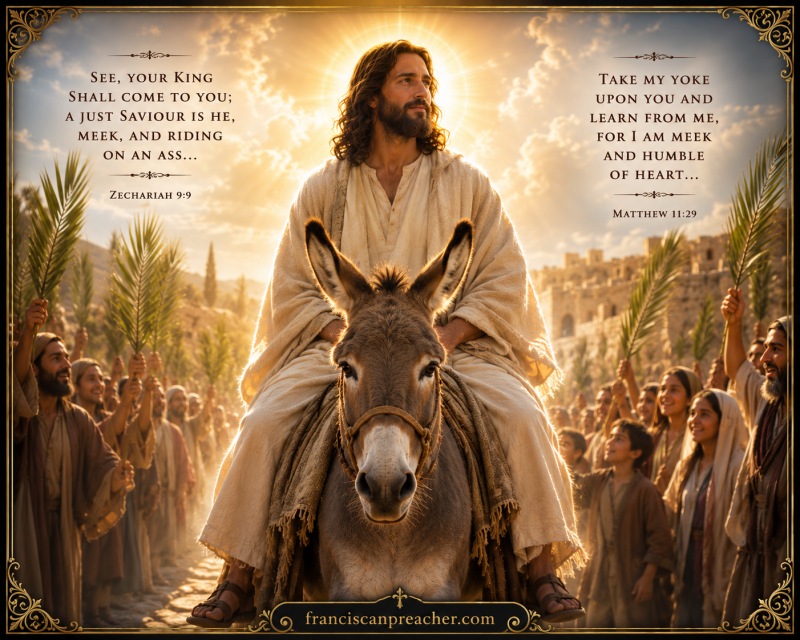
This prophecy finds its perfect fulfilment, of course, in Jesus entering Jerusalem on Palm Sunday. My brothers and sisters, how many times is it part of our instinct to admire strength, prestige, and influence? Yet God sends a King who is meek. Jesus conquers not by crushing his enemies, but by dying for them. Every Christian is called to build God's kingdom in the same way, not through domination, anger, or pride, but through humility, mercy, and sacrificial love.
In the second reading, taken from the eighth chapter of Saint Paul's Letter to the Romans, we have one of the most hope-filled chapters in all of his writings. After explaining how Christ has freed us from sin, Saint Paul reminds believers that baptism has fundamentally changed who they are. And I quote: “You are not in the flesh; on the contrary, you are in the spirit, if only the Spirit of God dwells in you.” (Romans 8:9) My brothers and sisters, this is not merely symbolic language. The very Spirit who accomplished the greatest miracle in history now lives within each and every one of us. “The one who raised Christ from the dead will give life to your mortal bodies also.” (Romans 8:11)
Therefore, we as Catholic Christians are no longer slaves to sinful desires, but are called to cooperate with the Holy Spirit each day. We need to ask ourselves: am I truly living the freedom that God has won for me as His son or as His daughter? Do I feel free in the Spirit, in the Holy Spirit? Or am I still bogged down by the heavy weight of addiction, attachments, worldly pleasures, honours, power, and wealth? Let us pause and reflect whether or not we're spending enough time with Christ to allow Him to liberate us.
Saint Paul says in today's second reading: “We are not debtors to the flesh.” (Romans 8:12) In other words, we do not owe our old way of living anything. Instead, and I quote: “If by the Spirit you put to death the deeds of the body, you will live.” (Romans 8:13) Saint Paul intends that fullness of life that Christ said He came to bring us: a life of goodness, purpose, generosity, happiness, a transcending of ourselves and focusing on the other, the other person. Extending our gaze beyond our selfish needs and rather looking to the needs of others, where each day we can wake up in the morning and say, “Lord, I will serve. I will serve you today in my brother who is struggling, in my sister who's going through a difficult time. Let me help somebody in some way today.”
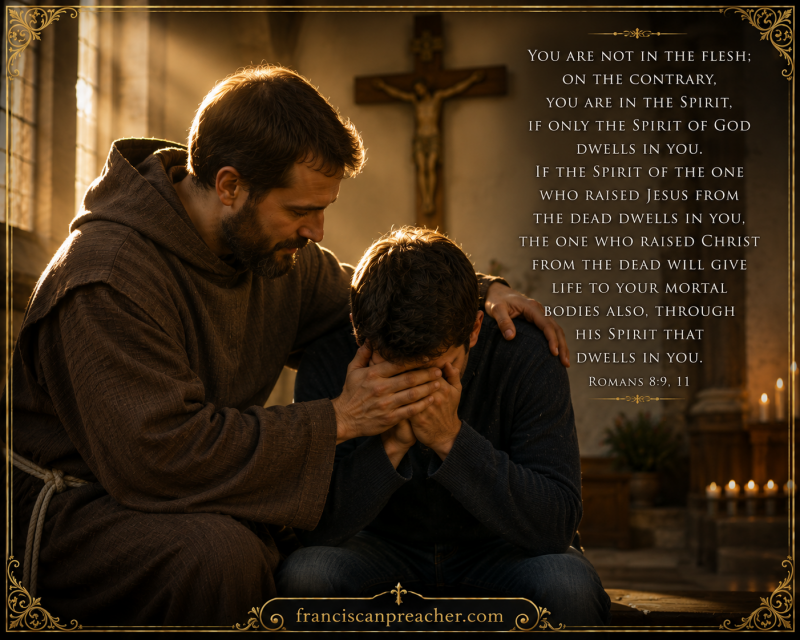
Holiness is not simply trying harder through willpower. It is allowing the Holy Spirit to work within us. Every temptation we resist, every act of forgiveness we extend, every generous sacrifice we make is evidence that God's Spirit is alive and active in us.
When we come to the Gospel, Jesus speaks these words in the Gospel of Saint Matthew: “I give praise to you, Father, Lord of heaven and earth.” (Matthew 11:25) He explains that God's deepest mysteries are not grasped by those who rely on their own wisdom, but are, and I quote, “revealed to little ones.” (Matthew 11:25) Immediately afterwards, Jesus extends one of the most comforting invitations in all of Scripture: “Come to me, all you who labour and are burdened, and I will give you rest.” (Matthew 11:28)
Notice that Jesus never promises a life without burdens. Instead, He says: “Take my yoke upon you, for I am meek and humble of heart.” (Matthew 11:29) The same humility foretold by Zechariah in the first reading is now revealed in full splendour in the person of Christ through today's Gospel reading.
The yoke becomes light, not because life suddenly becomes easy, but because we no longer carry it alone. Rather, Christ, we discern, is in our hearts, in our minds, in our lives. He walks side by side with us every step of the way. And as He promises in today's Gospel: “You will find rest for yourselves. For my yoke is easy, and my burden light.” (Matthew 11:29-30)
In the name of the Father, and of the Son, and of the Holy Spirit. Amen.
Add comment
Comments