May the good Lord, on this Sunday, bless you in a very special way. Today I would like to offer you some reflections on the First Reading, the Second Reading, and the Gospel, before bringing them all together to see what the Lord may be saying to us. As always, I encourage you to read the readings themselves. The Word of God is rich, profound, and always worthy of our prayerful meditation.
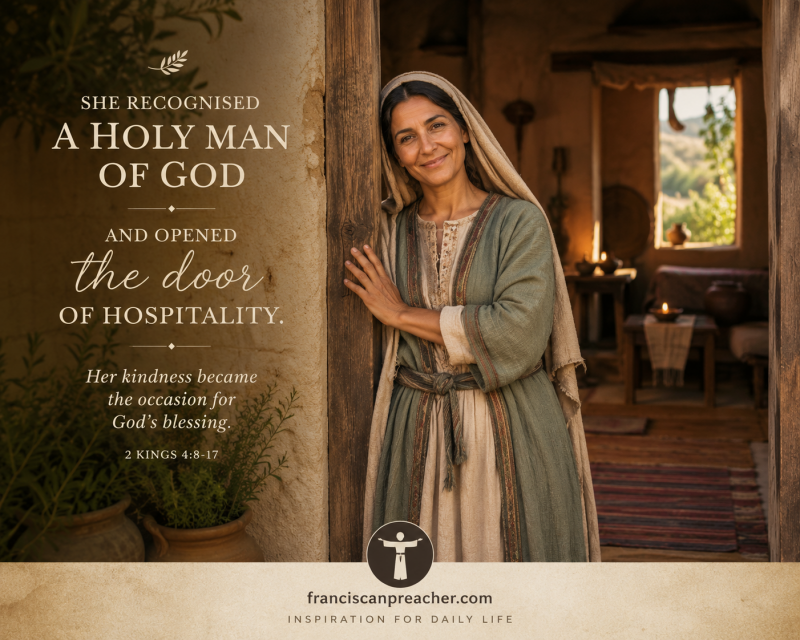
The First Reading comes from the Second Book of Kings, a book traditionally attributed to the prophet Jeremiah, although modern scholarship generally understands it to be the work of several inspired editors drawing upon royal records and prophetic traditions. It was written during or shortly after the Babylonian Exile to explain why Israel and Judah suffered exile as a consequence of their covenant unfaithfulness.
Today's passage takes place during the ministry of the prophet Elisha, the successor of Elijah, in the ninth century before Christ during the period of the Northern Kingdom of Israel. We hear about the generous hospitality of the Shunammite woman, who recognises Elisha as a holy man of God and goes out of her way to provide him with a place to stay whenever he passes by. Her quiet generosity becomes the occasion for God's blessing. Although she asks for nothing in return, the Lord rewards her hidden act of charity with the miraculous gift of a son. It is a beautiful reminder that God never forgets even the smallest act of generosity performed for His sake.
In the Second Reading, Saint Paul writes to the Christian community in Rome around the year A.D. 57 while he is in Corinth preparing to travel to Jerusalem. The Church in Rome consisted of both Jewish and Gentile Christians whom Paul had not yet personally met. In chapter six of his letter, Paul responds to the mistaken idea that, because God's grace is abundant, Christians may continue living in sin. His answer is emphatic. Through Baptism we have been united to Christ in His death and resurrection. Our old life has died, and we are called to live an entirely new life in Christ. It is therefore completely contradictory for someone to claim to be a Christian while believing that he or she can continue deliberately living in sin. The Christian life is a life of continual conversion.
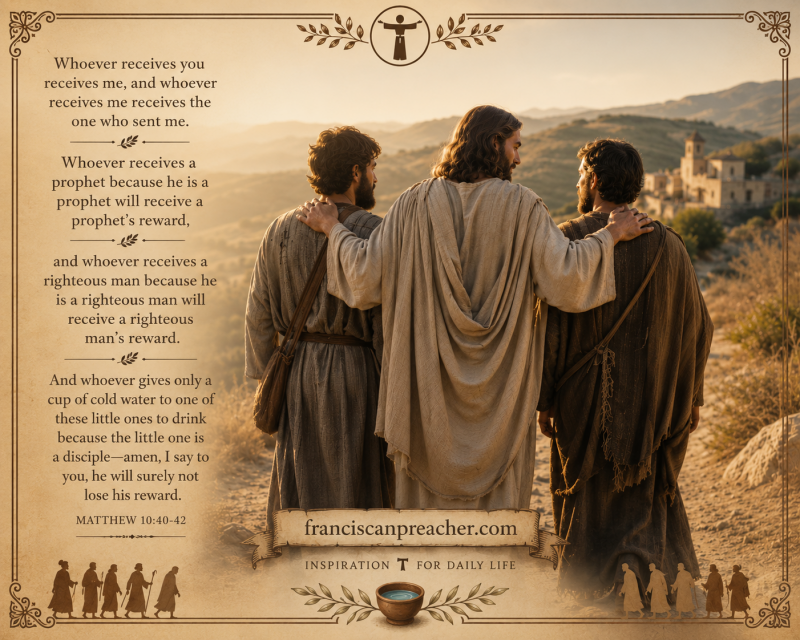
The Gospel is taken from Saint Matthew, whose Gospel was written primarily for Jewish Christians. Matthew constantly draws upon the Old Testament to demonstrate that Jesus is indeed the long-awaited Messiah. Yet He is infinitely more than simply the Messiah. He is Emmanuel—God with us.
Today's Gospel forms part of Jesus' missionary discourse as He prepares the Twelve Apostles before sending them out to preach throughout Israel. He does not promise them an easy road. Instead, He warns them that discipleship will demand sacrifice. Following Christ may even bring opposition from those closest to us. Yet Jesus also teaches that whoever welcomes His disciples welcomes Him, and whoever performs even the smallest act of charity for His sake will certainly receive a reward.
How, then, do these readings come together?
The first great lesson is that hospitality shown to God's servants is hospitality shown to God Himself. The Shunammite woman receives Elisha because she recognises him as a man of God, and the Lord abundantly blesses her generosity. Jesus teaches precisely the same truth when He tells His Apostles, "Whoever receives you receives me." Every act of kindness shown to one of Christ's disciples—even something as simple as offering a cup of cold water—becomes an act of love offered directly to Christ Himself. These readings remind us that God notices what the world often overlooks. Hidden acts of generosity never escape His loving gaze.
The second theme is that authentic discipleship always requires dying to oneself in order to receive new life. The Shunammite woman gives without expecting anything in return, and God blesses her with new life through the gift of a son. Saint Paul teaches that through Baptism we die with Christ so that we may also rise with Him. Jesus completes the lesson by declaring, "Whoever loses his life for my sake will find it." The pattern is always the same. God never allows a generous sacrifice to be wasted. Every act of self-giving offered in faith becomes the seed of an even greater blessing, whether in this life or in eternity.
My brothers and sisters, let us therefore take courage. Be generous to everyone. Let your light shine before others. Be the salt of the earth. Follow Christ whatever the cost. Do not be surprised if you encounter persecution, misunderstanding, or rejection. Our Lord warned us that this would happen. If they hated the Master, they will also hate His disciples. But never lose heart. Christ Himself assures us, "Take courage; I have conquered the world." Cling to Him each day, for He walks beside you through every joy, every trial, and every step of your pilgrimage towards heaven.
Amen.
Add comment
Comments