My dear brothers and sisters in Christ, Sunday blessings to you all in the name of Jesus. My dear friends, in today's readings we hear about persecutions and difficulties, but that nothing is insurmountable, knowing that the Lord our God is with us and gives us the grace to overcome all difficulties.

In the first reading, we hear from this passage that scholars often call one of Jeremiah's confessions. The prophet Jeremiah expresses in deep personal prayer his interior struggles. And we have to remember that when these words were written, Jeremiah was not merely an unpopular prophet. He was hated, hated by the people. He had been commissioned by God to warn Judah that destruction was coming because of their infidelity. And rather than listening to him like the people of Nineveh had done with Jonah, the people turned against him.
Notice the phrase “Terror on every side!” This was actually a mocking nickname that they had come up with for Jeremiah because he was instructed by God to go and proclaim impending disaster if they did not convert. And now his enemies, his own people, ridicule him by throwing his own words of admonition back at him. “Oh look, 'terror on every side' is coming.”
Even worse, Jeremiah, on a very intimate level in terms of his friends, says: “All those who were my friends are on the watch for any misstep of mine.” So even his friends were a source of anguish for him. He experiences their betrayal, and he experiences the rejection of an entire nation who ultimately imprison him, beat him, and humiliate him in public.
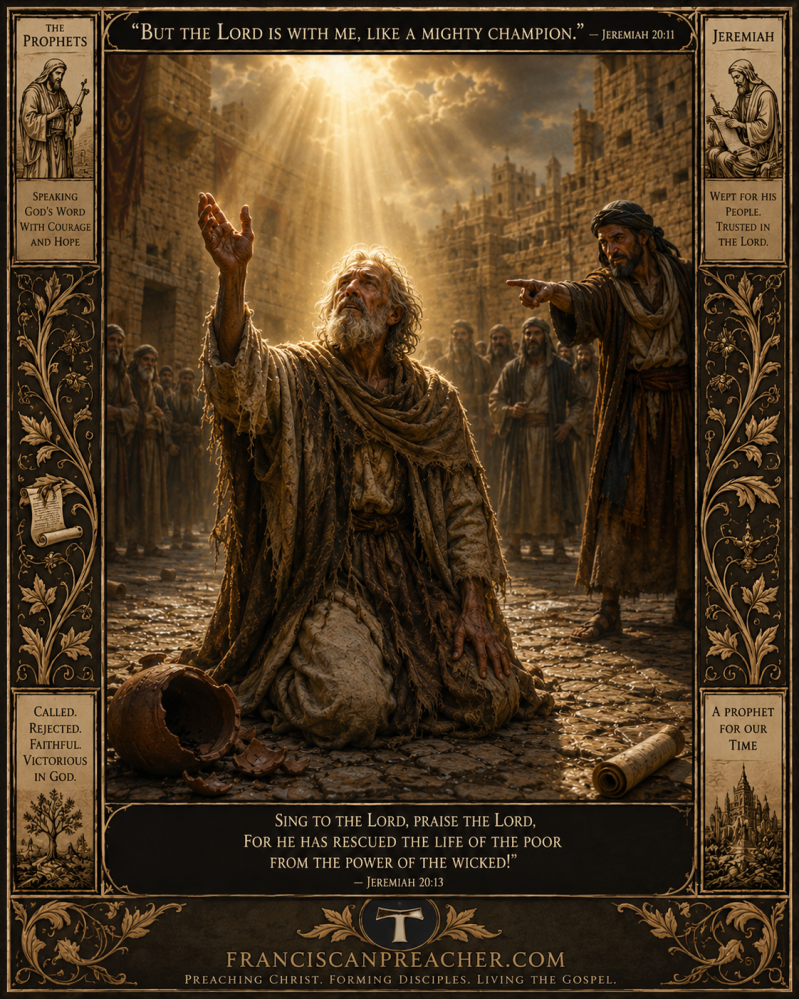
Yet, in the middle of his anguish, he suddenly proclaims: “But the Lord is with me like a mighty champion.” The Hebrew image is that of a mighty warrior standing beside him. Now here we see that the prophet is surrounded by his enemies, but he is sustained by God's presence. But make no mistake about it, the enemy's power is real. It's devastating. But we know that God's power is greater.
In the second reading, we have what is perhaps one of Saint Paul's most profound theological passages, in which he compares the two representative figures of Adam and Christ. Adam, the head of fallen humanity; Christ, the head of redeemed humanity, the Lord and the God of all, the Creator of the universe.
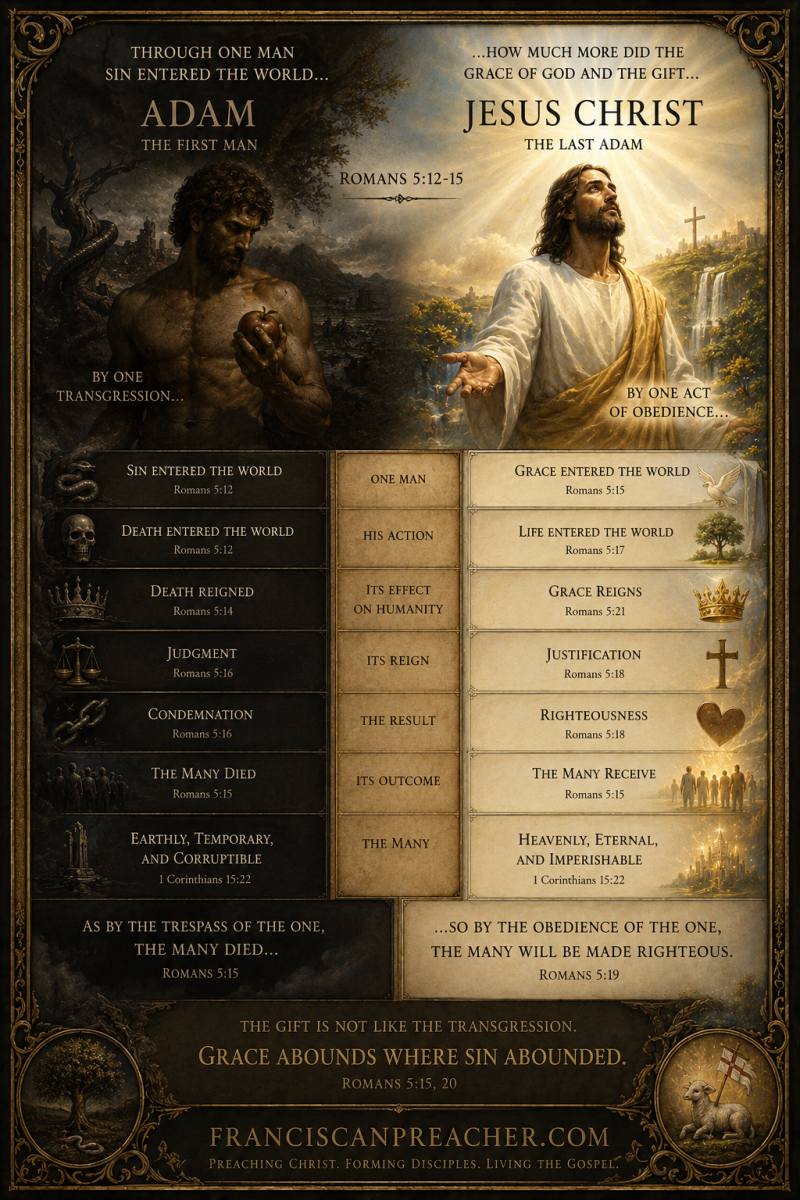
He compares the two when he says that through Adam's disobedience sin entered into the world. Death entered the world. Humanity became wounded. But through Christ and His obedience, grace enters into the world. Life enters into the world. Salvation is put on offer for all people.
Saint Paul's point is not that Adam and Christ are equal opposites, by no means, but rather that Christ infinitely surpasses Adam. Notice, and I quote: “The gift is not like the transgression.” And again: “How much more...” This phrase is crucial. Adam brought ruin, but Christ brings something greater than mere restoration. He brings an overflowing abundance of grace.
My dear brothers and sisters, picture our Lord crucified on the Cross. Horrific agony. But through that day's Passion, humanity for all time would be redeemed. The gates of heaven would be opened. And if we but merely accept Him and try to live by His commands, we can be with Him forever. He didn't just restore us, but He gave us an opportunity to live with Him, the Father and the Holy Spirit, and our Blessed Mother and all the angels and saints, our fellow brothers and sisters who, purified, will one day be there forever and ever, time without end.
Adam brought ruin, but Christ brought us something much greater than mere restoration of that ruin. He brought us an overflowing abundance of grace.

My brothers and sisters, in the Gospel Jesus is sending the Twelve out on a mission. And this is the first major missionary discourse in Saint Matthew's Gospel. But He is simultaneously preparing them for opposition. Notice that He does not say, “You will be loved,” nor does He say, “You will avoid suffering at all costs.” Instead, He says repeatedly: “Do not be afraid.”
Three times in this section Jesus commands them not to fear. Why? Because notwithstanding anything that they will go through—rejection, persecution, mockery, violence, even martyrdom—Jesus will be there, giving them strength in the moment to overcome the wiles of the devil and those who have gone astray and have abandoned God and His goodness.
Jesus uses the image, which everyone would understand, of a sparrow, among the cheapest birds sold in the marketplace, practically worthless in economic terms. Yet, and I quote: “Not one of them falls to the ground without your Father's knowledge.” Then Jesus draws the conclusion: “You are worth more than many sparrows.”
The Father governs even the smallest details of creation. Will He not look after our eternal destiny if we entrust ourselves into His hands, and we continue to grow in a loving relationship with Him? And we know what it means to love Him. Jesus told us what it means to love God when we listen to His commands. Forgive. Love your enemy. Yes. Do good to those who persecute you.
My brothers and sisters, the road ahead might be long. The challenge is great. Adversaries may seem insurmountable. But with the Lord at our side, we will conquer all things. “Blessed are the meek, for they shall inherit the earth.” We can do all things through Him who strengthens us. And we can conquer, if we have the great and mighty conqueror by our side, all difficulties, all obstacles.
Just place your trust in Him.
In the name of the Father, and of the Son, and of the Holy Spirit. Amen.
Add comment
Comments