My dear brothers and sisters in Christ, peace be with you. Today in the Franciscan world, we celebrate a very special saint by the name of Saint James of the Marches. And he teaches us about preparing the way for Christ through holiness, simplicity, and apostolic zeal. Such an appropriate saint before entering into the sacred time of Advent this Sunday.
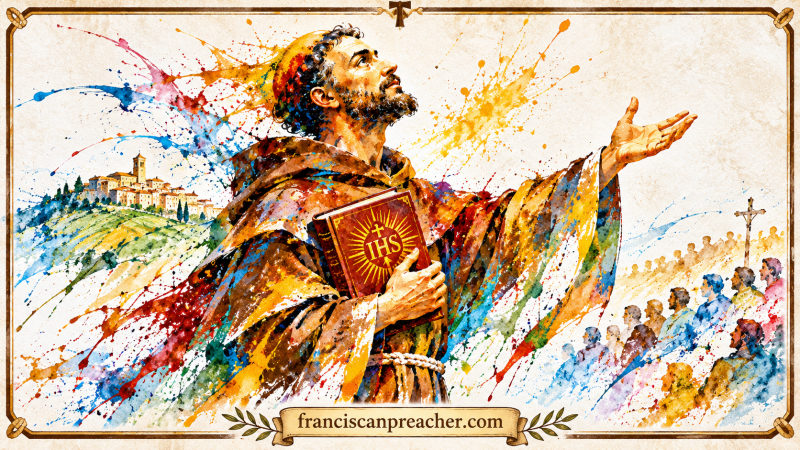
Born Domenico Gangala in Monteprandone, in the Italian region of the Marches, James studied law before entering the Order of Friars Minor in 1416. He was a disciple of Saint Bernardine of Siena and a contemporary of Saint John of Capistrano, becoming one of the great preachers of the Franciscan Observant Reform, to which I belong. He traveled extensively throughout Italy and Central and Eastern Europe, preaching repentance, promoting reconciliation, combating doctrinal errors, and encouraging devotion to the Holy Name of Jesus. His concern for the poor also led him to promote charitable lending institutions, Monti di Pietà, to protect people from exploitative moneylending. Despite his extraordinary apostolic activity, James maintained a life of rigorous poverty, penance, and prayer. He died in Naples on 28th November 1476 and was canonized by Pope Benedict XIII in 1726.
My dear friends, in today's first reading from the Book of Sirach — now, these readings are taken from the Proper for the feast of this saint's day — we hear in this first reading how the spiritual authority of God's messengers comes not merely from their knowledge or abilities, but from their intimacy with God. Moses was chosen not simply because of his leadership qualities, because actually he had none, but because of his faith and meekness. Even with a stuttering problem, God sent him to Egypt, to the Pharaoh, to this man who had made himself a god, and He sent him another man, a broken man, in the person of Moses. And when Moses complained to God that he couldn't even speak, God said, “Aaron will speak on your behalf” (cf. Exodus 4:14–16). In other words, God could have healed Moses. But the point was He wanted to humble the Pharaoh by sending him a broken man.
Now, my brothers and sisters, Saint James of the Marches understood that effective preaching — and this is what we're all about here on franciscanpreacher.com — but effective preaching must flow from prayer, personal conversion, and holiness of life. My friends, if I do not communicate with God every day in some way, shape, or form, and then come to you and preach His word, I will be but an empty shell, a gong clamouring in the wind. No substance, because there won't be the actual lived experience of what I am trying to convey to you and what I am trying to help you to embrace yourself. So the credibility of the preacher — this is what Saint James taught us — depends greatly upon whether he lives what he proclaims.
Now, do we live it perfectly? We're still, all of us, a work in progress. All of us are trying to live the word of God. Sometimes we struggle, and sometimes we live it beautifully. But the Lord has given us also a way to receive His mercy when we have not kept His word, and that is in the confessional.
The key verse for today's first reading is that “He sanctified him in his faith and meekness, and chose him out of all flesh” (Sirach 45:4). The Lord sanctified Saint James of the Marches to live an extraordinary life and give an extraordinary witness and testimony of what prayer can do in one's life, and penance. Saint Francis once told his brothers, which by extension meant Saint James of the Marches, that the friar who did not embrace penance in his life would never get to heaven. It was Saint Francis who taught this.
In today's Gospel from Luke, the Gospel of prayer, the Gospel of the Holy Spirit, the Gospel of mercy, we hear how the missionary is sent not to draw people to himself but to prepare them for an encounter with Jesus Christ. Notice that the seventy-two disciples are sent into places where Jesus Himself intends to go. Their mission is, therefore, to prepare the way for Him. Saint James traveled throughout Europe with this same apostolic purpose, bringing people back to Christ through preaching, reconciliation, and concrete works of charity. His Franciscan poverty also reflected the Gospel's insistence that missionaries rely primarily upon divine providence rather than material resources.
Our Lord in today's Gospel says that “The harvest indeed is great, but the labourers are few. Pray ye therefore the Lord of the harvest, that he send labourers into his harvest” (Luke 10:2).
My brothers and sisters, how important it is that we pray for vocations to the Church, vocations that will minister to the Bride of Christ, vocations that will give their lives in service to others, just as Saint James did, and Saint Francis, and Saint Clare, and all the saints who gave their lives generously out of love for their brothers and sisters.
How important it is that we pray. I remember, it's only when we began praying, in the time that I spent at a retreat house in Caledon, where we began doing adorations for vocations. Immediately, the year after, first we got two young men, and then the year after that, we got five. Because people were coming to pray and to ask the Lord to send labourers into His vineyard.
Let us continue to pray. Every time we're before the Blessed Sacrament, when we remember, let us ask the Lord in His mercy to continue to send us priests, religious, sisters, who can nourish us and feed us the word of God, just the way Saint James of the Marches did.
These readings are from the proper Mass in both the Italian Messale Serafico, published by the Friars Minor of Assisi, and the English Franciscan Proper of the Saints. Both provide prayers specific to Saint James.
Assisi OFM+1
There also exist a specifically designated set of readings in the diocesan liturgical directory for the Marche region, where Saint James is celebrated as a regional co-patron, with the rank of feast.
Arcidiocesi di Ancona Osimo
November 28 – Saint James of the Marches, OFM
Priest – White vestments
The following are the readings designated in that regional proper. We are reproducing them in their entirety using the public-domain Douay-Rheims translation, rather than the modern liturgical translation.
First Reading – Sirach 45:1–5a
Moses was beloved of God, and men: whose memory is in benediction.
He made him like the saints in glory, and magnified him in the fear of his enemies, and with his words he made prodigies to cease.
He glorified him in the sight of kings, and gave him commandments in the sight of his people, and shewed him his glory.
He sanctified him in his faith, and meekness, and chose him out of all flesh.
For he heard him, and his voice, and brought him into a cloud.
The word of the Lord.
Responsorial Psalm – Psalm 16 (15)
Suggested response: You are my inheritance, O Lord.
Preserve me, O Lord, for I have put my trust in thee.
I have said to the Lord, thou art my God,
for thou hast no need of my goods.
The Lord is the portion of my inheritance and of my cup:
it is thou that wilt restore my inheritance to me.
I will bless the Lord, who hath given me understanding:
moreover my reins also have corrected me even till night.
I set the Lord always in my sight:
for he is at my right hand, that I be not moved.
Thou hast made known to me the ways of life,
thou shalt fill me with joy with thy countenance:
at thy right hand are delights even to the end.
Gospel – Luke 10:1–9
A reading from the holy Gospel according to Luke.
And after these things the Lord appointed also other seventy-two: and he sent them two and two before his face into every city and place whither he himself was to come.
And he said to them: The harvest indeed is great, but the labourers are few. Pray ye therefore the Lord of the harvest, that he send labourers into his harvest.
Go: Behold I send you as lambs among wolves.
Carry neither purse, nor scrip, nor shoes; and salute no man by the way.
Into whatsoever house you enter, first say: Peace be to this house.
And if the son of peace be there, your peace shall rest upon him; but if not, it shall return to you.
And in the same house, remain, eating and drinking such things as they have: for the labourer is worthy of his hire. Remove not from house to house.
And into what city soever you enter, and they receive you, eat such things as are set before you.
And heal the sick that are therein, and say to them: The kingdom of God is come nigh unto you.
The Gospel of the Lord.
Add comment
Comments