Today as we celebrate the memorial of Saint Ignatius of Antioch who was an early bishop, an early church father, and martyr of the Church. We focus our attention on how he teaches us that when we die to ourselves, we produce fruit for the glory of the kingdom of God.
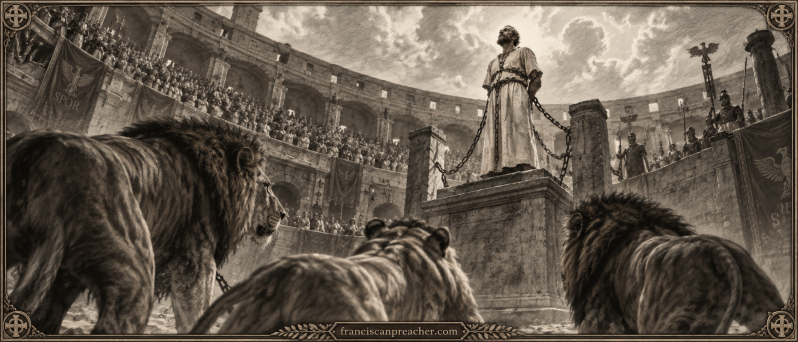
So just a bit of a biographical background to this wonderful saint and successor of the apostles. St. Ignatius was one of the early earliest bishops of Antioch, as I just stated, in present day Turkey, and he was an important witness to the Apostolic Church. Traditionally, he's associated with the apostle John. He was arrested during the reign of Emperor Trajan and transported under military guard to Rome where he was martyred traditionally dated around the year 100 107 by being thrown to wild beasts in the arena that's how they dealt with converts to christianity who would not worship the gods of the state, they would throw them to the lions. During his journey he wrote seven extraordinary letters to christian communities encouraging unity around their bishops, fidelity to Christ, and perseverance under persecution which we must all face if we are truly following Jesus. His writings provide some of the earliest testimony to the church's hierarchical structure and eucharistic faith. He also famously referred to the Christian community as the Catholic Church in his letter to the Smyrnaeans. St. Ignatius understood his approaching martyrdom not simply as death, but as his final offering of himself to Christ.
In today's first reading that is given to us for his memorial, we hear from Saint Paul Paul's letter to the Philippians in chapter three where he says to them, “but our citizenship is in heaven, and from it we also await a savior, the Lord Jesus Christ” (Philippians 3:20). Saint Paul reminds us that our ultimate homeland is not this world. And this is because our Lord continually spoke about the hereafter what awaits us to store up for ourselves treasure in heaven, because he is going to a place before us, and he will prepare a place for us. “I am going to the Father. Do not be disheartened. I am going to prepare a place for you so that where I am, there you may also be” (John 14:2–3, 12). See, our faith is always looking ahead, looking forward, living in the here and now, doing our best to live charitably, generously, spending ourselves, but remembering that we are heading somewhere, we're not aimlessly wandering through a desert. But there's a promise land which we hope to arrive at one day the ports of heaven.
Although facing a brutal death, Saint Ignatius lived this hope of everlasting life, he understood that his earthly life was temporary, and that his true destiny was eternal communion with Christ. To die to ourselves means learning to surrender our attachments, ambitions, and self interest so that Christ may reign within us. Martyrdom is the supreme witness to this surrender.
In the gospel today, Saint John recalls the words of our Lord for us and his teaching and I quote, “Unless a grain of wheat falls to the ground and dies, it remains just a grain of wheat. but if it dies, it produces much fruit” (John 12:24). Our Lord here reveals the parish paradox of Christian fruitfulness life is multiplied when it is given away. Ignatius understood that his martyrdom would not be a meaningless loss but a participation in Christ. Christ's own self-offering. The church grows through this kind of sacrificial love. We may never be called to shed our blood, but we are called daily to die to our pride, to our selfishness, to our resentments, and the desire to have everything go our own way. And we're called to do so to die to ourselves so that charity, unity, and holiness may flourish in the body of Christ and the Church.
Saint Ignatius received this invitation with a very generous heart writing to the christians in Rome, he pleaded with them not to interfere with his martyrdom In his letter to the Romans chapter four verse one he writes, “I am God's wheat. I am ground by the teeth of wild beasts. that I may be found pure bread of Christ” (Letter to the Romans, 4:1). What an extraordinary reflection and concrete example of our Lord's promise that if we die to ourselves we will bear much fruit and look at us 2000 years later. later learning, reflecting, drawing closer to God because of his sacrifice Ignatius's sacrifice in the Colosseum. Ignatius saw himself as the grain of wheat that must die to bear fruit. His desire was not death for its own sake, but complete union with christ.
Saint Francis in his letter to the entire order in article 29 says “let us therefore hold back nothing of ourselves for ourselves, so that he who gives himself totally to us may receive us totally.” Saint Francis expresses this same spirituality of total self giving. We do not necessarily need to die as martyrs on one future given day to live the mystery of martyrdom because every act of humility, of obedience, of forgiveness and self-denial can become an offering that bears fruit for God's kingdom. Ignatius gave his life for Christ in one final act of martyrdom, but we are invited to give ours Christ through countless daily acts of love and service.
The question is not simply what we are prepared to do for Christ, but what we are prepared to surrender so that Christ may bear greater fruit through us in his church and for the glory of the Father. Through the intercession of Saint Ignatius and the queen of all martyrs, may almighty God bless you in a very special way with courage, wisdom, and strength, in the name of the Father and of the Son, and of the Holy Spirit. Amen. Go in Peace. Thanks be to God.
Add comment
Comments