My dear brothers and sisters in Christ, peace be with you. Through today's readings we reflect on a very important truth; that it's not enough for us – it will not suffice to merely know things about God, to know Scripture inside out, to be able to explain the faith to others. None of it is enough in comparison to actually knowing God. After all his questioning and suffering, Job finally admits that God's purposes are beyond his understanding. He says, “I had heard of you by word of mouth, but now my eye has seen you” (Job 42:5).

In the Gospel, the disciples return excited by what they have accomplished, but even there, Jesus redirects them from spiritual success towards something far greater, and that is that they belong to God, that they're in a relationship.
The deepest joy of our faith is not so much understanding everything, and that is impossible, or accomplishing extraordinary things, for that's not always possible, but knowing that our lives are held in the palm of God's hand, and that our names are written in heaven.
So in the first reading, from Job, we hear him address the Lord in this way: “I know that you can do all things and that no purpose of yours can be hindered. I have dealt with great things that I do not understand, things too wonderful for me which I cannot know” (Job 42:2–3).
We see that Job has spent much of the book demanding an explanation for his demise, for his suffering. In the end, God does not give him a neatly packaged explanation. Instead, Job encounters God himself. He enters more deeply into the profound reality of the relationship, the gift that is the presence of God in our lives. Good times and bad times.
Faith sometimes reaches maturity when we can say, “I do not understand this, but I know that my understanding is not the measure of God's providence, God's omnipotence.”
Job says, “I had heard of you by word of mouth, but now my eye has seen you” (Job 42:5).
My friends, this is perhaps the great turning point of the entire book of Job, where he moves from second hand knowledge to personal encounter. “I had heard of you, but now my eye has seen you.” His suffering has not answered every question, but somehow it has brought him into a deeper knowledge of God.
My brothers and sisters, how many times do we hear about somebody without having met them? And we draw up an image in our mind of what they must look like, or what we imagine them to be. But then it is only when we actually meet them that we discover the face behind the name, that we discover a person behind a description, which is always so inferior to the thing.
And that is why encountering God in prayer, spending time with him, is of utmost importance because otherwise, we will just have heard of him. We ourselves may have just spoken of him, but we haven't entered into the mystery of our relationship with him.
In the Gospel, Jesus had sent out the disciples who return now rejoicing. And they say to Jesus, “Lord, even the demons are subject to us because of your name.” And Jesus said, “I have observed Satan fall like lightning from the sky. Behold, I have given you power to tread upon serpents and scorpions, and upon the full force of the enemy, and nothing will harm you. Nevertheless, do not rejoice because the spirits are subject to you, but rejoice because your names are written in heaven” (Luke 10:17–20).
And this is the central point, my brothers and sisters. The disciples are excited about what they have done and what they can do now in the future, but look at where our Lord redirects their attention.
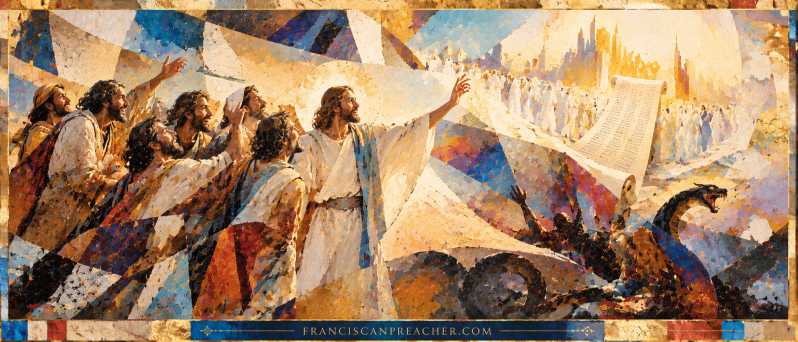
He tells them to remember who they are, that they are beloved by the Father, that their greatest joy should not be their power or their success, even in their ministry or their accomplishments, but their greatest joy should be in the fact that they belong to God.
How about us, my brothers and sisters, where is my greatest joy? Am I ecstatic, happy that I can call God my Father, for that is who he truly is, that I have such a loving, merciful, patient Father? Do I know him? Do I love him? Do I trust him? Is he the source of my joy? Or do I continue to place my hope in trivial things, in passing things, in things that will never fill my heart?
This theme of knowing God rather than just possessing all the answers is something that strikes at the heart of the Franciscan spirit.
When Job says, “I have dealt with great things that I do not understand” (Job 42:3), he really captures what Saint Francis later on would himself experience.
Saint Francis, who was not interested in possessing God intellectually, but rather he wanted to know him through relationship, prayer, and the true following of Christ, being a true and authentic disciple.
In his famous Praises of God Most High, which he wrote after receiving the stigmata on Mount La Verna, Saint Francis prayed, and I quote, “You are our faith. You are our hope. You are our charity. You are all our sweetness.”

Notice the language. He doesn't simply say, “I know things about you.” But he says, “You are.”
That is where Job finally arrives. “I had heard of you by word of mouth, but now my eye has seen you” (Job 42:5). Has seen who you are.
And it is where Jesus leads the seventy-two. “Do not rejoice because the spirits are subject to you, but rejoice because your names are written in heaven” (Luke 10:20).
Do not build your identity, my brothers and sisters, upon what you accomplish, even impressive religious accomplishments. But build your identity strongly rooted in a true relationship with God. Discover more and more that you are His Son. You are His Daughter.
May Almighty God this day reveal this to you more splendidly in a very powerful way through the intercession of our Mother in heaven, Saint Francis and all the angels and saints, in the name of the Father, and of the Son and of the Holy Spirit. Amen.
Go in peace.
Thanks be to God.
Add comment
Comments