My dear brothers and sisters in Christ, peace be with you. As you know, here at FranciscanPreacher.com, we like to give insights regarding specific Franciscan saints that you may not have heard about before. And that is because every single one of these people who are declared models and followers of Jesus that we are to emulate, all of them have a very special story, and all of them can teach us something beautiful about how it is we are to serve the Lord.
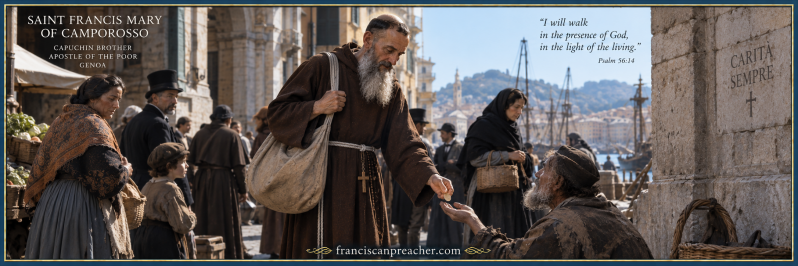
One such saint is Francis Mary of Camporosso, who is also known as the Holy Father of Genoa. And I'll tell you why that name is so incredible for this particular individual in a minute, but Francis Mary was born actually Giovanni Evangelista Croese in 1804. Francis Mary is the religious name that was given to him when he became a Capuchin Franciscan.
He was born in a place called Camporosso, which is a small Ligurian town near the French border. He came from a poor farming family, and he had very little formal education. Eventually he entered the Capuchins and became a lay brother rather than a priest.
For roughly 40 years, his principal apostolate was extraordinarily simple. He would walk through the streets of Genoa as a questore, meaning somebody begging alms for the friars and for the poor.
Now this is important for understanding him, because 19th-century Genoa was a bustling Mediterranean port undergoing enormous social and political change. Francis lived through the decades of the Risorgimento, industrial growth, poverty, epidemics, and the upheavals that eventually produced a unified Italy.

Yet his pulpit was essentially the street. Day after day, he encountered merchants, dock workers, wealthy families, beggars, mothers, children, and the sick. People began coming to him not merely because he collected alms, but because he gave himself to them.
His reputation for kindness, counsel, and holiness became so great that the Genoese affectionately called this unordained Capuchin brother Padre Santo, the Holy Father. The Capuchin Order summarizes his 40 years in Genoa as a ministry in which he helped people both materially and spiritually.
Now, we hear in Saint Paul's Letter to the Corinthians, in the first reading, that “what you sow is not brought to life unless it dies” (1 Corinthians 15:36). Francis spent his entire religious life sowing. And what was the seed?
Nothing spectacular: a conversation, a loaf of bread, an alms collected, a visit to someone who was sick, a word of encouragement, a smile, asking somebody's name, listening to someone's troubles, walking another street, knocking on another door, giving whatever he could to help the poor.
That is precisely the mystery of the seed. A seed looks insignificant. You can hold it between two fingers. Yet hidden inside it is something vastly greater than what you can see.
Saint Francis Mary himself would have appeared insignificant by worldly standards. He wasn't a bishop, he wasn't a theologian, not even a famous preacher, not even a priest. He was a lay friar, walking the streets with his collecting bag. But God saw the harvest hidden inside the seed.
Saint Paul goes on to say, “It is sown weak; it is raised powerful. It is sown a natural body; it is raised a spiritual body” (1 Corinthians 15:43-44).
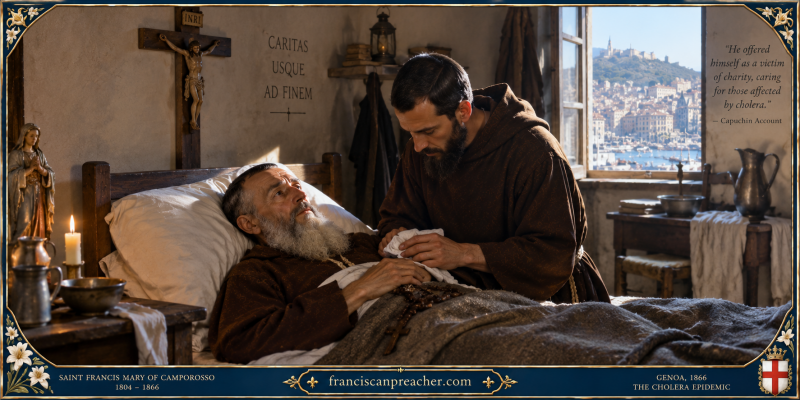
The seed that dies, that brings forth marvellous life. Saint Francis had spent his life giving himself away little by little. Then at the end he gave what remained.
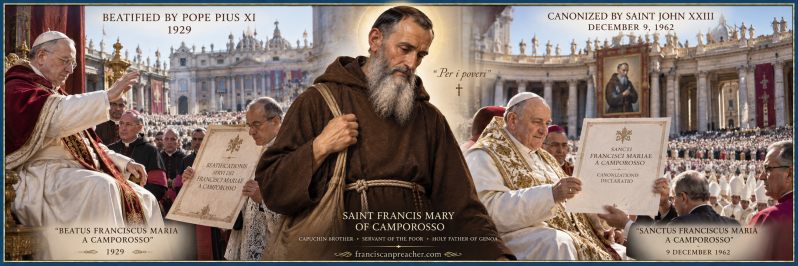
He was beatified by Pope Pius XI in 1929 and then canonized by Saint John XXIII on December the 9th, 1962.
In the Gospel, Jesus tells us, “The seed is the word of God” (Luke 8:11). And suddenly Francis of Camporosso becomes an extraordinarily good illustration of the rich soil.
Jesus describes who the rich soil symbolizes when he speaks about specific reactions to the Word of God. And he says of the good soil, “They are the ones who, when they have heard the word, embrace it with a generous and good heart, and bear fruit through perseverance” (Luke 8:15).
The final word, perseverance, may be the key to understanding Saint Francis Mary of Camporosso. Francis did essentially the same humble work not for a couple of months, or a couple of years, but for four decades. There's something profoundly Franciscan about that.
We sometimes imagine holiness as accomplishing something extraordinary. But the Gospel presents another possibility: receive the seed, protect it, and remain faithful long enough for God to produce the harvest.
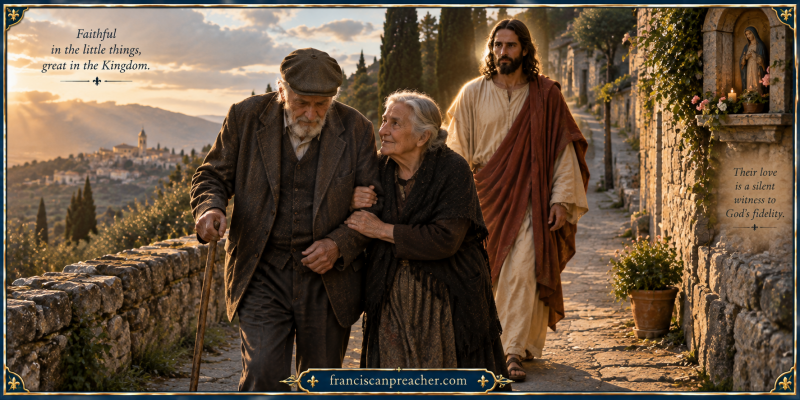
For a lot of us, for example, that's accomplished in marriage. But we can persevere and be consistent and constant in whatever vocation the Lord has given to us.
My brothers and sisters, through the intercession of Saint Francis Mary of Camporosso, may Almighty God bless you in a very special way, in the name of the Father, and of the Son, and of the Holy Spirit. Amen.
Go in peace, loving and serving the Lord.
Praise be to God.
Add comment
Comments