In today's first reading from the Book of Lamentations, which is traditionally traditionally associated with the prophet Jeremiah, although the author is not explicitly named, it was written in the aftermath of the destruction of Jerusalem, which we heard about yesterday, by the Babylonians in 587–586 B.C., the very event we have been hearing about throughout the past week.

In fact, in Second Kings, the city has fallen. Solomon's Temple has been burned, and the king has been captured, and thousands have been led into exile.
And this is not merely a historical account, my brothers and sisters. It is the cry of a broken people trying to understand how God's chosen city could be reduced to ruins.
After being so complacent and indifferent to their sin, the author recognizes that this disaster was not simply the result of Babylon's military strength, but of Israel's persistent infidelity to the covenant.
Yet even amid the overwhelming grief, the reading ends not in despair, but with an invitation: "Cry out to the Lord, pour out your heart like water in the presence of the Lord."
My brothers and sisters, genuine repentance remains a doorway for us, a doorway to hope.
In the Gospel.
Once again, after delivering the Sermon on the Mount, as we saw yesterday, Jesus is demonstrating through His miracles His divine authority behind His teachings.
And in today's Gospel, Matthew deliberately presents three miracles: the healing of the centurion's servant, Peter's mother-in-law, and then many others who are sick or possessed, that are healed and grouped together.
The centurion was a Roman officer, a Gentile, and therefore an outsider to Israel.
Jesus praises his extraordinary faith, declaring, and I quote, "In no one in Israel have I found such faith."
Matthew is using this encounter to foreshadow for us that the universal mission of the Church involves every nation, and not just Israel.
The Gospel concludes by quoting Isaiah 53: "He took away our infirmities and bore our diseases."
Identifying Jesus as the long-awaited suffering servant who heals both body and soul.
In today's first reading, we hear.
The question being posed, "Who can heal you?"
And this is being posed to the broken people of Israel who have been facing these horrific scenes of destruction all around them.
And the Gospel answers.
Jesus can.
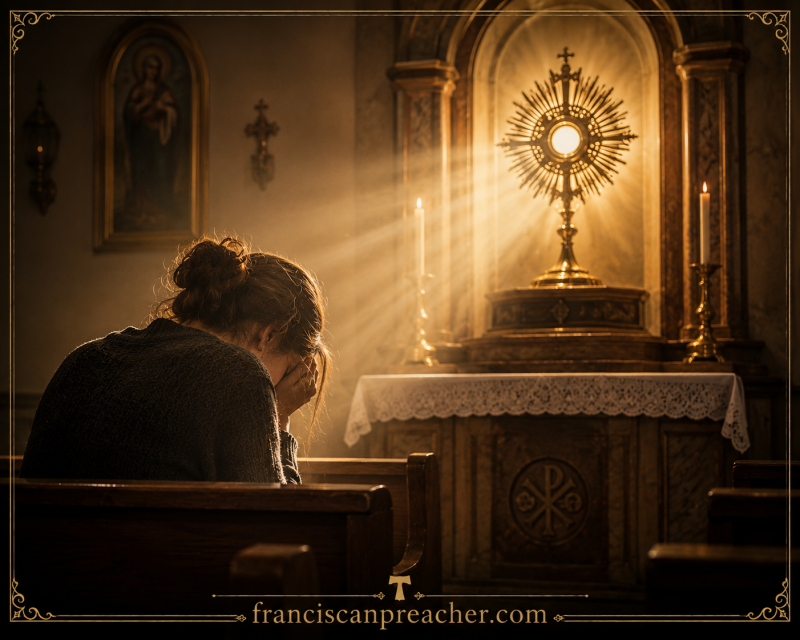
Jesus can heal us.
My brothers and sisters, Jesus wants to heal us on so many levels psychologically, emotionally, physically, spiritually, and it is important that we allow Him to heal us. Because if we continue to carry around our brokenness without addressing it. We end up lashing out at others. Building up walls around our hearts so that forgiveness can never be extended. We fall prey to the culture of vengeance and pride. And the sinfulness that brings about our destruction.
Little by little, and in our complacency and in our indifference. We often forget to turn back to the Lord. And so sometimes He allows for pain and suffering in our lives only because He wants us to return to Him.
Now, my brothers and sisters, we have seen that there are times where instead of, through trials and sufferings, people returning to God. They do the opposite. They are driven further away.
And of course, only God knows each and every one of our hearts. We can never judge, but we can ask, what is it that causes a person to turn away? In suffering from God.
Do we accept God only when we are dealt out good things? Should we not accept. The difficult things when they come. We receive good from the Lord. Why cannot we deal with evil when it comes to us in a way that pleases Him?
My brothers and sisters, may the good Lord give us the strength to look inward, to look at what might be bringing our own destruction little by little.
A lack of prayer.
A lack of healthy eating.
A lack of sleep.
A lack of forgiveness.
A lack of generosity.
A lack of peace in our hearts.
And instead of turning to Him, we turn to so many other frivolous things that can never heal us.
Search for Him in the tabernacle. He is there. He never runs away. You'll never go to the tabernacle and find that He's out of the office. He's nowhere to be found. He's always there. Such a pillar of presence in our lives.
And just sitting with Him in front of the Blessed Sacrament. He can heal us. We don't have to know each time that we're sitting in front of our Lord what to say, what to think. Just sitting silently in His presence is enough to heal us. That fidelity, that faith. To just sit with Him.
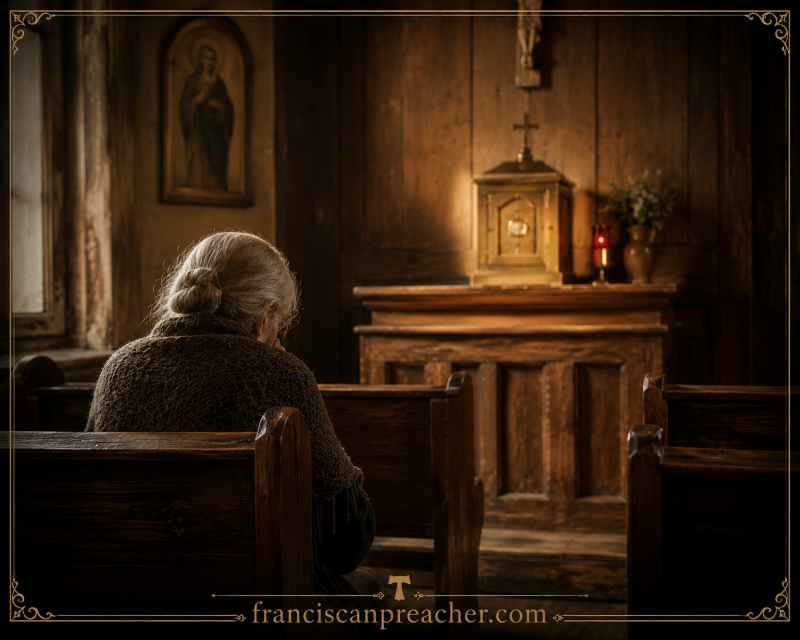
Just as spouses sit together on a bench in a park and perhaps hold hands, and they do not utter a word, but their mere presence with one another is an extension of their love and the goodness that they desire for each other.
So, too, just sitting with the Lord has great healing power in our lives.
Think about it.
Commit yourself more to spending time with Jesus.
He alone can heal the brokenness of our hearts.
In the name of the Father, and of the Son, and of the Holy Spirit. Amen.
Add comment
Comments