Today we celebrate the very beautiful and special memorial of Saint Justin Martyr. Saint Justin Martyr, who is remembered in the history of the Church as truly personifying martyrdom and what it means in a very special way. And so the first thing that comes to mind is, why does the Church give him this unique title when there were so many other martyrs, like, for example, Saint Peter, who was martyred and called the Apostle or the Prince of the Apostles, Saint Paul, who was martyred as well, Saint Ignatius of Antioch, Saint Polycarp.
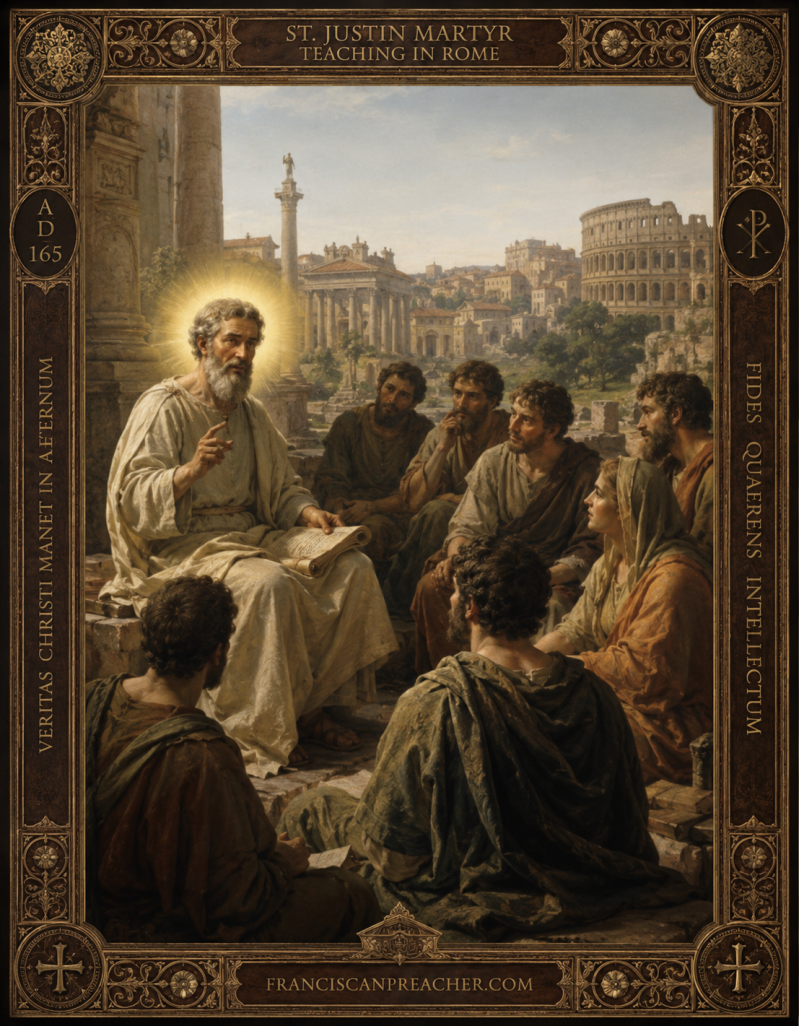
So why aren't they called Saint Peter Martyr or Saint Paul Martyr or Saint Polycarp Martyr? Well, because with Saint Justin Martyr, the title martyr became almost part of his proper name due to his public witness and execution, which were so defining in the memory of the Church.
Just like Saint Francis of Assisi becomes Alter Christus. Now, the Church does not give that title to any other saint, because Saint Francis so vividly represented and imitated the Lord in his humility, in his poverty, in his love for God. And so that was emblazoned in the memory of the Church. And so he was given the title Alter Christus.
My dear brothers and sisters, Saint Justin Martyr was born around 100 A.D. in Samaria in Flavia Neapolis, 100 A.D., which means just 67 years after the death of Christ. So close is he to the Lord himself and the Apostles. And so his writings and his teachings carry a lot of weight.
He searched through different philosophical schools before he embraced Christianity, and he called Christianity the true philosophy, and continued wearing the philosopher's cloak. After his conversion, he wrote major defenses of Christianity, especially the First Apology and the Dialogue with Trypho.
He gave one of the earliest descriptions of the Eucharistic liturgy. And this is very important because we learn from the disciples of the Apostles as well, that the bread that we break and the wine that we bless do not just become symbols, but the actual body and blood, soul and divinity of the Lord.
He was martyred in Rome around 165 A.D. after refusing to sacrifice to pagan gods.
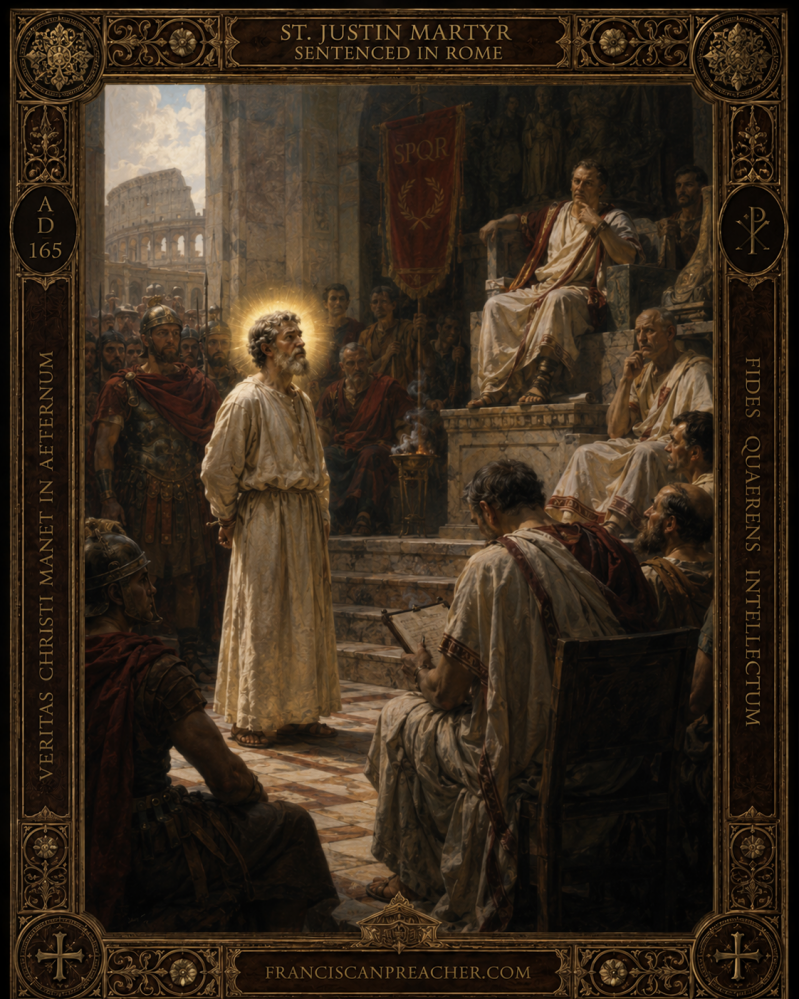
Now, a little lesser known story about Saint Justin Martyr is that he operated a Christian philosophy school in Rome. A pagan philosopher named Crescens became hostile toward him after Saint Justin publicly challenged him and reduced his philosophy to clearness. Justin reportedly predicted that Crescens would therefore have him killed, and during his trial, Justin boldly declared, and I quote, “No one who is right thinking turns from true worship to false worship.” He and his companions were then scourged and beheaded.
My dear brothers and sisters, in today's first reading from the Second Epistle of Saint Peter, we hear him emphasize that holiness is not self-made, but that it comes from God.
“His divine power has bestowed on us everything that makes for life and devotion” (2 Peter 1:3), said Saint Peter.
And the Church is using this reading on this feast of Saint Justin to show that even this very special martyr in the Church could only witness because of the divine power that had been bestowed on him, that gave him the energy for life and devotion and true devotion.
We may add Christians are called to transformation, says Saint Peter, and to, and I quote, “share in the divine nature” (2 Peter 1:4).
Saint Peter also speaks about how faith must continually grow. He says, “Supplement your faith with virtue, virtue with knowledge, knowledge with self-control” (2 Peter 1:5-6).
And my brothers and sisters, this is our life's journey, a lifelong journey where we grow, where we mature, where we allow the Holy Spirit to sanctify us. That what we believe, our faith, can be enriched by a life of virtue. And living a life of virtue, we can also seek greater knowledge about the Lord and about his ways, and about how to help people.
And that knowledge as well can be restrained with self-control. Otherwise it can turn into arrogance or pride. So it's a continual movement forward, a progression, a maturation in our faith.
The reading presents the Christian life almost like a ladder ascending toward love. Because if we do all these things, but we lack love, Saint Paul reminds us we have nothing.
Saint Justin lived this progression concretely. Intellectual knowledge led him to virtue, endurance, devotion, and finally, martyrdom.
In today's Gospel, the Lord gives us the parable of the vineyard, which represents Israel, and the tenants symbolize many of its leaders, especially the prophets.
God repeatedly sends servants in this parable who, of course, do represent the prophets, but they are rejected. And I quote, “Some they beat, others they killed” (Mark 12:5).
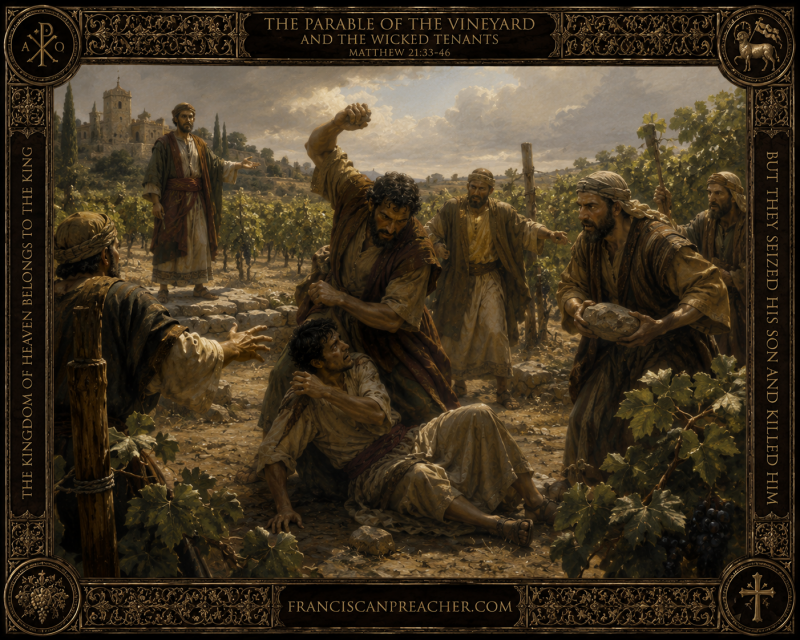
And then finally the owner sends a beloved son, clearly pointing to Jesus himself. And the tenants say, “This is the heir. Come, let us kill him” (Mark 12:7).
Now Jesus is foretelling his own rejection and death in Jerusalem. And the quotation, “The stone that the builders rejected has become the cornerstone” (Mark 12:10), points to Christ's victory through suffering and rejection, and how the Church he would found would grow and flourish through the blood of the martyrs.
Like Christ, Saint Justin was rejected by the world, but he became a powerful witness to the truth and to goodness, to God himself.
My brothers and sisters, through the intercession of Saint Justin and Saint Francis, may Almighty God continue to bless you on your journey, as our Blessed Mother continues to accompany you day and night, to bring you ever so much closer to the Lord Jesus, our God and our Savior.
In the name of the Father, and of the Son, and of the Holy Spirit. Amen.
Add comment
Comments