My dear brothers and sisters in Christ, peace be with you. On this 27th Monday in ordinary time, my brothers and sisters, today, instead of beginning with the first reading, and then moving on to the gospel, I'd like to focus on the Responsorial Psalm. And then we'll get to the readings. But in the Responsorial Psalm for today, we say that “the Lord will remember his covenant forever” (Psalm 111:5). Now, as you will recall, the Lord made a number of covenants. First with Noah, and then with Abraham, and then with Moses on Sinai, and then with King David, and all of them were pointing towards the greatest covenant or the fulfillment of the greatest covenant, which would be realized in Christ.

And this is so important, my brothers and sisters, that we really understand this movement through salvation history, this gradual unfolding of God's plan and how He showed us that he would always be with us, and that he was interested always, not only in good things for us, but in the greatest good.
And what is the greatest good for each and every one of us? Eternity with him. And he fulfills that through his promises, through what he promises his faithful sons and daughters.
So the responsorial psalm is, “The Lord will remember his covenant forever” (Psalm 111:5).
First of all, biblical remembering does not mean God had forgotten something. When scripture says God remembers his covenant, it means that he remains faithful to it, and acts according to the promises he has made.
For example, God remembered his covenant with Abraham, Isaac, and Jacob when Israel suffered in Egypt. In other words, he acted to save them because he remained faithful to his promise.
So Psalm 111 is really proclaiming that this that God will never cease to be faithful to what he has promised.
Now which of the covenants does Psalm 111 mean? to refer to? It does not specify only one covenant. Its language recalls especially God's covenant relationship with Israel, yes, but rooted in the promises to Abraham and manifested concretely in the Exodus and Sinai.
The surrounding verses are important. “He has given food to those who fear him. He will forever be minded. be mindful of his covenant. He has sent deliverance to his people. He has ratified his covenant forever” (Psalm 111:5, 9).
So originally an Israelite singing this song would naturally hear it in the context of God, God's enduring covenant faithfulness to his people and how he redeemed them from suffering and from slavery.
But Christianity reads that history as moving toward something greater. It's pointing towards a more beautiful, a more perfect, an everlasting liberation.
Because think of it, my brothers and sisters, God freed those people from Egypt, for example, from the Pharaoh. But those people died. They had to face the grave.
But Jesus came into the world to fulfill that promise that God would be with his people forever. by dying and laying down his life for us.
That is why we see that the prophets begins speaking of something still to come.
Jeremiah gives us the decisive expression in the Old Testament when he says, “the days are coming, says the Lord, when I will make a new covenant with the house of Israel and the house of Judah” (Jeremiah 31:31).
And then comes Jesus.
And at the Last Supper, my brothers and, sisters, and this is so important for us to understand, he takes the chalice and declares, “this cup is the new covenant. in my blood” (Luke 22:20).
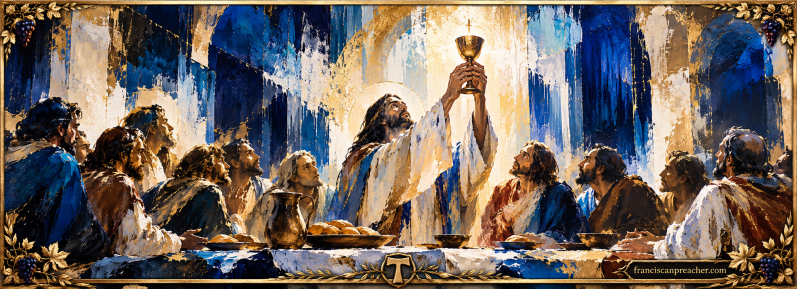
My brothers and sisters, that is an astonishing statement that we hear at every mass at every mass. We remember that it's in Jesus that God's true covenant with us, when he promises us that he will be with us forever.
It is in Jesus and what he has done for us, that those words come to perfect fulfillment.
Because God himself, the second person, of the divine Trinity, descended from his golden throne, to be born among us, to walk in our midst, to teach us, To die for us. so that when we breathe our last breath, we can be with him forever.
But in the meanwhile, even here and now, in his risen glory, he accompanies us, each and every one of us, every day in very special ways.
And so Jesus himself says, “I have come not to abolish but to fulfill” (Matthew 5:17).
So the earlier covenants, therefore, prepare for and find their fullest meaning in Christ.
Now, my brothers and sisters, this is so important because right now, when we are faced with the horror horrors and the nightmare of war. When we try to justify the political system of Israel today, attacking another people for whatever reason.
But when we justify that by declaring that God blesses his Old Testament people, and that that blessing is unconditional, we make a crucial error.
Because that blessing persists only in those who have accepted Christ, who have not rejected Him, in other words, who have not rejected God Himself when He came to us.
But what a lot of our Protestant evangelists brothers are doing when they brainwash, for example, the American president, Donald Trump, with oh, we we need to back Israel at all costs, whatever they say, goes.
Because “whoever blesses Israel is blessed will be blessed by God.”
They quote that Old Testament verse, but they're forgetting that there was a transition, there was a development, that that covenant, that blessing that God promised, persists only to those who have received his Son.
That is why Jesus says to the apostles, at the end of his Earthly ministry, and in his risen form, “go out and baptize all nations. In the name of the Father and of the Son and of the Holy Spirit, whoever believes will be saved. Whoever does not believe is already condemned” (Matthew 28:19; Mark 16:16; John 3:18).
Our Lord uses very strong language that we shy away from, but when we do, it leads to the justification of all kinds of atrocities and atrocities in the name of God.
And this, my brothers and sisters, is diabolic. diabolical.
This is a master class of deception from the evil one himself, who wishes to only ruin, to destroy, to kill, whereas God wishes to restore, to heal, to save.
My brothers and sisters, this is why Saint Paul, who originally as Saul, was a very staunch Jew to the exclusion of everything else. After he encountered the risen Christ and the Holy Spirit illuminated his heart and his mind to show him the progression of how God's truth moved from the Old Testament throughout, into the New Testament, and that it is about receiving him, receiving his son.
“Whoever receives me receives the one who sent me,” said Jesus (Matthew 10:40).
But this is why Saint Paul then goes on to say, to the Galatians, “there is neither Jew nor Greek, there is neither slave nor free person, there is not male and female, for you are all one in Christ Jesus” (Galatians 3:28).
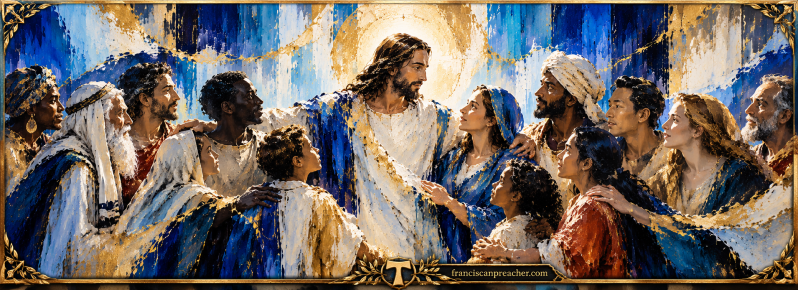
It was all about truly being faithful to what God had done.
And this is what makes us true Israelites. And when I say true Israelites, I mean what the church means about how now the new Israel, the new people of God is the universal church.
So that if a Jew converts, or if a Greek converts, or if an atheist receives Christ, that is what is important.
Because and then Saint Paul goes on to say, “and if you belong to Christ, then you are Abraham's descendant, heirs according to the promise” (Galatians 3:29).
That's in Galatians chapter three verse 29.
My brothers and sisters, pray over this. Look into this deeper. do your own research, but remember that God blesses those who have received his Son, who love him, and who live by one law, and one law alone.
And that law is love.
In the name of the Father and of the Son and of the Holy Spirit. Amen.
Go in peace.
Add comment
Comments