Today's readings at Mass confront us with the difference between mercy and indifference. Saint Paul refuses to pretend that serious sin does not matter, precisely because sin destroys the person and can corrupt the community. In the Gospel, Jesus refuses another distortion of religion: rules observed so rigidly that they prevent us from doing good. Rules that have been taken out of context, from the spirit in which God had allowed them.
True Christian love neither ignores sin nor allows religious observance to become an excuse for withholding mercy. Both readings will ask us the same question: What genuinely leads a person toward life and salvation?
In the first reading from the First Letter of Saint Paul to the Corinthians, he writes, “Brothers and sisters: It is widely reported that there is immorality among you, and immorality of a kind not found even among pagans—a man living with his father's wife. And you are inflated with pride. Should you not rather have been sorrowful?” (1 Corinthians 5:1-2).
So, my brothers and sisters, Paul's first concern here is not simply that grave sexual immorality exists, but that the Christian community has apparently become comfortable with it. It's like they're numb to the promptings of the Holy Spirit that is convicting them of that sin.
Saint Paul's response shows a kind of sorrow, like he's grieved. Sin should never become an occasion for self-righteousness or gossip. When another person is seriously harming himself spiritually, the Christian response begins with grief and concern for their salvation.
Now, my brothers and sisters, Saint Paul goes on to say that “when you have gathered together and I am with you in spirit, with the power of the Lord Jesus, you are to deliver this man to Satan for the destruction of his flesh, so that his spirit may be saved on the day of the Lord” (1 Corinthians 5:4-5).
Now that final phrase of Saint Paul is essential for understanding the severity of the situation: “so that his spirit may be saved.” The discipline is medicinal, not vindictive. Paul wants the man to confront the seriousness of what he is doing, repent, and ultimately be saved. Christian correction must always have restoration as its goal.
But this concept of penance is very difficult for the ears, especially those who think that they have done no wrong or that they are currently morally upright.
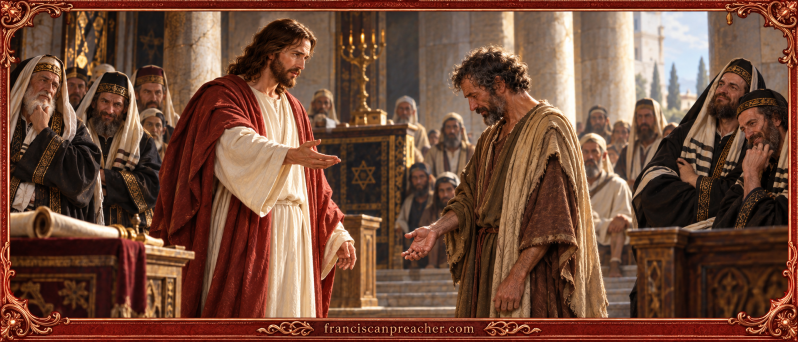
In the Gospel, we hear that “on a certain Sabbath, Jesus went into the synagogue and taught. And there was a man there whose right hand was withered. The scribes and the Pharisees watched him closely to see if he would cure on the Sabbath so that they might discover a reason to accuse him” (Luke 6:6-7).
My brothers and sisters, there's something very tragic happening here. A suffering man is standing before them, but instead of seeing someone who needs mercy, they see an opportunity to accuse Jesus. Religious observance has become detached from compassion.
And the reading goes on to say, “But he realized their intentions and said to the man with the withered hand, ‘Come up and stand before us.’ And he rose and stood there. Then Jesus said to them, ‘I ask you, is it lawful to do good on the Sabbath rather than to do evil, to save life rather than to destroy it?’” (Luke 6:8-9).
Now, Jesus here is going directly to the heart of the matter. The Sabbath was given by God for life, worship, human good, rest. Therefore, doing good cannot violate the true purpose of God's law. Jesus refuses a religion that knows the rule, but forgets the person standing in front of it.
So too, we have a lot of beautiful and important rules in our Catholic faith, like Sunday obligation, and the true family unit, what composes a true marriage, for example. And we have a lot of irregular marriages and relationships and people cohabiting, but also people who are in these situations who desire to be in good standing with the Church so that they will be able to receive the sacraments.
Now the rule is clear, precise, and full of purpose. But we cannot just take the truth and drop it like a bomb on a couple, for example, who's suffering or going through some kind of difficulty to regularize their union. We need to accompany that person with love, with patience, with mercy.
There is a process, a process of annulment, that a lot of times they have to engage in, and this process sometimes will take up to a year to complete and it takes effort, but the couple wants to do the right thing. And so we have to be careful that we're not judging them, that we're not making their life even more difficult.
Saint Francis gives us a particularly beautiful way of holding today's two readings together. For Paul insists that sin must not simply be ignored, and Jesus insists that the sinner and the suffering must never cease to be treated with mercy.
Francis faced exactly this tension when governing his brothers. In the Letter to a Minister, he gives extraordinary advice to a superior struggling with difficult and sinful friars. And Francis tells him, and I quote, “There should not be any brother in the world who has sinned, however much he could have sinned, who, after he looked into your eyes, would ever depart without your mercy.”

My brothers and sisters, that is a remarkable Franciscan principle. Francis does not say that the sin does not matter. In the same letter he speaks about brothers who have sinned, and the need to deal seriously with their situation. But the sinner must never look into the eyes of his brother and conclude, “There is no mercy left for me.”
That illuminates Saint Paul beautifully. Paul's severe discipline of the Corinthian man has an explicit purpose: “so that his spirit may be saved” (1 Corinthians 5:5). And it illuminates Jesus in the synagogue. The Pharisees see a problem with the Sabbath, and Jesus sees a man with a withered hand.
Let us ask the Lord to give us the grace to see our brother and sister in need before us, to address the situation, and to help them to come to the truth and into good moral uprightness through love and mercy.
In the name of the Father, and of the Son, and of the Holy Spirit. Amen.
Add comment
Comments