Today we celebrate the feast of Saint Bartholomew, one of the 12 apostles, named explicitly in the apostolic lists of the Synoptic Gospels and in the Acts of the Apostles. Bartholomew is probably not his personal name, but a patronymic from the Aramaic Bartalmei, meaning son of Ptalmei. An ancient Christian tradition identifies him with Nathaniel, whom we meet in today's gospel, largely because Nathaniel is closely associated with Philip in John, while Bartholomew is associated with Philip in the synoptic lists.
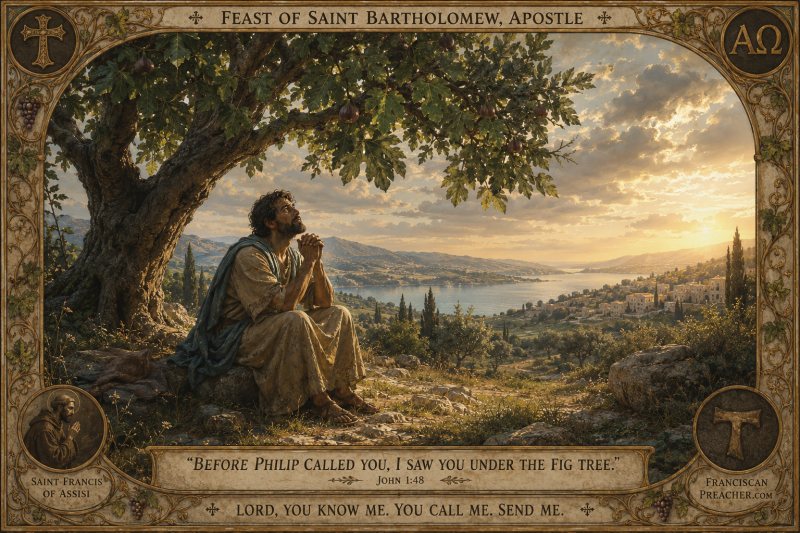
Nathaniel was from Cana in Galilee. He first appears skeptical. “Can anything good come from Nazareth?” (John 1:46). But he is also strikingly sincere. Jesus immediately recognizes this quality. “Here is a true child of Israel. There is no duplicity in him” (John 1:47).
When Jesus reveals that he had mysteriously seen him beneath the fig tree, Nathaniel makes the extraordinary confession, “Rabbi, you are the Son of God. You are the King of Israel” (John 1:49). The late Pope Benedict XVI noted that we do not know what happened beneath that fig tree. But clearly Jesus touched something deeply personal in Nathaniel, convincing him that Christ knew him completely.
Today's first reading from Revelation gives us a beautiful way of understanding Bartholomew's whole life. John sees the heavenly Jerusalem, whose wall rests upon “12 courses of stones as its foundation, on which were inscribed the 12 names of the 12 apostles of the Lamb” (Revelation 21:14).
St. Bartholomew is one of those foundation stones. This is especially striking because Scripture tells us almost nothing about what he accomplished after Pentecost. The man himself disappears, but the church built upon the apostolic witness remains. His greatness, therefore, was not in making himself remembered, but in making Christ remembered.
Tradition fills in some of what scripture leaves silent. Although we should distinguish carefully between historical evidence and later tradition, the fourth century historian Eusebius reports that when Pantaianus travelled to India, he found there a tradition connected with Bartholomew. Other ancient traditions associate his preaching with Mesopotamia and regions toward India, while a very strong Armenian tradition venerates Bartholomew together with Thaddeus as an apostolic evangelizer of Armenia.
The Holy See itself speaks of this as the ancient tradition of the Armenian Church, while acknowledging that the precise historical details cannot always be established with certainty.
And that makes the response of the Psalm almost biographical. “Your friends make known, O Lord, the glorious splendor of your kingdom” (Psalm 145:12).
How many beautiful opportunities we have had to make known the glorious splendor of Christ's kingdom, his goodness, the virtue that he instills in our hearts, and that he inspires us to live in our lives.
Saint Francis fits remarkably well in these readings as a companion, so to speak, to Saint Bartholomew. Because Francis wanted the friars to recover precisely this apostolic mobility: to encounter Christ, leave security behind, go out, announce the kingdom, and allow one's life to authenticate one's preaching.
Saint Bartholomew did not remain beneath his fig tree, and Francis did not remain in the security of his father's house in Assisi. Christ called both of them beyond, to transcend their comfort zones.
There's also a deeper connection with today's gospel. Jesus praises Nathaniel not for learning, eloquence, or accomplishment, but because there is no duplicity in him. That is profoundly Franciscan.
Saint Francis desired a life without masks, a life of simplicity, truth, poverty, and transparency before God. He inspires us friars and laity alike to follow Christ with a pure heart, with a focus, a singular purpose to truly live for Jesus, leave the world behind, and the allurements that so often distract us not only from God, but from one another.
Through the intercession of Saint Bartholomew, apostle to Armenia and to the nations, follower of Christ, may almighty God continue to bless us all.
In the name of the Father, of the Son, and of the Holy Spirit. Amen.
Add comment
Comments