In today's readings, we hear from the prophet Jeremiah and we hear from our Lord Himself, who both speak to us about a particular way in which God speaks to us, that is, through symbols and figures and parables. And we will see that He does this only because He wants us to delve deeper into what He's trying to impress upon us. He is always calling us back to Him, to His ways of doing things: love, mercy, generosity, and service.
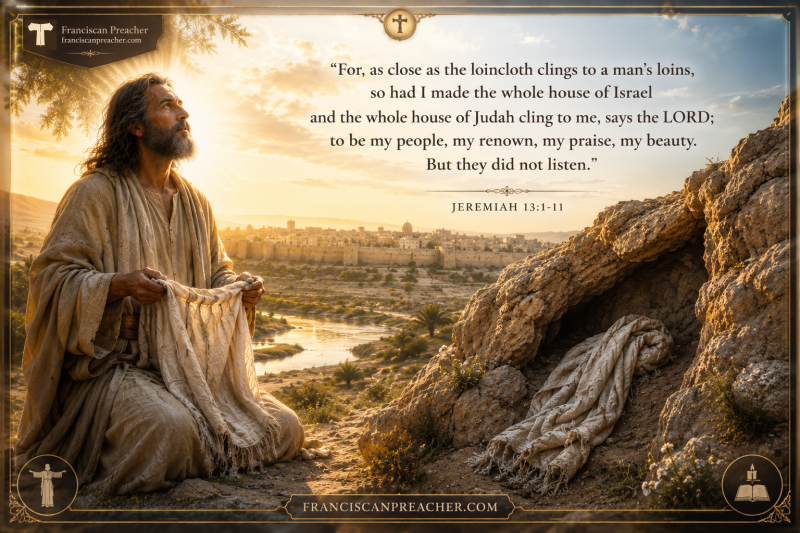
In today's first reading, we hear from the prophet Jeremiah, from the thirteenth chapter, which belongs to the prophet's early ministry around 627 to 605 BC, during the final decades of the kingdom of Judah before the Babylonian exile.
God often instructed Jeremiah to communicate His message through symbolic actions rather than words alone. In this passage, the linen loincloth is significant because linen was the material worn by priests. And you'll be able to find that in the Book of Exodus, chapter 28, verses 39 to 42. It symbolizes closeness, dignity, and a special relationship with God.
So, by Jeremiah burying the loincloth at the command of God near the Euphrates, and later retrieving it in a rotten condition when God asked him to go and get it, Jeremiah dramatically illustrates what has happened to Judah. It was this symbol of goodness and purity. The priesthood was intact, free from corruption, but it had lost its way. The people, once chosen to cling closely to the Lord, had become spiritually corrupted through pride, idolatry, and persistent disobedience.
The heart of this reading, my brothers and sisters, is not merely the warning of judgment, but the tragedy of a broken relationship.
But through it, through this evil and through this seeming tragedy of human failure and weakness and sinfulness, God was ushering in a new age, a kingdom that would never be separated or divided.
Remember that the kingdom was once united in the Old Testament. The United Kingdom. Saul was the first king. David established Jerusalem as the capital of that one kingdom. His son Solomon, of whom we heard yesterday, who asks for understanding in order to lead and govern the people, builds the first temple. It's the glorious age of Solomon.
But even Solomon had his imperfections, his defects, his defects. Because, my brothers and sisters, there will only be one King of kings. And you know who I'm talking about. The Lord Jesus, the King of kings, the Creator of all things, would eventually come to us.
The northern tribes had grown weary of Solomon's heavy taxation and forced labour, especially for his grand building projects. And so they asked Rehoboam, his heir, his son, to lighten their burden.
Instead, he famously replied: “My father disciplined you with whips, but I will discipline you with scorpions.” (1 Kings 12:11)
Only the tribes of Judah and Benjamin, out of the twelve, remained loyal to Rehoboam and the Davidic dynasty in Jerusalem.
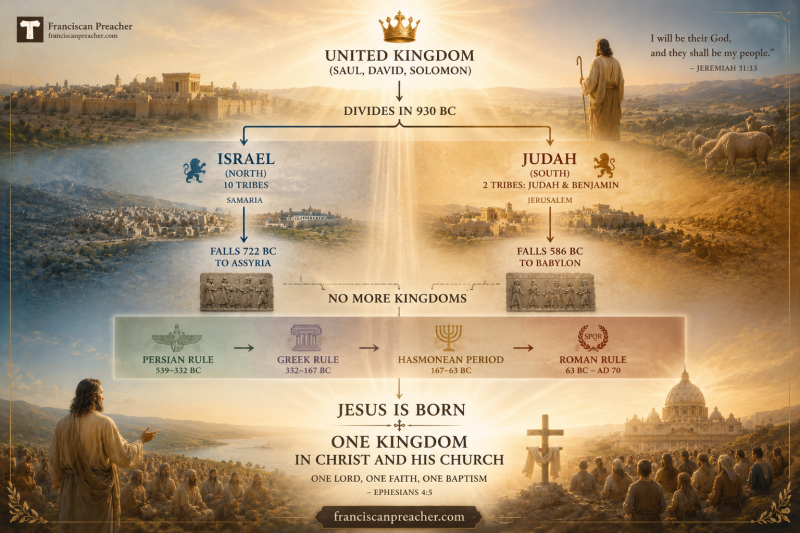
But from that moment there were two kings: Rehoboam, who ruled the southern kingdom, Judah, from Jerusalem, the capital city; and Jeroboam, who ruled the northern kingdom, Israel, whose capital was initially Shechem and Tirzah before Omri later established Samaria as the permanent capital.
So in the south, you had Jerusalem. In the north, you had Samaria. But both of these would come to a crashing end.
In the north, in Samaria, in the year 722 BC, they were invaded by the most brutal and ruthless of all the ancient empires, the Assyrians. The capital of Assyria was Nineveh. As you will recall, Jonah was sent there by God to preach repentance.
To the south, Jerusalem, the kingdom of Judah was overtaken by the Babylonians in 586 BC.
From that time all the way to the time of Jesus, never did the kingdom reunite.
And when Jesus dawns upon human history, there is no actually centralized kingdom of the people of God, but just the territory known as Judea, which of course we know was under Roman occupation.
Because the everlasting kingdom that God had promised David was not of earthly making. It was not the initiative of man, but it would only be fulfilled in that one King who is from everlasting, the King of kings, the Lord of lords, Jesus.
My brothers and sisters, in the first reading we heard God speak to us through a symbol, a loincloth. Jesus, in the Gospel, speaks to us through parables. And we're told that without parables—the exact quote is—“All these things Jesus spoke to the crowds in parables. He spoke to them only in parables, to fulfill what had been said through the prophet: ‘I will open my mouth in parables. I will announce what has lain hidden from the foundation of the world.’” (Matthew 13:34–35)
Jesus, the King who now unites us all, even here on earth, in one kingdom.
You know what that kingdom is?
The Church.
Now the Church, men and women and children of every nation, are adoring God in the true temple, all the Catholic churches around the world, with the Lord at its centre, each of those churches containing in the Most Holy Tabernacle His Body, His Blood, His Soul, and His Divinity, to be with us as we journey towards our heavenly homeland.
But we wait. The promises are not yet all fulfilled, for the Lord must return and gather all His children to Himself. And there in Heaven they will live with Him forever.
In the name of the Father, and of the Son, and of the Holy Spirit. Amen.
Add comment
Comments