Today in the Church, there is an optional memorial for a wonderful saint by the name of Apollinaris. It is one of the oldest commemorations of a bishop martyr in the Western Church. And although many of the details of his life come from later tradition, rather than from people who actually lived in his days, his witness was so deeply ingrained and rooted in the memory of the Church, that he has been venerated for well over 15 centuries, although he goes all the way back to the times of the apostles—20 centuries. Because Saint Apollinaris was a disciple of Saint Peter himself, the Prince of the Apostles.
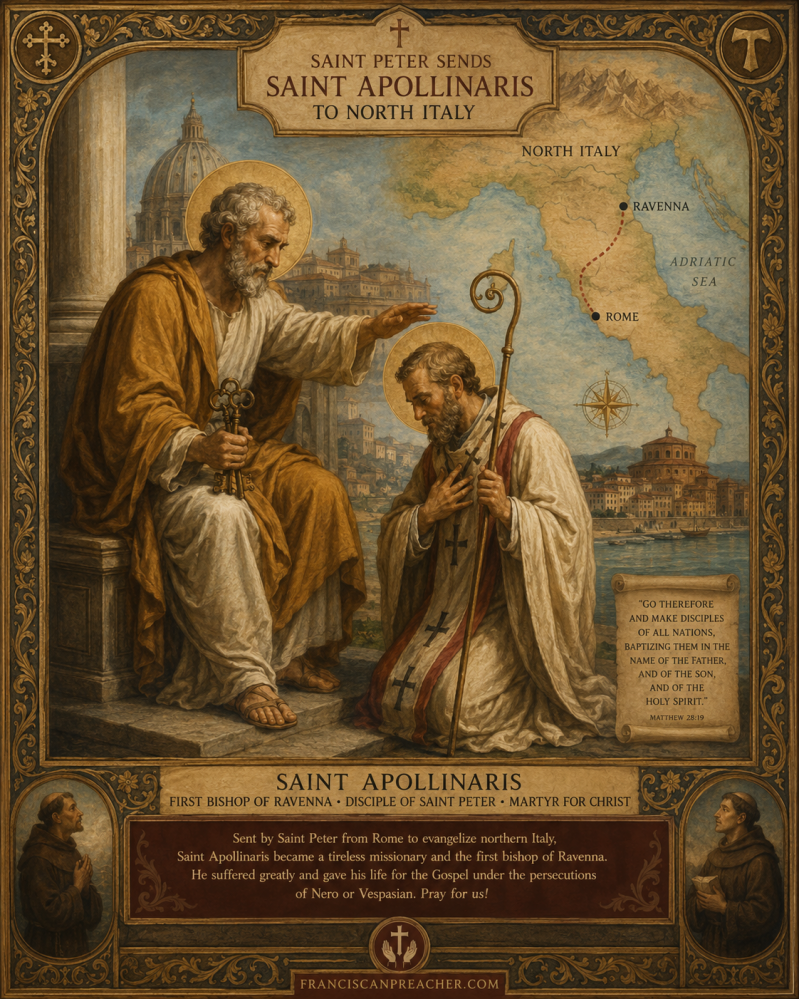
And Saint Peter sent him from Rome to evangelize northern Italy. Imagine. Now I myself right now reside in Rome as I have been stationed here to minister as a formator to our Franciscan students. And I can just imagine my superior saying to me, "I want you to head north into Italy to preach the Gospel and convert the masses over there." In a world that back then did not have the means of transportation that we have today, did not have the civilization that we have today, they were dangerous times. Don't forget, Christians were hunted down.
And so what kind of a man must this have been? Saint Apollinaris. For Saint Peter to entrust into his hands such a lofty mission, a dangerous mission. So he eventually becomes the first bishop of Ravenna, a city that would later become one of the most important Christian centres of the Western Roman Empire.
And so he's a missionary bishop. He leaves everything behind out of his love for Christ. And he did so under the horrific reigns of Nero or Vespasian, two brutal emperors of the Roman Empire. He was repeatedly imprisoned, beaten, exiled, and tortured for preaching Christ before eventually dying from injuries that he sustained during persecution.
There is no doubt that an early bishop named Apollinaris gave heroic witness to the faith in Ravenna and became the city's patron saint, even if not every detail is historically certain or 100% accurate. But that fact we can rely on. His magnificent Basilica of Saint Apollinaris in Classe still contains some of the finest sixth-century Christian mosaics in the world.
So what did he exactly accomplish? Well, his lasting accomplishments were not political or intellectual, but they were pastoral. He established the Church in Ravenna. He preached the Gospel where Christianity was, like I said, still persecuted and fragile, gathering scattered believers into a stable local Church. Because even back then, they realized how important it is we support each other, that we gather together on a Sunday, that we lift up our voices together to God.
My brothers and sisters, never take that for granted. It is true we receive the treasure beyond every other treasure at Mass, the Body and Blood of Jesus. But the fact that we meet together with all those other families who are all struggling, perhaps in the same way that your family is, but more importantly, who can all feel the tension between the world and the faith. All of us are there gathered together to praise our Lord, to hear His word and then to go out into the world again to be His witnesses and His disciples. And as He says, "You are the salt of the earth... You are the light of the world." (Matthew 5:13-14)

Saint Apollinaris shepherded his people through persecution. He didn't flee when opposition arose. Tradition says he endured repeated arrests and torture, but he continually returned to encourage the faithful. So we see that God gave this man a heart for the people.
He converted many through miracles and preaching. Ancient accounts describe healings, exorcisms, and conversions that accompanied his preaching. This is something that the Lord himself promised. "Go into the whole world and proclaim the gospel to every creature." (Mark 16:15) "These signs will accompany those who believe." (Mark 16:17) And our Lord lists off a number of incredible things that would accompany the words that were being spoken. So that if people didn't believe the words, they could at least believe the works that they were seeing.
So Apollinaris became the model of an apostolic bishop. He embodied the ideal of a bishop who knows his people personally, suffers with them, and is willing to die for them. And most of all, who is handing on to them the truth that God has revealed to us.
In today's first reading from the Book of the Prophet Ezekiel, God condemns Israel's false shepherds and then makes an astonishing promise. And I quote: "I myself will look after and tend my sheep... The lost I will seek out, the strayed I will bring back, the injured I will bind up, the sick I will heal." (Ezekiel 34:11, 16)
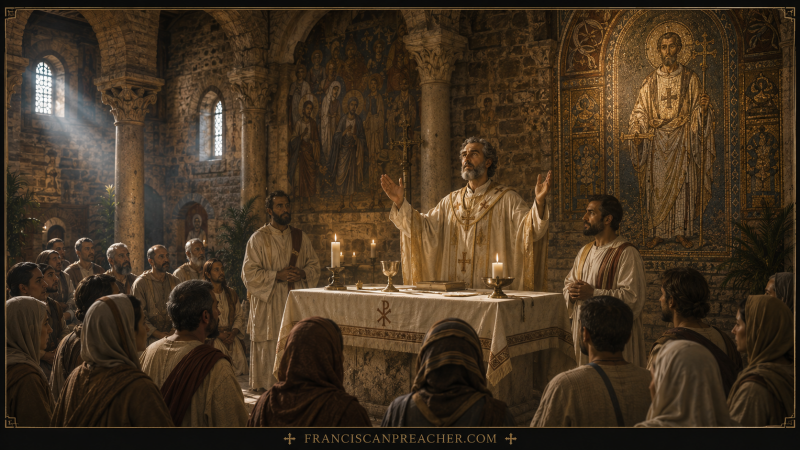
So this prophecy has two levels. First, God himself will become the shepherd. And we see this also in the Gospel, where Jesus himself says, "I am the good shepherd." (John 10:11) And Jesus, of course, is God among us.
But secondly, He will exercise that shepherding through those whom He appoints. My brothers and sisters, here at franciscanpreacher.com, we ask you to pray for us who have been assigned to preach to you the Good News. Pray for your priests and your religious, for your sisters, and the monks, and the brothers, all those who have consecrated themselves in order to accompany you through the perils, the spiritual perils of this world.
Pray for us. For as you know, we are attacked. We are attacked by the evil one. For the last thing that he wants is that the word of Christ gets out there. It's like a secret that he doesn't want known, that treasure hidden in a field that God wants us to find, but that the devil does not. And so he will attack us priests for trying to bring you that treasure hidden in a field.
Pray for us as we pray for you. And may Saint Apollinaris, that wonderful man of God who shed his blood for the faith, now from eternal bliss, pray for each and every one of us.
In the name of the Father, and of the Son, and of the Holy Spirit. Amen.
Lectionary: 601B
Below are the readings suggested for today's Memorial. However, readings for the Memorial may also be taken from the Common of Martyrs (#713-718), or the Common of Pastors (#719-724).
Reading 1
Thus says the Lord GOD:
I myself will look after and tend my sheep.
As a shepherd tends his flock
when he finds himself among his scattered sheep,
so will I tend my sheep.
I will rescue them from every place where they were scattered
when it was cloudy and dark.
I will lead them out from among the peoples
and gather them from the foreign lands;
I will bring them back to their own country
and pasture them upon the mountains of Israel
in the land's ravines and all its inhabited places.
In good pastures will I pasture them,
and on the mountain heights of Israel
shall be their grazing ground.
There they shall lie down on good grazing ground,
and in rich pastures shall they be pastured
on the mountains of Israel.
I myself will pasture my sheep;
I myself will give them rest, says the Lord GOD.
The lost I will seek out,
the strayed I will bring back,
the injured I will bind up,
the sick I will heal,
but the sleek and the strong I will destroy,
shepherding them rightly.
Responsorial Psalm
- (1) The Lord is my shepherd; there is nothing I shall want.
The LORD is my shepherd; I shall not want.
In verdant pastures he gives me repose;
Beside restful waters he leads me;
he refreshes my soul.
R. The Lord is my shepherd; there is nothing I shall want.
Even though I walk in the dark valley
I fear no evil; for you are at my side
With your rod and your staff
that give me courage.
R. The Lord is my shepherd; there is nothing I shall want.
You spread the table before me
in the sight of my foes;
You anoint my head with oil;
my cup overflows.
R. The Lord is my shepherd; there is nothing I shall want.
Only goodness and kindness follow me
all the days of my life;
And I shall dwell in the house of the LORD
for years to come.
R. The Lord is my shepherd; there is nothing I shall want.
Alleluia
- Alleluia, alleluia.
I am the good shepherd, says the Lord;
I know my sheep, and mine know me.
R. Alleluia, alleluia.
Gospel
Jesus said:
"I am the good shepherd.
A good shepherd lays down his life for the sheep.
A hired man, who is not a shepherd
and whose sheep are not his own,
sees a wolf coming and leaves the sheep and runs away,
and the wolf catches and scatters them.
This is because he works for pay and has no concern for the sheep.
I am the good shepherd,
and I know mine and mine know me,
just as the Father knows me and I know the Father;
and I will lay down my life for the sheep.
I have other sheep that do not belong to this fold.
These also I must lead, and they will hear my voice,
and there will be one flock, one shepherd."
Add comment
Comments