In the beautiful readings that are presented to us today, we will have a lot to learn about examining ourselves, our conduct before God, and to see whether or not we ourselves are living in accordance with his will and with his commands. As we will see repeatedly, God admonishes his people, but his sound guidance and his loving counsel fall on deaf ears, and the people preferred to follow strange and foreign gods, non-existent gods, and they turned their back on the one true God.
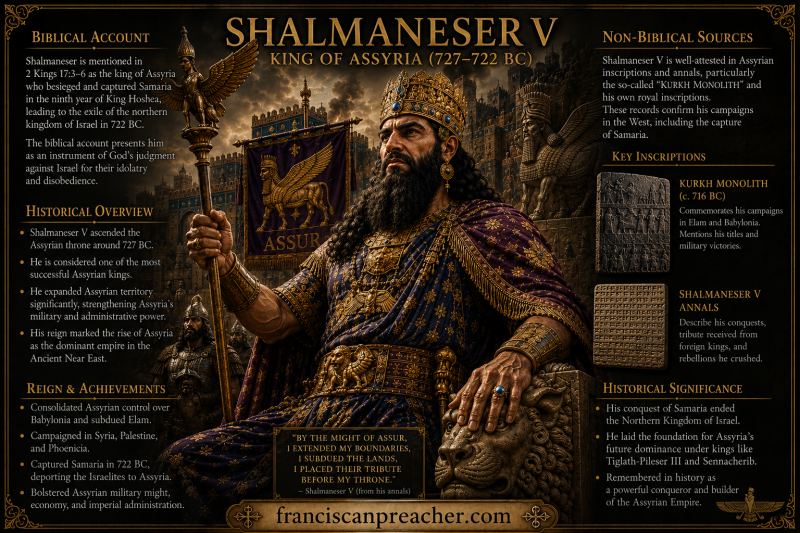
And so we finally hear what happens when the people resisted prophets like Ezekiel, Amos, and Jeremiah, where we're told in the first reading that "Shalmaneser, the king of Assyria, occupied the whole land and attacked Samaria, which he besieged for three years. In the ninth year of Hoshea, king of Israel, the king of Assyria took Samaria and deported the children of Israel to Assyria, settling them in Halah, at the Habor, a river of Gozan, and the cities of the Medes."
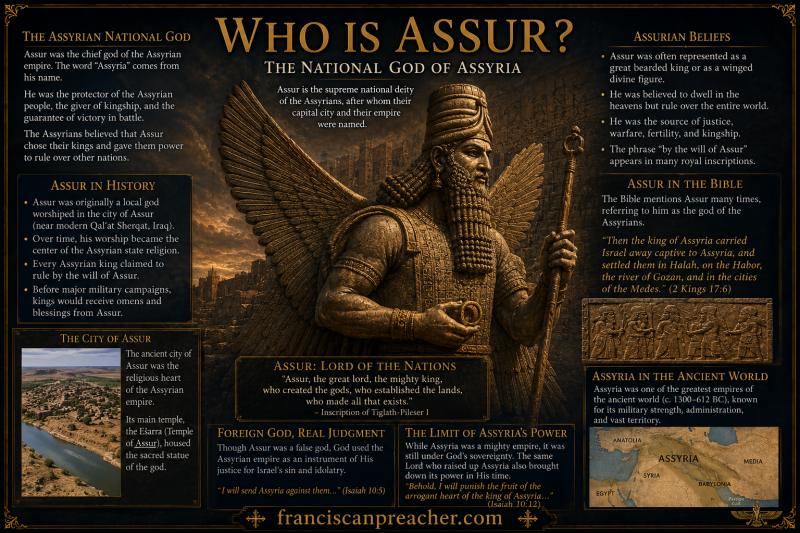
My brothers and sisters, we keep in mind that Assyria was one of the cruelest empires in the known ancient world. And this is why, for example, the prophet Jonah refused to go to Nineveh, which was the capital of Assyria, because he feared that God would end up sparing it and showing mercy to these cruel barbarians. Eventually he goes, and eventually the entire nation converts, and they turn their hearts to the true God, because up until then, their god was Ashur.
And I will provide you in today's written homily a few images of both King Shalmaneser, the king of Assyria, and the god that they worshipped, Ashur, from which the name Assyria comes. He was thought to be the god of war, and the one who brought about military victories against other nations, and the god of kings. And so for many years this is the god that shaped those people in that part of the world throughout that part of history.
And so the reading continues that... "it came about because the children of Israel sinned against the Lord their God, who had brought them up from the land of Egypt, from under the domination of Pharaoh, king of Egypt. And because they venerated other gods, they followed the rites of the nations whom the Lord had cleared out of the way of the children of Israel, and the kings of Israel whom they set up."
So even some of Israel's own kings had grown to be evil and idolatrous, like Ahab, who was supposed to keep the people safe, who was supposed to tend the flock of God, the people of God. Kings like Joash, who was installed as a seven-year-old innocent king, did many beautiful, amazing, wonderful things in his youth. But then his own heart was corrupted, and he too turns to false gods. Imagine.
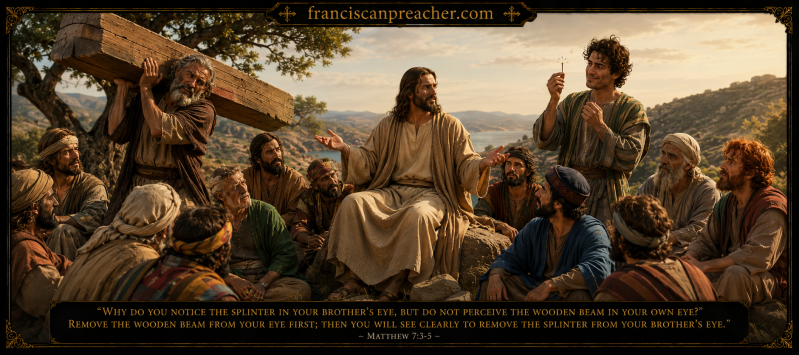
How about ourselves, my brothers and sisters? And this is why in the Gospel Jesus is telling us that it's easy to point towards others, but we need first to look at ourselves in this Gospel that is so often misunderstood. Jesus is saying, do not judge by appearances. And elsewhere he says in John 7:24, “Judge with right judgment.” Right?
So in today's Gospel, where Jesus says, “Stop judging, that you may not be judged,” okay, and then he says, “You hypocrite, remove the wooden beam from your eye first. Then you will see clearly to remove the splinter from your brother's eye.” So he does want us to remove the splinter from our brother's eye. But we need to be people who are capable of right judgment.
Okay, so Jesus himself is not commanding us to cease all kinds of judgments, for the Church has taught us for millennia, and therefore Christ through the Church, that Christians must often make moral judgments about actions, doctrines, and behaviour. For example, we may judge that murder is evil. We may judge that adultery is sinful and very painful to the afflicted party, to the party that is betrayed. We may judge that a teaching is false, like when our Mormon and our Jehovah Witness brothers and sisters proclaim Jesus to be merely a prophet at best, a lesser kind of god.
This is false. Pastors, parents, teachers, and civil authorities often make prudent judgments. What we may not do is claim to know the interior state of another person's soul. Only God sees the heart perfectly.
So what is Jesus condemning exactly in the Gospel? He's condemning rash judgment. The Church teaches that rash judgment occurs when we assume the worst about other people without sufficient evidence. The Catechism states in article 2477: “He becomes guilty of rash judgment who, even tacitly, assumes as true, without sufficient foundation, the moral fault of a neighbour.” A Christian should strive to interpret another's actions in the most charitable way possible.
Jesus is particularly attacking hypocrisy here. The image is intentionally humorous. A man has a huge wooden beam sticking out of his own eye while attempting eye surgery on someone else. The point is not that the other person has no fault. The point is, deal with your own sins first. Only then can you truly help your neighbour.

Saint Augustine noted that Christ here is speaking about faults we cannot know with certainty. He warns that we often see an outward action but cannot see motives, circumstances, intentions, and repentance. Many people condemn others for the very sins they themselves secretly commit. The beam that Jesus speaks of often consists of pride, which blinds us to our own faults.
My brothers and sisters, as we attend Mass today, let us ask the Lord to give us a pure heart, to help us to strive towards a virtuous life, to make of us instruments of fraternal correction, correction that is done with charity, not with judgment, with charity, for the good of the other. For this is true love, when we will the good of the other.
But first and foremost, let us respond to the promptings of the Holy Spirit within us, who wishes to purge, to purify, to extract from within us that which is ungodly, which involves a day-to-day journey of interior conversion. If we allow him to speak to us in prayer, and if we make our way over to the confessional on a frequent basis, look after your soul, look after one another, for an eternity awaits us all.
And God is with us to help us, to love us, to guide us by illuminating our paths and setting our feet upon solid ground, the solid ground of his truth.
May Almighty God bless you, the Father, the Son, and the Holy Spirit. Amen.
Add comment
Comments