On this Monday of the 11th Week in Ordinary Time, Year A, our first reading is from the First Book of Kings, and one of those kings in the history of Israel was Ahab. Ahab, who got it wrong so many times. And having an evil wife, Jezebel, didn't help him either.
So we hear the very dramatic and tragic story—tragic for Naboth, who owned a vineyard beside the king's palace. A man from Jezreel, he possessed a vineyard that had belonged to his family for generations and so happened to be located right beside the palace of King Ahab. Ahab wanted the vineyard for a vegetable garden and offered Naboth either money or a better vineyard in exchange. But Naboth refused because the land was his ancestral inheritance entrusted to his family by God.
And so, angered and depressed by the refusal, Ahab returned home and sulked like a baby, the king of Israel refusing to eat. Seeing his misery, his wife Jezebel promised to obtain the vineyard for him. So she secretly wrote letters in Ahab's name to the leaders of Naboth's city, ordering them to arrange false charges against him.

Two dishonest witnesses accused Naboth of cursing God and the king, and so the people ended up stoning him to death. When Jezebel learned of this, she told Ahab that the vineyard was now his for the taking. Ahab immediately went down to the vineyard and took possession of it, believing he had finally gained what he had desired for so long. But Naboth's blood cried out to God for justice.


My dear brothers and sisters in Christ, when desire is not governed by justice and the fear of God, it can lead to terrible evil. Ahab's sin begins with something that seems small. He wants something that belongs to someone else. What do we call this? We call this coveting, right? A few of the commandments: “You shall not covet your neighbour's wife. You shall not covet your neighbour's goods.” And he coveted this vineyard that didn't belong to him, even though he was king, who really, if you think about it, had everything he could possibly want. But it was that little vineyard that gave him the itch.
Instead of accepting Naboth's rightful refusal, he becomes resentful and self-pitying. Jezebel then takes that disordered desire and turns it into a conspiracy involving lies and corruption, demonstrating an abuse of power and, ultimately, murder. What begins as coveting ends in bloodshed. You see how respectful we ought to be of God's commandments and guidance. Otherwise, we lose our way. We hurt ourselves. We hurt others.
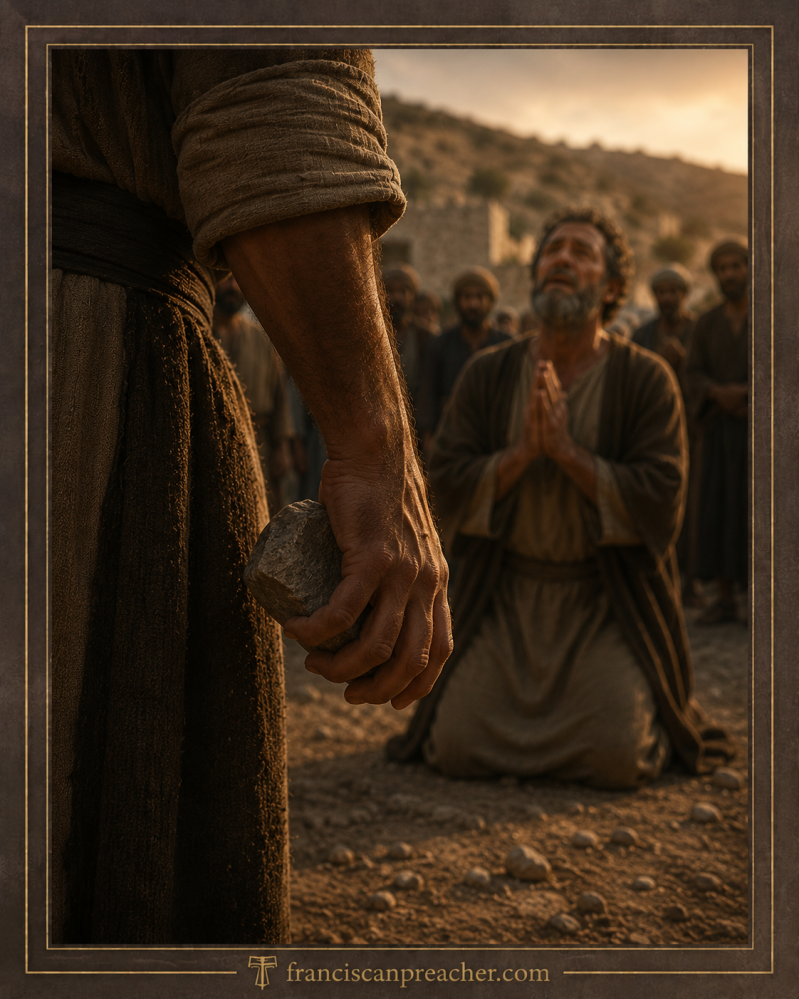
This story teaches us that not everything can be bought. Not everything has a price tag. Naboth understands that his vineyard is not merely property. It is a sacred inheritance entrusted to him by God through his ancestors. We also learn that evil, as personified in Jezebel, often requires cooperation. The elders, nobles, and false witnesses all participate in the injustice. Their silence afterwards and compliance with the letters that were sent out to them make the crime possible. But God sees it all. The innocent may suffer, but God sees. Naboth appears defeated. And in the next episode, which we will examine throughout this week, the conclusion to this story is one in which Naboth is vindicated. God sends the prophet Elijah to expose the crime and pronounce judgement.
And finally, to reiterate a point made earlier, perhaps one of the greatest lessons of this story is that small sins can grow into great sins. Covetousness, envy, self-pity, and resentment are not harmless if they are allowed to take root.
My brothers and sisters, in the Gospel, Jesus gives us the opposite spirit. Jesus said to the disciples, “You have heard that it was said, an eye for an eye and a tooth for a tooth. But I say to you, offer no resistance to one who is evil.”
Now that saying, “an eye for an eye and a tooth for a tooth,” was formulated in antiquity because what they had been seeing is that oftentimes justice would mete out to the criminal a punishment greater than what the crime deserved. So someone would steal a loaf of bread, and they'd give him twenty years of heavy labour, almost like the story Les Misérables. And so they came out with the law: “An eye for an eye, a tooth for a tooth.”
But Jesus says, “Offer no resistance to one who is evil.” In other words, do not plan payback. Vengeance. “And when someone strikes you on the right cheek, turn the other one to him as well. If anyone wants to go to law with you over your tunic, hand him your cloak as well."
Now the Lord here is speaking in this way, why? Because our ultimate destiny is not here. Our home is not in this world, but in the eternal abode of Paradise with God. And in that worldview, everything changes. And Jesus was always speaking with a spirit of our eternal destiny in mind.
May the Lord, in His mercy and in His kindness, the One who went the extra mile for all of us, bless you in a very special way to obey His command, to live heroic virtue in your life.
In the name of the Father, and of the Son, and of the Holy Spirit. Amen.
Add comment
Comments