In today's readings, we have an awesome juxtaposition between the Beatitudes that Jesus leaves us and the ways and the mentalities of the world which God leaves behind. My dear brothers and sisters, in today's first reading from the First Book of Kings, we are introduced to the amazing figure of the prophet Elijah.

I will cite the reading itself again because of its brevity. We read:
“Elijah the Tishbite, from Tishbe in Gilead, said to Ahab: ‘As the LORD, the God of Israel, lives, whom I serve, during these years there shall be no dew or rain except at my word.’ The LORD then said to Elijah: ‘Leave here, go east and hide in the Wadi Cherith, east of the Jordan. You shall drink of the stream, and I have commanded ravens to feed you there.’ So he left and did as the LORD had commanded. He went and remained by the Wadi Cherith, east of the Jordan. Ravens brought him bread and meat in the morning, and bread and meat in the evening, and he drank from the stream.” (1 Kings 17:1-6)
My dear brothers and sisters, this introduces us to the figure of Elijah and how he is sent by God to the king of Israel, who had lost his way.
Ahab, one of the best politically, but most disastrous spiritually.
Now, just to give you a bit of an idea of who these figures are and where they are chronologically placed in salvation history, we note that Ahab reigned from 874 to 853 BC.
Now, I will remind you that we're counting down to year zero. So anything greater in number than 874 means it is older.
In other words, King Saul, 1050 BC, came around 200 years before the reign of Ahab. Then, after Saul, King David, 1010 BC, and then his son Solomon, 970 BC. Then the kingdom divides. In 930 BC, there's north Israel and Judah to the south.

The northern kingdom falls into repeated idolatry, and this is when the reign of Ahab begins, and his evil companion, wife Jezebel, promotes the worship of Baal.
Now Elijah appears suddenly on the scene. We're not given any genealogy, no childhood story. He appears like a thunderbolt, just out of nowhere.
God raises prophets precisely when leaders fail, and God often raises unexpected saints as well in times of crisis.
The darker the age, the greater the saints that God provides.
Ahab and Jezebel were ruthless.
Ahab was one of Israel's worst kings. Like I said, politically successful but spiritually disastrous.
Jezebel, the princess from Sidon, modern Lebanon, was a devoted worshipper of Baal, and she imported pagan religion into Israel, sponsored hundreds of pagan prophets, but she persecuted the prophets of God.
My brothers and sisters, evil often enters gradually through compromise.
Ahab did not reject Yahweh outright, but he attempted to mix Yahweh and Baal into one god, one religion, kicking to the curb, so to speak, the only one true God who exists.
Now why does God send the drought?
Because the punishment perfectly matches the sin.
Baal was believed to be the god of rain, the god of storms, of fertility, of crops, of agricultural abundance.
And so Elijah effectively says to King Ahab, “You think Baal controls the rain? Foolish man. Let's see.”
And then God shuts the heavens.
Three years of drought become God's demonstration that Baal is powerless.
Now we will note that Baal is one of the names that one of the fallen demons takes upon himself, and one of the generals of Satan that the exorcists speak about.
And so this is what Satan always tries to do: create these false gods.
And Elijah speaks about “the God before whom I stand” (1 Kings 17:1).
In other words, he serves not Ahab, not public opinion, not the culture, not any false god, but he stands before God Almighty, who is one, true, and holy.
The fear of God frees us from the fear of men.
The closer we get to God, the more fearless we become in the face of persecution.
Elijah goes east of the Jordan, and here we find important symbolism because Israel remains in the Promised Land and Elijah leaves it.
And what's the message in that?
Well, that God's people have spiritually exiled themselves.
They possess the land, but they've lost touch with the covenant, with the marriage they entered into between God and themselves.
My brothers and sisters, a person can sit in church every Sunday and yet be spiritually far from God.
It really does boil down to our personal relationship with Him.
Now, modern forms of Baal worship.
Pornography.
Sexual libertinism.
Identity built primarily upon sexual desires.
Submission to fertility gods, where the modern mind begins to think, “I decide truth. My desires determine morality.”
The self becomes a little kind of god.
The worship of power.
Ancient kings used Baal worship for political advantage.
The modern worship of Baal enters into ideologies, political messianism.
“I will save you. I will make your life better. No more wars. Peace in the world. I am the liberator. The saviour.”
Treating governments or movements precisely as saviours.
We fall into this, my brothers and sisters, and we need to be careful of it.
What is the answer to all of this?
We begin with the Responsorial Psalm:
“Our help is from the Lord, who made heaven and earth.” (Psalm 121:2)
We read:
“The LORD will guard you from all evil; he will guard your life. The LORD will guard your coming and your going both now and forever.” (Psalm 121:7-8)
Jesus.
The way Jesus shows us where true blessedness lies.
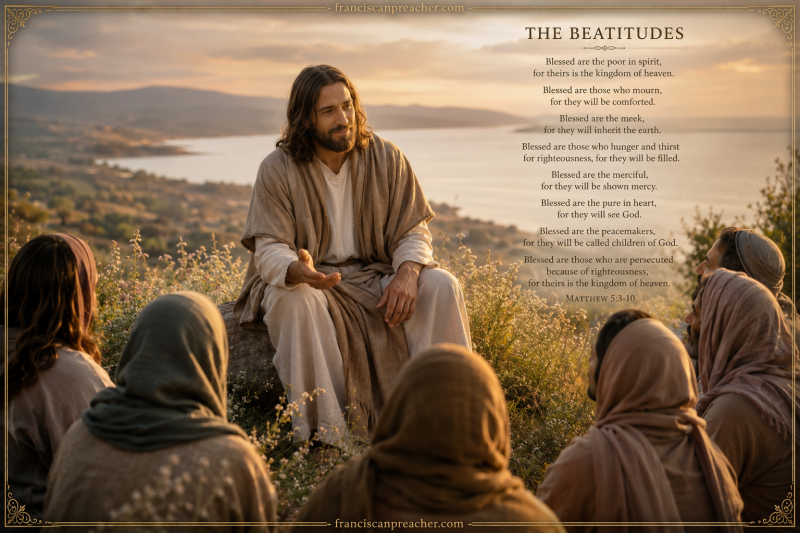
And He speaks of the Beatitudes, those things that will truly bring happiness into our lives.
Being poor in spirit.
Being meek.
Thirsting for what is good and holy and righteous.
Being merciful.
Being pure of heart.
Honest, truthful, courageous.
Being peacemakers.
When we are persecuted for doing good, even there, Jesus says there's true and profound happiness.
“Blessed are they who are persecuted for the sake of righteousness, for theirs is the Kingdom of Heaven.” (Matthew 5:10)
When people insult us and persecute us and speak all kinds of evil against us falsely because of Him, because of Jesus, then is our happiness at its peak.
For as Jesus says:
“Rejoice and be glad, for your reward will be great in heaven.” (Matthew 5:12)
And:
“Thus they persecuted the prophets who were before you.” (Matthew 5:12)
So what we're going to see throughout these next few weeks, reading into the life of Elijah and his ministry to the people of God, is a prophet who is persecuted for speaking the Word of God and doing His will.
And this is what we are called to do through the Beatitudes, the instructions that Jesus gives us to do God's will, and then we will be serving the true and only God.
May He bless you.
In the name of the Father, and of the Son, and of the Holy Spirit. Amen.
Add comment
Comments