My dear brothers and sisters in Christ, in today's Gospel we continue the reading which describes the meeting between Nicodemus and Jesus, between a teacher of the law and the supreme legislator of the law, although yet unknown to Nicodemus in His fullness. And so Nicodemus is inquiring, and Jesus says to him—and we continue from yesterday's Gospel—“You must be born from above” (John 3:7). “The wind blows where it wills, and you can hear the sound it makes, but you do not know where it comes from or where it goes. So it is with everyone who is born of the Spirit” (John 3:8).
And my brothers and sisters, there is a transitioning from darkness to light, from death to life, from despair to joy, from slavery to freedom in anyone who was not only born again through Baptism, but who dedicates themselves to cultivating the gift that was planted, the seed that was placed in the heart of that individual even as an infant—an infant who grows, who learns, who becomes that free son and daughter of God that he was always meant to be. And in today's first reading, we have an example of what it looks like to cultivate the gift of spiritual rebirth through water and the Holy Spirit. When we allow the Holy Spirit to work within us, He gives us the grace. He guides us. He directs us. But we also need to be open to that direction. We also need to be attentive to the whisperings of His sweet voice in our ear when we know we are about to do something which is not conducive to our vocation. Because sometimes, even though He whispers, and even though our guardian angel tries to help us if we ask him, we nevertheless sometimes make the wrong decisions.
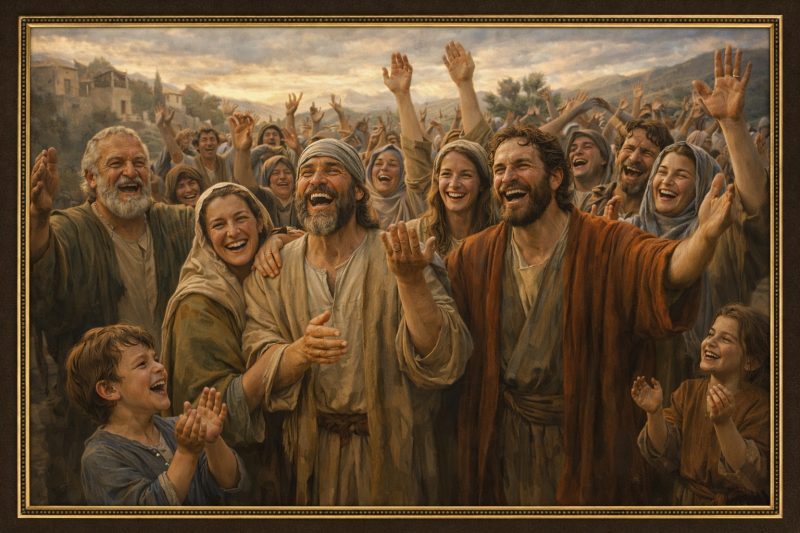
In this first reading, the people of God, the first early Christians, made the right decisions. Listen to how beautifully they are described: “The community of believers was of one heart and mind, and no one claimed that any of his possessions was his own, but they had everything in common” (Acts 4:32). “With great power the Apostles bore witness to the resurrection of the Lord Jesus, and great favor was accorded them all” (Acts 4:33). “There was no needy person among them, for those who owned property or houses would sell them, bring the proceeds of the sale, and put them at the feet of the Apostles, and they were distributed to each according to need” (Acts 4:34–35).
Now, my brothers and sisters, a lot of political debates and arguments in favor of communism and socialism often point to this very passage to buttress their positions. But what is the big difference between communism and what we just heard? Communism forces people to do things. Communism coerces people to do things. Communism abolishes private property by political force. It redistributes through state power the goods that it has pending in its resources, through coercive economic restructuring. But nothing in this passage suggests coercion. Peter affirms that the land belonged to them privately. “While it remained unsold, did it not remain your own? And when sold, was it not under your control?” (Acts 5:4). They had the right to keep it. They had the freedom to dispose of it as they wished. And so the big difference here is that the people sold their houses and brought their money to the group to help the needy, to help those less fortunate—out of love. Out of love. This is the big difference.
Imagine there is a man and a woman who are courting each other, and God is initiating something beautiful in them. And imagine that the parents get impatient. They are annoyed at the fact that this is taking too long, too long a process. And so they push, they shove, they force the eventual would-be son-in-law to espouse their daughter. And instead of letting things develop, they have coerced that young man into a marriage which he was intending to embrace, but which they rushed him into. Later, it causes complications. Their intrusiveness causes arguments, discord, and the eventual breakup of the couple. Do you know that that young man would have grounds for an annulment? Because one of the grounds for an invalid marriage is being forced into the marriage.
And so this is what we have happening in today's first reading: rather than them being forced to do something good, they are responding to the promptings of the Holy Spirit and acting out of love. I repeat, “The community of believers was of one heart and mind” (Acts 4:32). Only the Holy Spirit can do that. “No one claimed that any of his possessions was his own, but they had everything in common” (Acts 4:32). This also, by the way, my brothers and sisters, is a perfect description of what we as Franciscan friars ought to be, and what we are being called to be by Saint Francis: of one heart and mind. None of our possessions are our own, and everything we have we share in common because we are just here to do the will of the Father.
My brothers and sisters, may you who are born again through Baptism continue your journey of deepening your commitment to the Lord and discovering the freedom that truly comes with a heart that is responsive to the promptings of the Holy Spirit.
In the name of the Father, and of the Son, and of the Holy Spirit. Amen.
Add comment
Comments